
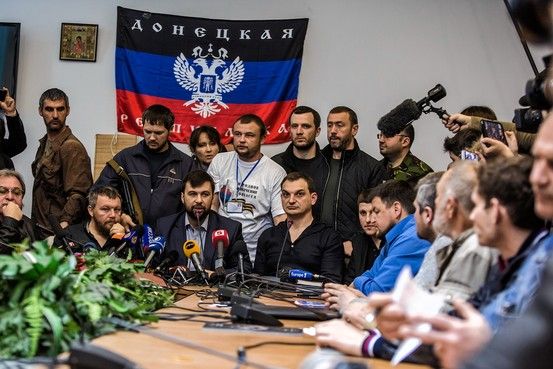
© Getty ImagesDenis Pushilin, center, leader of the self-proclaimed Donetsk People's Republic, announced Thursday that its referendum would go ahead.
Western capitals had already been skeptical of Mr. Putin's surprise appeal Wednesday, a change of tone that included a claim that Russian troops had pulled back from the border. With the decision by separatists in the Luhansk and Donetsk regions at the heart of the insurgency, the conflict again appeared to be escalating.
In Kiev, the Foreign Ministry said the decisions confirmed fears that Moscow was just trying "to whitewash its aggression in the eyes of the international community" by appearing to endorse dialogue. Ukrainian officials rejected Moscow's demands that they end their military operation in eastern Ukraine and negotiate with the rebels.
Comment: Excuse us? If anyone has been aggressive it's Kiev!
Kiev and its Western allies say the separatists are led by Russian agents and are part of Moscow's plan to undermine the pro-Western government, which took power in late Feburary after a Moscow ally, President Viktor Yanukovych, was toppled by months of street protests centered in the capital.
Previous diplomatic efforts to resolve the crisis have failed, often buying time for Russia and its allies to strengthen their position on the ground. (Track conflict along the border in an interactive map.)
The latest back-and-forth could be an effort by the Kremlin to bolster its claim that it doesn't control the separatists, while at the same time easing the pressure on Moscow to send troops to back them in the event the referendum passes.
"Putin wants to be able to say he tried but doesn't control the 'local' separatists," said David Kramer, director of Freedom House, based in Washington. But, he said, Russia "continues to destabilize Ukraine and threaten" its presidential elections planned for May 25.
U.K. Prime Minister David Cameron said Thursday that he called German Chancellor Angela Merkel and that they agreed Mr. Putin's "comments should be judged by de-escalation on the ground."
Comment: Cameron is right, in a twisted sense: Kiev should de-escalate the situation on the ground by neutering the Right Sector and all the other violent extremists supporting Kiev's dictates.
Moscow seemed to back away from the softer tone Mr. Putin had Wednesday on the elections, which he for the first time called "movement in the right direction." On Thursday, Foreign Minister Sergei Lavrov said the vote would be pointless if Kiev doesn't stop its military operation against the separatists.
Mr. Putin didn't address the refusal by the separatists to delay their vote, saying only that Moscow hopes to continue with efforts to reduce tensions. He ratcheted up his criticism of the government in Kiev, comparing the leadership to Nazis and saying its "irresponsible policies bring much grief and losses, hundreds of thousands of people are deprived of the chance to live a peaceful, prosperous life."
Comment: Seriously, is Russia the sole source of reason on this planet? Putin and his government are the only ones speaking common sense.
He spoke after presiding over sweeping military exercises involving strategic bombers, missiles and submarines from the Pacific coast to European Russia.
The exercise, which Mr. Putin said had been planned in November, included a simulated response to a nuclear first strike, with missile defenses protecting Moscow and ICBM launches from submarines and land.
Russia's Defense Ministry, meanwhile, reiterated that Moscow had withdrawn troops from near Ukraine's borders.
Deputy Defense Minister Anatoly Antonov accused the North Atlantic Treaty Organization and the U.S. of "cynical efforts to mislead the world community" with statements that they'd seen no sign of a Russian pullback. He also claimed that Ukraine had built up nearly 15,000 troops near the border with Russia.
Ukrainian officials have said they've reinforced deployments of their underfunded and inexperienced military along the border, but have focused troops on an operation in the Donetsk region against separatist militias.
Acting President Oleksandr Turchynov said the troops are "defending the lives and health of citizens in an antiterrorist operation being conducted against terrorists, saboteurs and other criminals who kill, torture and kidnap our people."
He said the government is open to negotiations, but not with what he called terrorists.
Ukraine's Interior Ministry said two separatist fighters had been killed overnight in the city of Slovyansk, the rebel fighters' center, after they fired on troops at a government checkpoint. There was no immediate confirmation from the separatist side.
Security forces also skirmished with separatists in the port city of Mariupol, and police reported fighting at a checkpoint near the city of Luhansk on Thursday, officials said.
Security Chief Andriy Paribiy said that unidentified armed men had attacked border posts overnight along the frontier with Russia. The attacks came from the Russian side, he said. There was no immediate reaction from Moscow to his claim.
Mr. Putin's comments Wednesday came after a meeting in Moscow with Swiss President Didier Burkhalter, who is also chairman of the Organization for Security and Cooperation in Europe. Mr. Burkhalter said the OSCE has drafted a road map for reducing tensions, including a cease-fire, political dialogue and elections. Details of that plan haven't been released
In Donetsk, the 78-member self-appointed council of the separatist Donetsk People's Republic voted unanimously to disregard Mr. Putin's appeal and go ahead with Sunday's vote.
"Civil war is already happening," said Denis Pushilin, the group's leader. "The referendum is a chance to put an end to it and move it to the political level." As Mr. Pushilin spoke, a man in civilian clothes holding a Kalashnikov assault rifle stood behind him.
Roman Lyagin, head of the Donetsk People's Republic's so-called electoral commission, said more than three million voting slips had been published and sent to towns across the region. The vote will take place in schools and other administrative buildings and would meet "European and international standards," he said.
"It's important to hold the referendum on May 11, because if we'd put it off for even a week, we'd have lost the trust of ordinary people," Mr. Lyagin said.
Given limited resources, Mr. Lyagin said the commission was staffed by volunteers.
"Almost all the money was spent on toner to print the ballots," he said.
Organizers of the independence referendum say if the vote passes they aim to create a new state called Novorossiya that would include the Donetsk and Luhansk regions. Kiev and Western capitals have called the referendum illegal and illegitimate.
- Alan Cullison and Nick Winning contributed to this article.

"Kiev and Western capitals have called the referendum illegal and illegitimate. "
Modus Operandi: Accuse the opposition of that which the accuser is guilty of.
Brand patriots as terrorists to legitimize the use of armed forces on the population.
The love of Money oozes the abuse of Power, and a dozen other evils.