
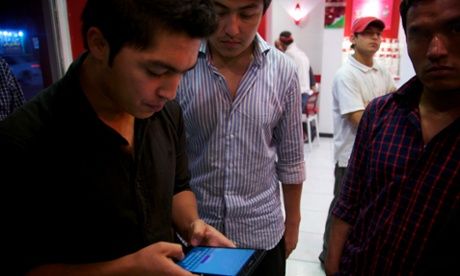
© Lally SnowA man checks his email on his smartphone in a frozen yoghurt cafe in Kabul. Could you resist replying to work emails after 6pm?
France's strict labour laws saw Apple fined for making staff in France work nightslast year, as the law forbids shifts between 9pm and 6am unless the work plays an important role in the economy or is socially useful. Its 35-hour week, introduced in 1999, has come under threat from the increasingly widespread use of smartphones.
Chairman of the General Confederation of Managers, Michel de la Force, said: "We must also measure digital working time. We can admit extra work in exceptional circumstances but we must always come back to what is normal, which is to unplug, to stop being permanently at work."
A Swedish city council announced this week that it's trialling six-hour workdays with full pay for its staff in Gothenburg. The experiment is based on the theory that after six hours, employees become tired and productivity is reduced.
Deputy mayor Mats Pilhem told the Swedish edition of The Local that a six-hour workday produced positive results at a car factory in the city, and he hopes that the trial will reduce inefficiency and create more jobs.
The left-wing Social Democrat and Green parties' initiative has been called a "dishonest and populist ploy" by the Gothenburg council's main opposition - the Moderate party - ahead of local elections this year. Full time workers in Austria and Greece work an average of 43.7 hours per week, the longest in Europe, with workers in the UK spending 42.7 hours a week at the office according to ONS figures from 2011.


Comment: There's an exaggeration here. The agreement target only 200 000 to 250 000 employees who are not subject to the legal weekly working time. Source: Le Monde