

© Raj Creationzs/ShutterstockThe bio-hybrid machines can swim like sperm and are modeled after flagella.
Their bio-hybrid machines, which are detailed in the January 17 edition of the journal Nature Communications, can swim like sperm and are modeled after flagella, or single-celled creatures that have long tails, the researchers explained in a statement.
"Micro-organisms have a whole world that we only glimpse through the microscope," said lead investigator Taher Saif, a mechanical science and engineering professor at the university. "This is the first time that an engineered system has reached this underworld."
Saif and his colleagues began by creating the body of this bio-bot using a flexible polymer, and then they cultured heart cells near the junction of its head and tail. Those cells self-aligned and synchronized to beat together, sending a wave down the machines' tails and propelling them forward, they explained.
According to the university, this self-organization is "a remarkable emergent phenomenon" and while they do not fully understand exactly how the cells on the flexible polymer tail are able to communicate with one-another, they have to beat together in the correct direction in order for movement to occur in the tail.
Saif explained that the bio-bots require "the minimal amount of engineering - just a head and a wire." After that, the cells are introduced and begin interacting with the structure so that it can become functional. His team also built machines with two tails, which are capable of swimming even more quickly.
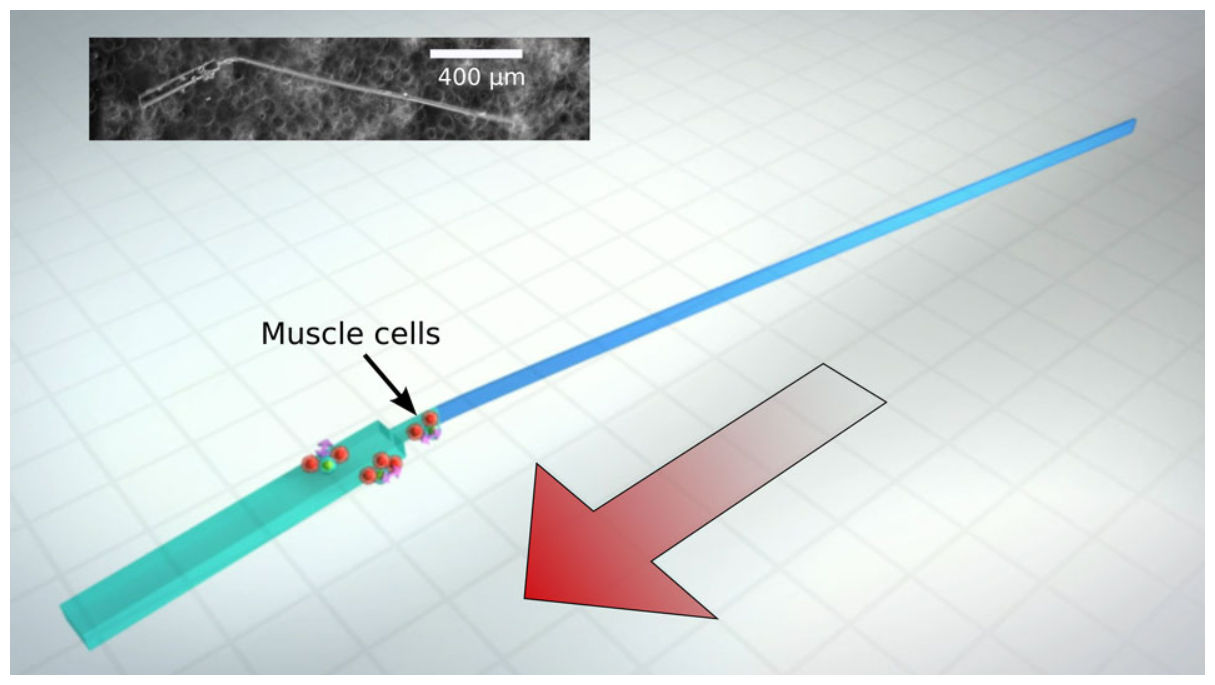
© Alex Jerez Roman, Beckman Institute for Advanced Science and Technology Engineers developed the first tiny, synthetic machines that can swim by themselves, powered by beating heart cells.
"The long-term vision is simple," explained Saif, who is also part of the university's Beckman Institute for Advanced Science and Technology. "Could we make elementary structures and seed them with stem cells that would differentiate into smart structures to deliver drugs, perform minimally invasive surgery or target cancer?"
Saif was joined on the project by fellow University of Illinois researchers Brian J. Williams and Sandeep V. Anand, as well as Arizona State University's Jagannathan Rajagopalan. Their work was completed as part of Emergent Behaviors in Integrated Cellular Systems (EBICS), a National Science Foundation-funded Science and Technology Center dedicated to building living, multi-cellular machines to solve real world problems.
"The most intriguing aspect of this work is that it demonstrates the capability to use computational modeling in conjunction with biological design to optimize performance, or design entirely different types of swimming bio-bots," said EBICS director Roger Kamm, a professor of biological and mechanical engineering at the Massachusetts Institute of Technology (MIT). "This opens the field up to a tremendous diversity of possibilities. Truly an exciting advance."
See an animation of the bio-bots in motion and a video of a free-swimming bot.



Reader Comments
to our Newsletter