
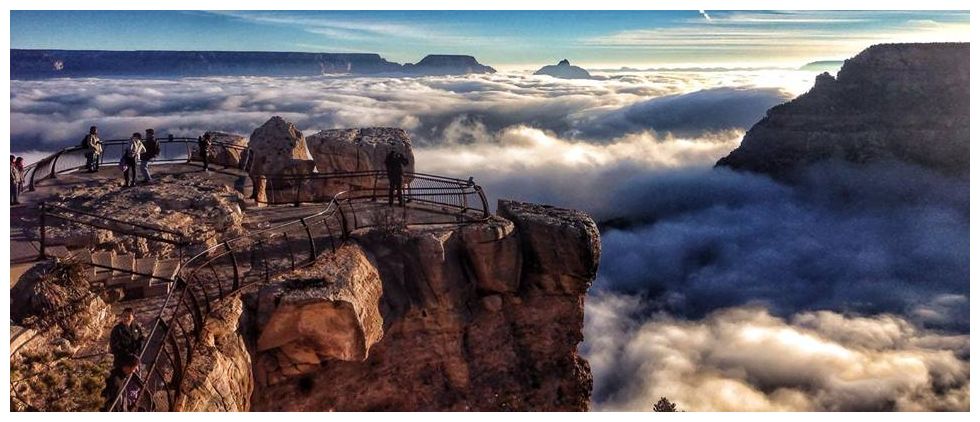
© National Park Service photo by Erin WhittakerThe Grand Canyon, filled with fog, in a rare weather event called a temperature inversion.
The weather event is known as a temperature inversion, and it only happens every few years, according to the National Park Service, who wrote about the event and posted photos of it on its Facebook page.
Temperature inversions typically happen in the winter when there are long nights, and as the name implies, an inversion takes place when a layer of cool air gets trapped underneath warmer air, according to the National Weather Service (NWS). This is the reverse of the usual pattern, with temperature generally decreasing with increasing altitude.
"Once the sun goes down, the ground loses heat very quickly, and this cools the air that is in contact with the ground," the NWS explained. "However, since air is a very poor conductor of heat, the air just above the surface remains warm. Conditions that favor the development of a strong surface inversion are calm winds, clear skies, and long nights," which is exactly what's taking place in the Grand Canyon now, according to weather reports.
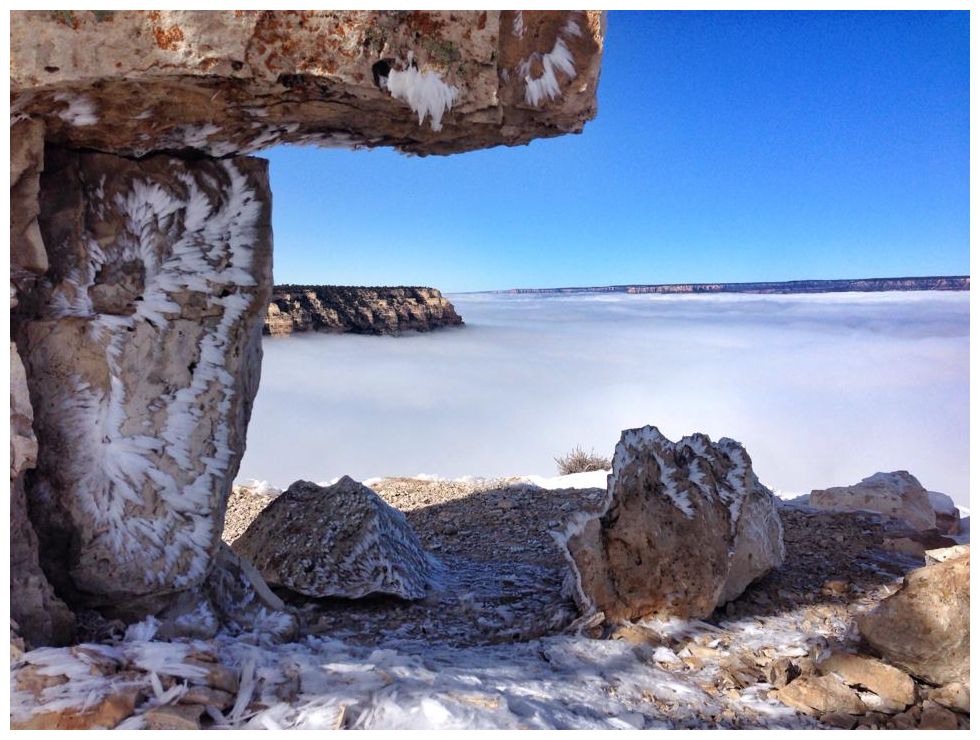
© National Park Service photo by Erin WhittakerFog filling the Grand Canyon. Noticed the ice crystals on the limestone in the foreground.
If moisture is trapped in this layer, it can form fog, as happened in this case. So far the inversion has taken place on two of the past three days in the Grand Canyon, which rarely happens, especially on days with blue, clear skies, the NPS wrote.
The Grand Canyon, which wends 277 miles (446 kilometers) along a sinuous path, became a national park in 1919; at that time some 44,173 visitors enjoyed the billions of years of history tucked into its colorful rocks. That's compared with the nearly 5 million visitors to the park today, according to NPS.


Reader Comments
to our Newsletter