
The Smith et al paper made the following specific predictions:
There would be 0.3°C warming over the decade 2004-2014Note that at that time, 2007, the warmest year was thought to be 1998; subsequent adjustments to the method made 2005 warmer than 1998.
At least half of the years after 2009 would be warmer than the record year of 1998.
The predictions were spread far and wide. They were included in a Met Office Press release, and a glossy brochure on "Informing Government policy into the future", with the almost obligatory scaremongering background pictures of black clouds and people wearing facemasks. Vicky Pope gave a talk on these predictions, saying that "these are very strong statements about what will happen over the next 10 years."
And of course the faithful media reported the story without questioning it.
These predictions have turned out to be wrong. We are almost into 2014 and there has been no warming at all since 2004. Of the years since 2009, none of them have broken the record of 1998 according to HADCRUT3 data. Using HADCRUT4, 2010 is warmer by a meaningless 0.01°C (that's one tenth of the error estimate). 2011 and 2012 were cooler and it's now clear that 2013 will be cooler also.
The warming prediction was for 0.30° ± 0.21°C [5 to 95% confidence interval (CI)], so unless we get some significant warming over the next few months it looks as though the observations will be outside the CI of the model.
COP19, Warsaw 2013: pause "expected"
The Met Office had a stand at the recent COP19 climate conference in Warsaw.
Here are two interesting pictures from this (HT Leo Hickman)
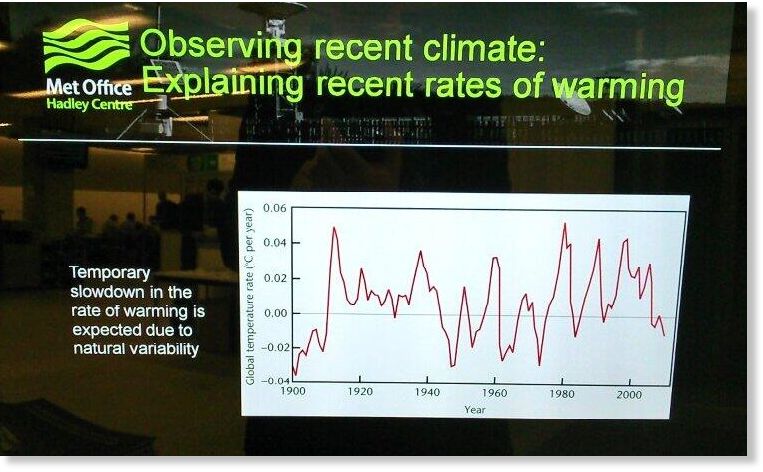
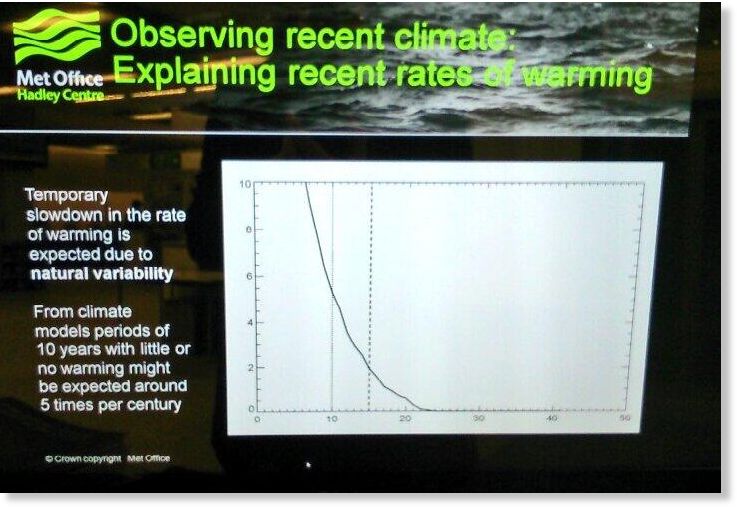
The second graph is interesting since the axes are unlabelled, failing the first rule of elementary graph-plotting. I asked on twitter what might be plotted against what. Thanks to Gerry Morrow for suggesting that it showed trust in climate science against time. Presumably it is supposed to show the number of times per century that a pause of a certain length is likely to occur, according to climate models. The text talks of a ten year pause, but the current pause is now more like 15 years, expected only twice a century if the models are correct.
Smith et al (2013): skillful models
A new paper, Smith et al (2013), "Real-time multi-model decadal climate predictions", has been published in Climate Dynamics. This one has 22 authors, reflecting the fact that it involves many more climate models. The tone is somewhat more cautious than the previous one; for example it says that "We stress that the forecast is experimental", but it also claims that the models "have undergone rigorous evaluation and individually have been evaluated for forecast skill".
The paper muddles up predictions and hindcasts, something the Met Office has been criticised for before, for example by claiming that "forecasts of the year 2011 agree well with observations". Reading the paper, it is not clear when these 'forecasts' were carried out.
There is no headline figure of a warming prediction over the next decade, but here is the graph showing the predictions in graphical form:
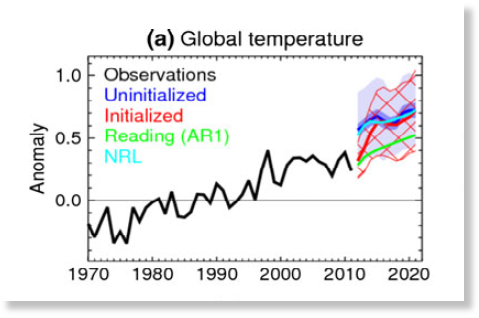
But what is most remarkable about Smith et al 2013 is that there is no attempt to assess the accuracy or otherwise of the previous paper Smith et al 2007, even though that earlier paper is cited, and despite the statement in the Introduction that "Assessing discrepancies between forecasts and subsequent observations can reveal weaknesses in initialization strategies, model simulations of internal variability, model responses to external forcing, and uncertainties in future forcing factors, all of which are invaluable for improving future forecasts".
Here's a reminder of the famous one-minute summary of how science works, from a guy called Richard Feynman.
Update: Ed Hawkins says there is a paper in preparation on examining the prediction biases in a version of DePreSys.



Sounds like the same type of specialists on Wall Street, where they are called 'economists'.