
- Comet ISON will skirt 150 times closer than us to the sun on November 28
- It will either light up in magnificent spectacle... or blast to smithereens
- Comet has already become visible without a telescope for the first time
- Some scientists have even claimed it could shine brighter than the moon
Comet ISON will pass exceptionally close to the sun in just under a fortnight, creating a spellbinding cosmic spectacle as ice in its body vapourises and forms a distinct bright tail.
At least, it will if the heat does not blast the comet to smithereens - which scientists warn is not out of the question.
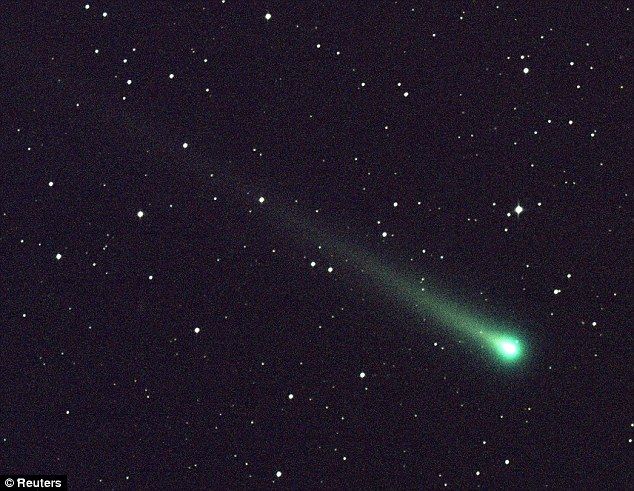
Cosmic show: Comet ISON, which is heading to within 600,000 miles of our sun on November 28
The comet was discovered in September last year by two amateur astronomers using Russia's International Scientific Optical Network, ISON, who marvelled at how bright it was even beyond Jupiter's orbit.
On November 28 it will pass just 621,000 miles from the sun's surface - 150 times closer to our star than we are.
It will be more than 100 times closer to the sun than the Hale-Bopp comet, one of the brightest of the last century which was visible with the naked eye for a record 18 months in 1997.
As it blasts towards the sun, the intense gravitational pull will make it speed up to 234 miles per second.
The sun's rays will also heat the ball of ice, metal and rock to 2,760 degrees Celsius, making it much brighter than most comets - with some scientists claiming it could outshine the moon.
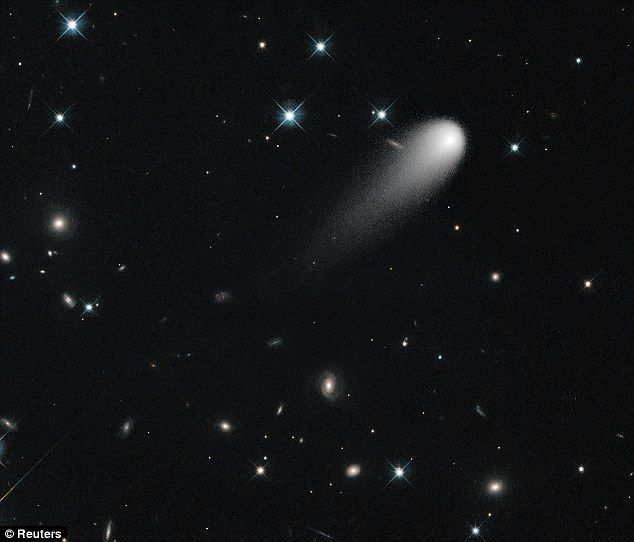
The comet, top right, has so far been photographed through telescopes and long exposures but is expected to be visible to the naked eye throughout December and January. It could be the brightest for 100 years
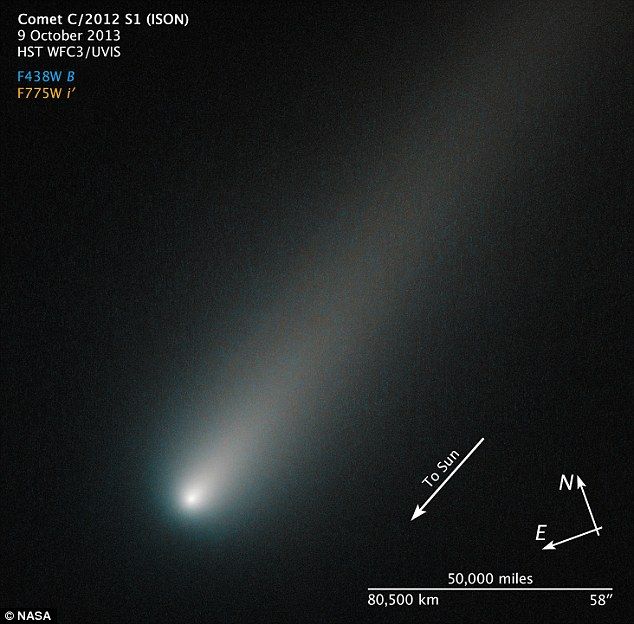
An image taken by astronomers in Maryland, U.S., which shows how directly it is heading for the sun
However, recent calculations have shown ISON is more likely than not to survive.
Over the weekend, amateur astronomers began posting the first pictures of the comet on the Internet that were taken with just binoculars or small telescopes.
Pilot Brian Whittaker wrote on the SpaceWeather.com website: 'I finally saw Comet ISON for the first time using small binoculars! It was faint, but is predicted to brighten and move each day! Exciting!'
It is expected to be visible to the naked eye in early mornings throughout December and during the night in January.
Comets are believed to be frozen remains left over from the formation of the solar system four and a half billion years ago.
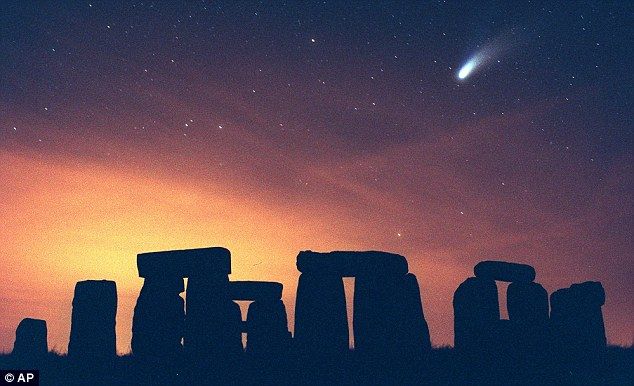
Supercomet: ISON could prove brighter than Hale-Bopp, pictured, which lit up the skies in 1997
These balls of ice are occasionally 'bumped' by the sun's gravity out of the cloud and into a flight path that brings them into the inner solar system.
The vast majority of comets are invisible to the naked eye, but the most famous is Halley's Comet.
That is because it is the only comet which visits often enough and shines brightly enough to be seen by most people in their lifetime.
It comes to our solar system between every 75 and 76 years and last visited in 1986. Among other things, it inspired the name of 1950s rock and roll outfit Bill Haley and His Comets.


These balls of ice are occasionally 'bumped' by the sun's gravity out of the cloud and into a flight path that brings them into the inner solar system.
Practice: Nature operates on an occasional basis, and then delivers huge clumps of incidents.
The Theory of 'only occasionally' without the benefit of the mass influx keeps the rate of incidence artificially low. Great for glossing over the real threat, which is we live in a cosmic shooting gallery. Between nudges, there is this debris rate, but the real deal is when a nudges sends in a big clump or wave of objects.
Imagine for a minute, the spectacle of brilliant comets outnumbering bright stars in the night skies, accompanied by a horde of fireball-making fragments. The currently ramped-up fireball sighting would then be the appetizer for the main course.