
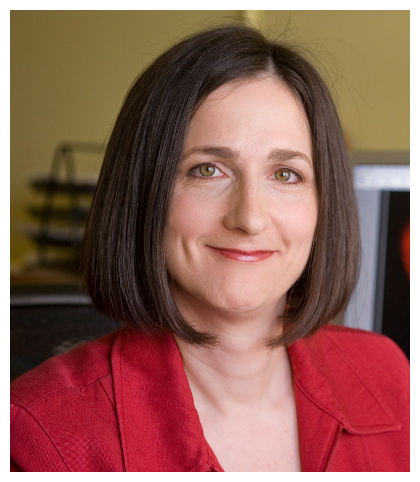
© MITSara Seager, expert planet hunter.
That may be about to change, says exoplanet expert Sara Seager at the Massachusetts Institute of Technology in Cambridge, Massachusetts. Upcoming missions such as the Transiting Exoplanet Satellite Survey and the James Webb Space Telescope, both due to launch around 2018, should be able to find and characterize Earth-like planets orbiting small stars.
Spotting signs of life on those planets will be possible because of progress in detecting not only planets, but their atmospheres as well. When a planet passes in front of its host star, atmospheric gases reveal their presence by absorbing some of the starlight. Oxygen, water vapor, or other gases that do not belong on dead worlds could very well provide the first evidence of life elsewhere.
In 1961, astronomer Frank Drake developed an equation that summarizes the main factors to contemplate in the question of radio-communicative alien life. These factors include the number of stars in our galaxy that have planets, and the length of time advanced alien civilizations would be releasing radio signals into space.
Instead of aliens with radio technology, Seager has revised the Drake equation to focus on simply the presence of any alien life. Her equation can be used to estimate how many planets with detectable signs of life might be discovered in the coming years. Presented at a meeting earlier this year, the Seager equation looks like this:
N = N*FQFHZFOFLFS
N = the number of planets with detectable signs of life
N* = the number of stars observed
FQ = the fraction of stars that are quiet
FHZ = the fraction of stars with rocky planets in the habitable zone
FO = the fraction of those planets that can be observed
FL = the fraction that have life
FS = the fraction on which life produces a detectable signature gas
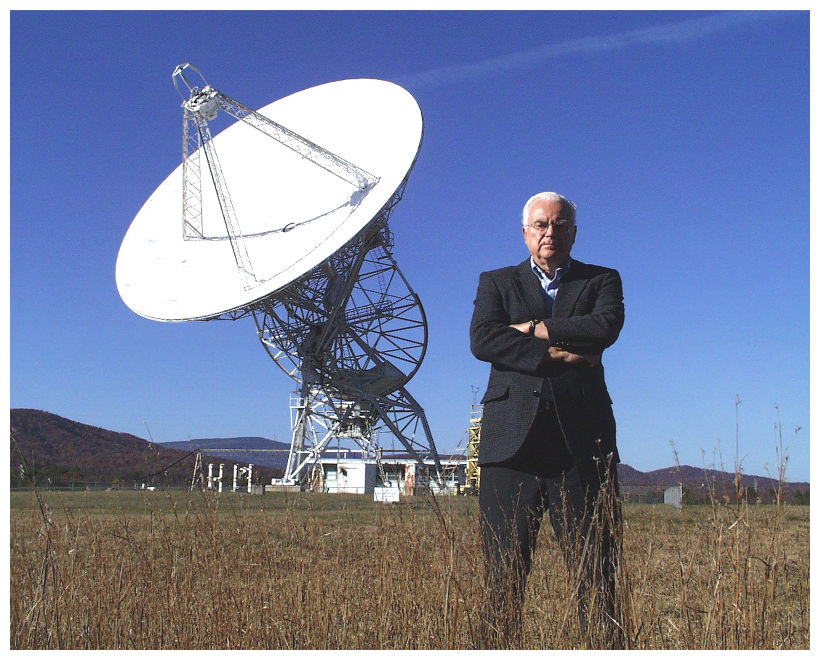
© NRAO/NSF/AUIFrank Drake has maintained his life-long interest in using radio telescopes to look for signs of intelligent life.
Q: What was the inspiration behind this equation?
Sara Seager (SS): People have been thinking about trying to find signs of life for a hundred years. This equation is a purposeful take-off on the Drake equation, which was about the search for intelligent extraterrestrial life. Frank Drake wrote that equation because he was using radio telescopes to look for life. It was relevant then and still is. SETI has been going on now for 50 years.
I wanted to explain that we have a new search in progress. We'll use TESS [the Transiting Exoplanet Survey Satellite] to find rocky planets transiting small stars. Then we'll use the James Webb Space Telescope to observe the atmospheres of those planets, during transits or secondary eclipses. The punchline here is that if we're really lucky and everything works in our favor, we will be able to infer signs of life on those planets. We have a shot - I'd call it a remote shot - of finding life within the next decade.
Q: Is your approach specific to intelligent life as well?
SS: No. The equation focuses on the search for planets with biosignature gases, gases produced by life that can accumulate in a planet atmosphere to levels that can be detected with remote space telescopes. If we find gases that we might attribute to life we will not know if the gases are produced by intelligent life or simple bacteria.
Q: Could someone like Drake have sketched out your equation 50 years ago, before the first discovery of an exoplanet?
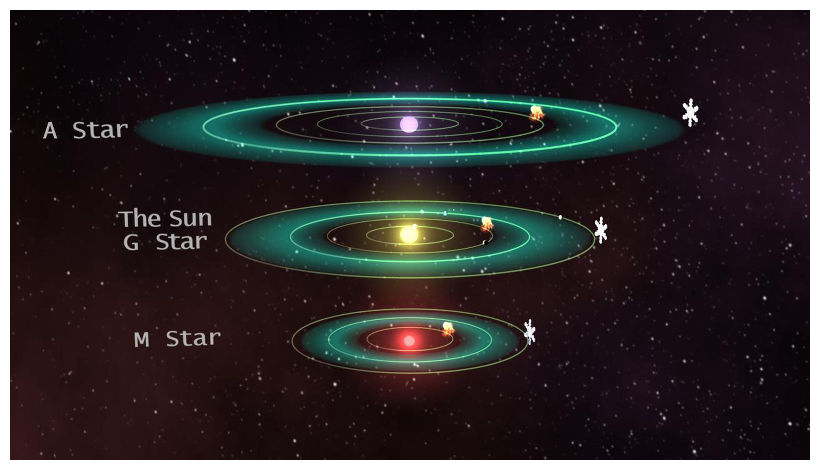
© NASAThe exact location of a planetary system's habitable zone, a region with temperatures amenable to liquid water and life, depends on the type of host star.
Q: How confident are you about the values you plugged into this equation?
SS: For some of the terms you can get a number that's an estimate with an error bar. We start with the number of stars bright enough to be seen by James Webb. What we need are enough photons to see the starlight shining through the atmosphere of a planet. We know that number: it's 30,000.
Then we select stars that are quiet. Some stars are like our solar maximum all the time, with flares and other activity. We don't like those noisy stars. It's hard to spot a planet transiting in front of the noise, hard to spot the dimming that occurs. Also the ultraviolet light from many active stars would destroy biosignature gases through a complicated series of chemical reactions.
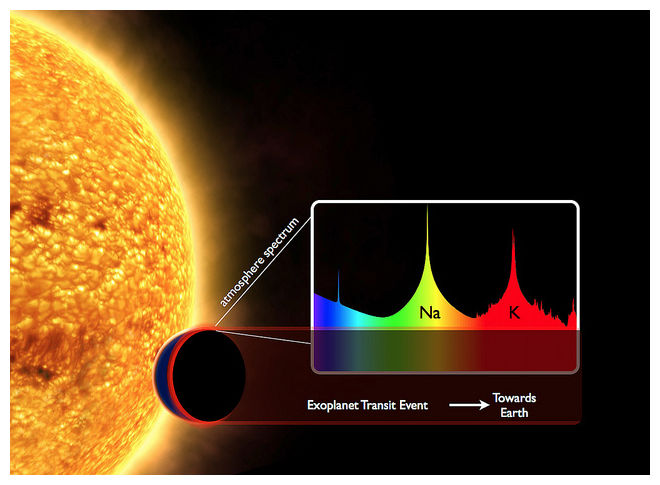
© European Space Agency with adaptations by David SingAs a planet passes in front of its host star, gases in a planet's atmosphere such as sodium and potassium can reveal their presence by selectively absorbing some of the starlight.
Q: What about the fraction of rocky planets in the habitable zone? Calculating that was the Kepler space telescope's mission, but Kepler broke down earlier this year.
SS: Astronomers have largely completed Kepler data analysis for small-star statistics. Small stars are what we're interested in. So we have this number, where the number is for quiet stars. It's 0.15.
Q: And the other terms?
SS: Not all of the terms in the equation can be calculated. The last two are just guesses. For the fraction of planets that have life, I put in one. I wanted to be optimistic. It really matters what you speculate for this term. You can put your own number in.
Detectable signatures of gas could mean a lot of things. As human beings, we exhale carbon dioxide. That's our biosignature gas. But that's not useful because carbon dioxide in the atmosphere is naturally occurring. There are other possible gases we could look for. Oxygen is produced by plants and photosynthetic bacteria. We have also considered ammonia as a biosignature gas.
I carefully crafted the last term of this equation so one could actually add more information in. Does life produce a detectable signature? Are there systematic effects that rule out some biosignature gases being detected in some planets? Can we not find the signature for technical reasons? We just don't know how many planets have life that is producing biosignature gases that are detectable by us.




Sentient species are formed in groups of seven and meant to interact.
[Link]EXTRATERRESTRIAL SENTIENT LIFE IN THE GALAXY
[Link]MANKIND'S COMBO ENSOULED INTELLIGENT LIFE FORM - EILFS
note: up to date main site is currently down.