
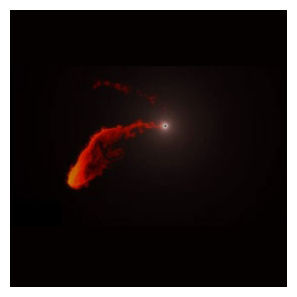
© ESO / MPE / M.SchartmannAn artist imagines one scenario for G2: as the black hole tidally tears the gas cloud apart, the gas heats to X-ray-emitting temperatures, causing an extended X-ray flare from the galactic center.
Whatever it might be, G2 will whizz past our galaxy's central black hole (often called Sgr A*) in mid-September. It'll pass just 180 times the distance between Earth and the Sun away from the black hole, an event that affords astronomers an unprecedented opportunity to watch the beast devour a snack. What exactly will happen is anyone's guess, but astronomers are at the ready, regularly monitoring the galaxy's central black hole.
On April 24th, the Swift telescope witnessed an X-ray flare coming from the galactic center, tantalizing lengthy compared to Sgr A*'s typical flares. And one day later, Swift's Burst Alert Telescope captured a fleeting, 32-millisecond-long burst of higher-energy X-rays
Needless to say, the galactic center had astronomers' attention.
But did the flare signal G2's imminent demise? The ultra-short flare emitted on April 25th looked more reminiscent of the type of outburst emitted by magnetars, spinning stellar corpses with extreme magnetic fields.
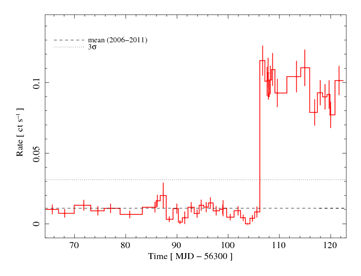
© http://dept.astro.lsa.umich.edu/~markrey/sgra/sgra.shtmlSwift's daily monitoring of the galactic center caught the flare that suddenly sent the level of X-ray emission soaring.
Swift didn't see any pulsations from the X-ray source, but it wasn't designed to - its detector can only register incoming X-ray photons every 2.5 seconds. NuSTAR, on the other hand, has a time resolution of 2 milliseconds.
And on April 26, two days after the initial flare, the space telescope gathered X-rays from the galactic center for a full 26 hours, spotting a complex, three-peaked pulse emitted every 3.76 seconds. A follow-up observation 9 days later confirmed that the source was a magnetar.
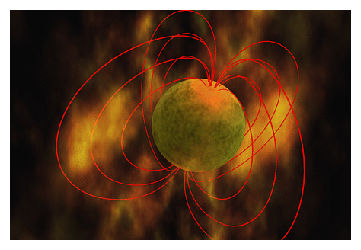
© Robert S. Mallozzi, UAH / NASA MSFCThis magnetar's magnetic field is organized into a dipole, just like a bar magnet. But it's probably disruptions in the field that cause magnetar outbursts.
"It appears Nature was playing a little game with us," Mark Reynolds (University of Michigan) says a tad ruefully. Reynolds is part of the Swift team monitoring Sgr A*.
But instead of witnessing galactic fireworks, astronomers had been handed an unexpected treat.
"I have been working on pulsars and magnetars for years," says Kaya Mori (Columbia University), "and I have to say, this source is an extraordinary object found at the most extraordinary place in our galaxy."
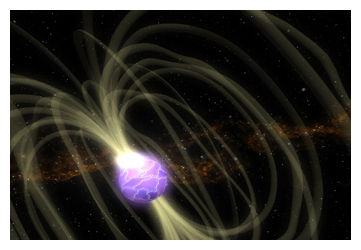
© NASA / GSFC Conceptual Image LabAnother artist illustrates a magnetar, this one showing the emissions created at the poles, where the magnetic fields bundle together. Antimatter-matter interactions might be responsible for the X-rays and radio waves seen from SGR 1745.
Whether the magnetar is close enough to orbit the black hole is a question for follow-up observations.
Reynolds acknowledges, "magnetars are strange beasts," and since only two-dozen magnetars are currently known, this newest discovery makes a valuable addition to the menagerie. (For comparison, over 1,500 pulsars have been discovered.)
Some magnetars are extremely active, but others can remain quiet for a decade or more. SGR J1745 appears to be one of the transients - archival observations from Chandra show that the X-ray source didn't exist at detectable levels before the recent flare.
Mori, who released a paper on the astronomy arXiv yesterday evening, says the recently emitted X-rays and radio waves come from electrons and positrons swirling in twisted magnetic field lines bundled at the magnetar's poles. Swift continues to monitor the galactic center, and its follow-up observations will help test Mori's theory.
Meanwhile, those hoping to catch G2's fireworks will have to wait a little longer for their treat.



Reader Comments
to our Newsletter