
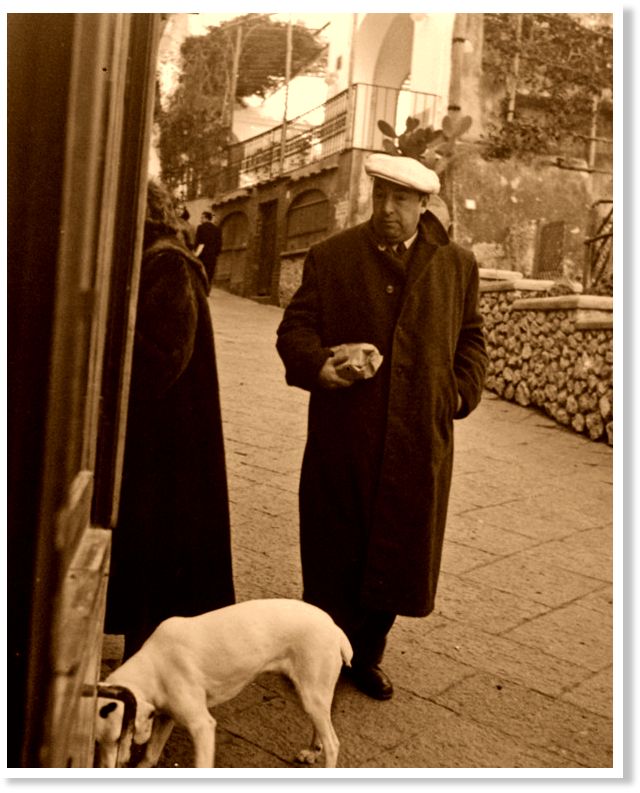
This Feb. 14, 1952 file photo shows Chilean poet Pablo Neruda in Capri, Italy.
At his funeral, a large crowd of mourners marched through the streets of Santiago - a grim city that was otherwise empty except for military vehicles. At his gravesite, in one of the only known acts of public defiance in the wake of the coup, the mourners sang the "Internationale" and saluted Neruda and also Allende. As they did, the regime's men were going around the city, burning the books of authors it didn't like, while hunting down those it could find to torture or kill.
A couple of years ago, Neruda's former driver came forth to express his suspicion that Neruda had been poisoned, saying that he'd heard from the poet that doctors gave him an injection and that, immediately afterward, Neruda's condition had worsened drastically. There are other tidbits of evidence that bolster his theory, but nothing conclusive. Forensic science, in the end, may provide the answer to a nagging historic question.
Why bring Maggie Thatcher into it? In a tribute Monday, President Barack Obama said she had been "one of the great champions of freedom and liberty." Actually, she hadn't. Thatcher was a fierce Cold Warrior, and when it came to Chile never mustered quite the appropriate amount of compassion for the people Pinochet killed in the name of anti-Communism. She preferred talking about his much-vaunted "Chilean economic miracle."
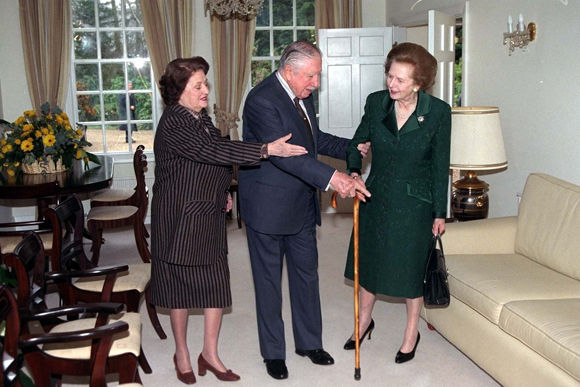
© Ian Jones/AFP/GettyPhotograph of Margaret Thatcher visiting Augusto Pinochet in 1999, when he was under house arrest in Britain
In 1980, the year after Thatcher took office, she lifted the arms embargo against Pinochet; he was soon buying armaments from the United Kingdom. In 1982, during Britain's Falklands War against Argentina, Pinochet helped Thatcher's government with intelligence on Argentina. Thereafter, the relationship became downright cozy, so much so that the Pinochets and his family began making an annual private pilgrimage to London. During those visits, they and the Thatchers got together for meals and drams of whiskey. In 1998, when I was writing a Profile of Pinochet for The New Yorker, Pinochet's daughter Lucia described Mrs. Thatcher in reverential terms, but confided that the Prime Minister's husband, Dennis Thatcher, was something of an embarrassment, and habitually got drunk at their get-togethers. The last time I met with Pinochet himself in London, in October, 1998, he told me he was about to call "La Señora" Thatcher in the hopes she could find time to meet him for tea. A couple of weeks later, Pinochet, still in London, found himself under arrest, on the orders of Spanish judge Baltasar Garzón. During Pinochet's prolonged quasi-detention thereafter, in a comfortable home in the London suburb of Virginia Water, Thatcher showed her solidarity by visiting him. There, and in front of the television cameras, she expressed her sense of Britain's debt to his regime: "I know how much we owe to you" - for "your help during the Falklands campaign." She also said, "It was you who brought democracy to Chile."
This, of course, was a misstatement of such gargantuan proportions that it cannot be dismissed as the overzealousness of a loyal friend.
Pinochet himself finally died in 2006, under house arrest and facing over three hundred criminal charges for human rights abuses, tax evasion, and embezzlement. By then, he was alleged to have over twenty-eight million dollars stashed in secret bank accounts in various countries, with no sign that it had been legally earned. At the end, Pinochet's only defense was a humiliating claim of dementia - that he couldn't remember his crimes. His final heart attack came before he could ever be convicted.
During the years of what could be called Chile's return to democracy, after 1990 - when Pinochet was forced to step down from the Presidency he had seized following a referendum on his rule, which he lost - little was done to truly exorcise Chile's demons, much less judge them. Pinochet retained the command of the armed forces, and when he stepped down from that role, in 1998, he retained a senatorship-for-life, which gave him immunity from prosecution. Until his detention in Britain, the Presidents who ruled "democratic" Chile continued to tiptoe around the fact that the country's chief former tormenter continued to dictate the terms of the national discussion about the recent past. Following his return home, after sixteen months, however, Pinochet was stripped of his parliamentary immunity, criminally indicted for some of his coup-era crimes, and spent much of the remainder of his life under house arrest. But it took Michelle Bachelet, Chile's President from 2006 to 2010 - the daughter of a general who opposed the coup and was tortured until he died of a heart attack in detention - to end the tradition of deference.
In a country where, for decades, history was buried, it is fitting for Chileans to dig up Neruda to find out the truth of what happened to him. In a sense, Neruda was Chile's Lorca, the Spanish poet who was murdered in the first weeks of Francisco Franco's Fascist coup of Spain in 1936, and whose blood has been a stain on the conscience of his country ever since.
Chile now has a chance to do the right thing by its poet. Neruda's beach home, at Isla Negra, some miles from Santiago on the coast, is a lovely, modest villa on a rocky beach, with windows that look out to sea and the poet's lyrical collection of old ship mermaids as decorations. He and his widow, Matilde Urrutia, were buried there, and that is where the investigators went to look for the truth of what happened. In the end, even if Neruda died of cancer, as was said at the time, his exhumation is an opportunity to reinforce the message to authoritarians everywhere that a poet's words will always outlast theirs, and the blind praise of their powerful friends.

Didn't know that Neruda was REALLY into politics. Senator, campaign manager and ambassador. Just checked his wiki page:
[Link]