
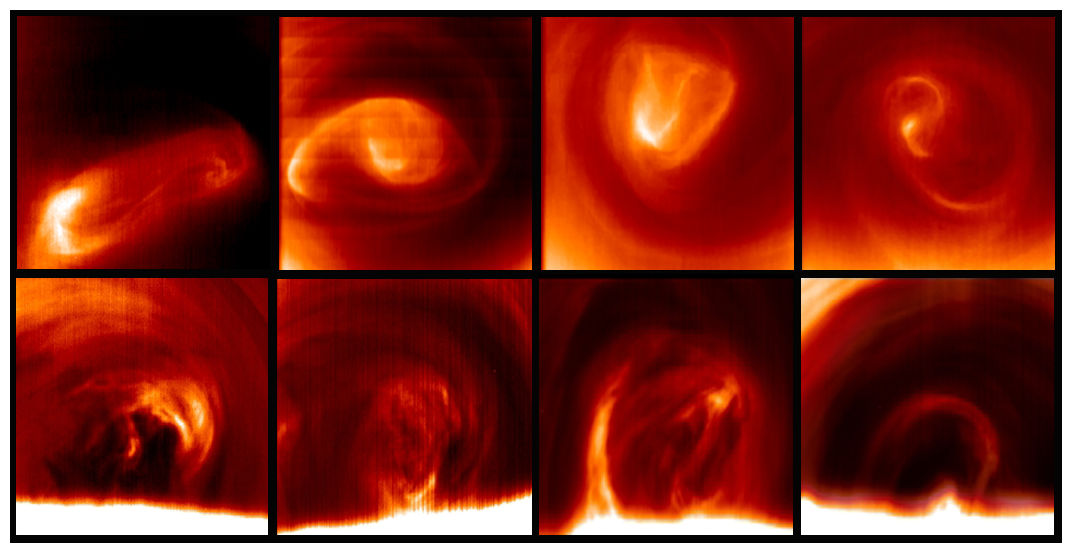
© Grupo de Ciencias Planetarias, UPV/EHU.The south polar vortex of Venus changes shape every day. The images at the top of the figure show the upper cloud of Venus, 65 km above the planet’s surface. The images at the bottom depict the south polar vortex of Venus 20 km further down showing the vertical extension and variability of the vortex.
The south pole vortex is a huge double whirlwind the size of Europe. Double? Yes. In the south polar vortex of Venus, there are two main cloud layers separated by a distance of about 20 kilometers (about 12 miles). These scientists announced today (March 24, 2013) that they've confirmed the "erratic" movement of air in the double vortex at Venus' south pole. And, surprisingly they said, each part of the vortex forms a separate "tube," which "goes its own way." Itziar Garate-Lopez, head researcher, said in a press release:
These scientists published their results online in the journal Nature Geoscience.We knew it was a long-term vortex; we also knew that it changes shape every day. But we thought that the centers of the vortex at different altitudes formed only a single tube, but that is not so. Each center goes its own way, yet the global structure of the atmospheric vortex does not disintegrate.
Long-term vortices are a frequent phenomenon in the atmospheres of fast-rotating planets, like Jupiter, Saturn and Earth, for example. But Venus rotates very slowly. It rotates only once every 243 Earth-days, more slowly than any other planet in our solar system. Its rotational speed is in contrast to about 24 hours for Earth, 9 hours 56 minutes for Jupiter and 10 hours 39 minutes for Saturn. Still, Venus has permanent vortices in its atmosphere at both poles. One clue to the reason might be that the rotation speed of Venus' atmosphere is much greater than that of the planet. Traveling at speeds of around 200 meters per second, the atmosphere takes only four Earth days to go all the way around the planet. Garate-Lopez said:
We've known for a long time that the atmosphere of Venus rotates 60 times faster than the planet itself, but we didn't know why. The difference is huge; that is why it's called super-rotation. And we've no idea how it started or how it keeps going.

© NASA/JPL-Caltech/Space Science InstituteWide-angle camera view from Cassini spacecraft of the north polar region on Saturn. It shows the central storm clouds inside a larger structure called the north polar hexagon. This vortex on Saturn is similar to Earth’s polar vortex where winds blow in a circular pattern.
On the Earth there are seasonal effects and temperature differences between the continental zones and the oceans that create suitable conditions for the formation and dispersal of polar vortices. On Venus there are no oceans or seasons, and so the polar atmosphere behaves very differently.

© NOAAStrong polar vortex over Maine on February 24, 2012.



...perhaps. Given that electrons stream into the planetary body at the poles and that Venus is closer to the sun and under more electrical influence the electron flow might provide the needed energy to attain these rotational speeds. Jim McCannys theory's on hurricane formation might well apply here.