
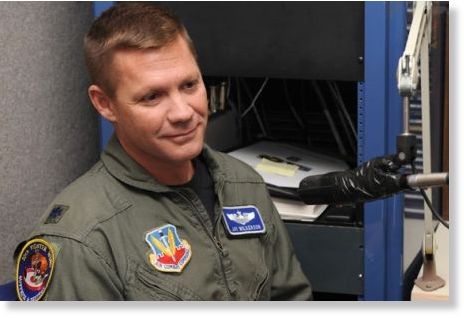
Lt. Col. James Wilkerson speaks as the then 20th Fighter Wing chief of safety at Shaw Air Force Base, S.C., Aug. 11, 2008.
Third Air Force commander Lt. Gen. Craig Franklin's decision to reinstate Lt. Col. James Wilkerson was a stunning example of structural problems in an outdated military justice system rife with bias that discounts victims while emboldening offenders, advocates said.
"It's really shocking," Susan Burke, a lawyer who represents numerous military women in lawsuits against the Defense Department, said of the case.
"It's inexcusable. It's like the poster child for why we need reform. It proves to Congress why they have to act," she said.
Greg Jacob, policy director of the Service Women's Action Network and a former Marine infantry officer, was likewise taken aback.
"It's atrocious. It's infuriating," he said. "It's a perfect example of the due process system being overridden just at the whim of the commander. It's a real travesty of justice.
"Now suddenly he's not guilty? If there's a sexual assault in this guy's unit after he shows up, do you think anyone's going to report it?"
The case has also outraged legislators and is expected to be examined at a congressional hearing later this month.
"We're going to do a press conference on this case," said Rep. Jackie Speier, a California Democrat who last year introduced a bill to create a new department within the Defense Department to handle sexual assault cases. The bill required sexual assault prosecutions to be handled by military and civilian experts and removed commander authority. That would inject professionalism into the process and remove commander conflicts of interest, she said.
She said she would reintroduce the legislation this year, that the idea was gaining traction, and that the Wilkerson case would further propel the idea.
"It's a mockery of the UCMJ (Uniform Code of Military Justice) and the entire sense of military justice," she said. "There always is a tipping point."
Franklin's decision to set aside the verdict freed Wilkerson after four months in a South Carolina brig, erased his conviction and restored the F-16 pilot, who'd been selected for promotion, to full-duty status.
Franklin, the authority who convened the court-martial, had concluded in his post-trial review that the evidence did not prove Wilkerson's guilt beyond a reasonable doubt, according to a Third Air Force statement. The decision was contrary to the recommendation of his staff legal adviser.
Franklin is also an F-16 pilot and formerly commanded the 31st Fighter Wing to which Wilkerson was assigned. A spokesman said that neither fact played any role in the general's decision.
Wilkerson, 44, the former 31st Fighter Wing inspector general was accused last March by a 49-year-old physician's assistant of groping her as she slept in a guest bedroom at the Wilkerson home after an impromptu party.
An all-male jury of four colonels and one lieutenant colonel convicted him of aggravated sexual assault after a weeklong trial in November at Aviano Air Base, Italy. The jury sentenced him to dismissal, total pay forfeiture and a year in jail.
Franklin's decision to overturn that in effect conveyed that the jury, guided in the law by the presiding judge, had made a serious mistake, military lawyers said. Stars and Stripes



Reader Comments