
The bodies were among a herd of 22 animals massacred in a helicopter-borne attack by professionals who swooped over their quarry.
The scene beneath the rotor blades would have been chilling - panicked mothers shielding their young, hair-raising screeches and a mad scramble through the blood-stained bush as bullets rained down from the sky.
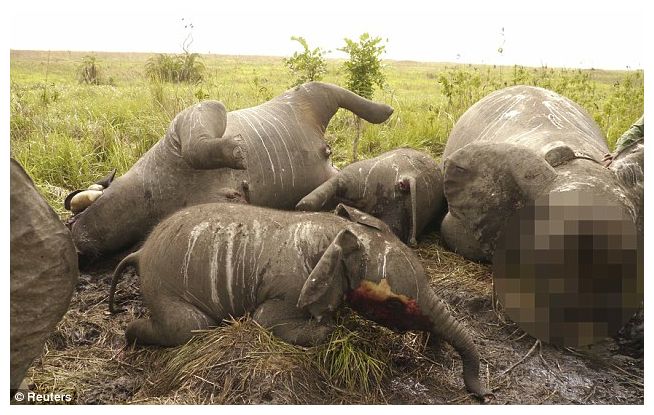
© ReutersBarbaric: In a scene too graphic to show in full, the carcasses of some of the 22 massacred elephants lay strewn across Garamba National Park in the Congo after being gunned down by helicopter-borne poachers.
'It's been a long time since we've seen something like this,' said Dr Tshibasu Muamba, head of international cooperation for the Congolese state conservation agency, ICCN, as he surveyed the macarbre scene at Garamba National Park.
After the slaughter, the killers set about removing their tusks and genitals before likely smuggling them through South Sudan or Uganda, which form part of an 'Ivory Road' linking Africa to Asia.
Elephant and rhino poaching is surging, conservationists say, an illegal piece of Asia's scramble for African resources, driven by the growing purchasing power of the region's newly affluent classes.
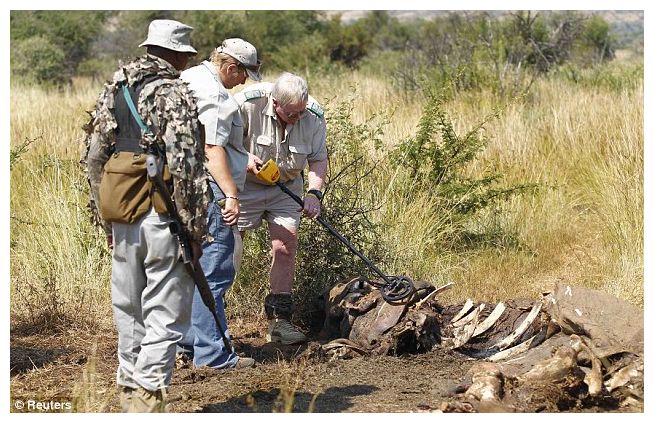
© ReutersMassacred: Members of the Pilanesberg National Park Anti-Poaching Unit stand guard as conservationists and police investigate the scene of a rhino poaching earlier this month in South Africa, where nearly two rhinos a day are being killed to meet demand for the animal's horn, which is worth more than its weight in gold.
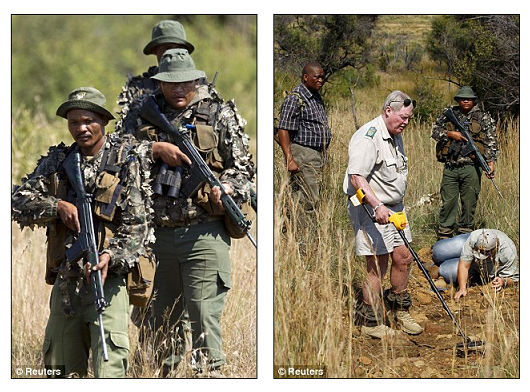
© Reuters'Biggest challenge': Conservation group TRAFFIC, which monitors the global trade in animals, said 2011 was the worst year for large ivory seizures in the more than two decades it has been tracking the trends.
In South Africa, nearly two rhinos a day are being killed to meet demand for the animal's horn, which is worth more than its weight in gold. More are being killed each week now than were being taken on an annual basis a decade ago.
Conservation group TRAFFIC, which monitors the global trade in animals and plants, said 2011 was the worst year for large ivory seizures in the more than two decades it has been running a database tracking the trends.
After the trade in ivory was banned at the end of the 1980s - a policy implemented to stem a slaughter of elephants at the time - the illegal trade declined sharply, helped by the co-operation of Japan from where most of the demand had been coming.
Conservationists say there was a spike in the mid 1990s driven by emerging Chinese demand that bubbled for a few years, then dropped off as red flags were raised.
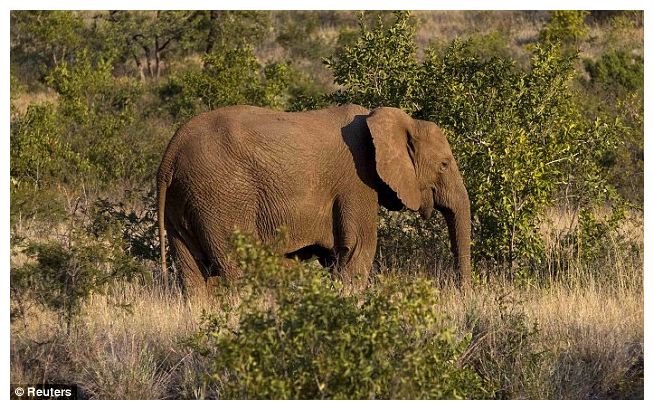
© ReutersTargeted: An elephant walks through scrub in the dusk light in Pilanesberg National Park in South Africa's North West Province. Hundreds of the pachyderms, listed by the International Union for Conservation of Nature as 'vulnerable', were slain in 2011.
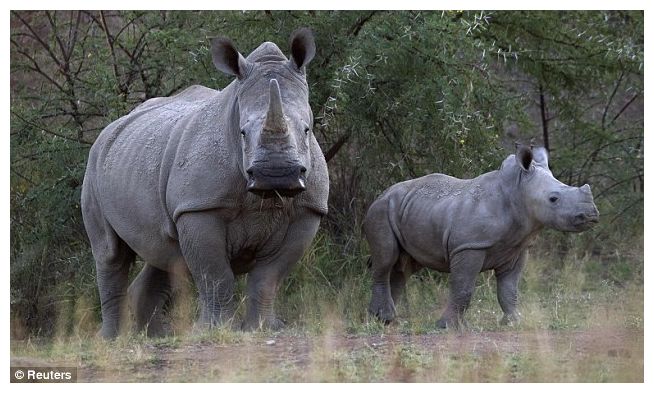
© ReutersEndangered: A White Rhino and her calf walk in the dusk light in Pilanesberg National Park. More than 180 have been killed in South Africa so far this year.
Ben Janse van Rensburg, head of enforcement for the Convention on International Trade in Endangered Species of Wild Fauna and Flora (CITES), the international treaty that governs trade in plants and animals, said: 'The biggest challenge is that in the last few years there has been a big shift from your ordinary poachers to your organized crime groups.'
This was on display in Congo last month, where investigators determined the poachers shot from the air because of the trajectory of the bullet wounds.
Helicopters do not come cheaply and their use points to a high level of organization.
Ken Maggs, the head of the environmental crimes investigation unit for South African National Parks, said one person recently arrested for trade in rhino horn had 5.1 million rand ($652,400) in cash in the boot of his car.
South Africa is the epicenter of rhino poaching because it hosts virtually the entire population of white rhino - 18,800 head or 93 per cent - and about 40 per cent of Africa's much rarer black rhino.
As of the middle of April, 181 rhinos had been killed in South Africa in 2012, according to official government data.
At this rate, more than 600 will be lost to poachers this year compared with 448 in 2011.
A decade ago, only a handful were being taken.




Criminal activities are pushed by 2 perceived forces, both created by the same cause.
What we see on the one hand is the use of force, technology, and immoral acts to obtain a "valuable." And on the other hand we see consumer demand for that valuable.
But the criminal mind is working both ends of the line. He uses marketing techniques and deceit to create demand. Then he uses money and influence to supply the demand. If the supply operations are "efficient," then the fact that the product being delivered is illegal just increases the profit margin.
People on both ends of the line have fallen victim to a criminal operation. But if the source of that operation is not discovered and dealt with, it will continue, no matter how many poachers are put out of business, nor how many customers are made aware that they are being conned.
Given the choice of enforcing anti-production laws versus educating potential consumers, I would choose the latter. If the criminal can't be reached, then consumer education is the best way to cut down his business in the long run.
But we must some day confront the crime situation on this planet and act forcefully to handle it. It is quite well along at destroying the entire game.