This image of the Apollo 11 landing site captured from just 24 km (15 miles) above the surface provides LRO's best look yet at humanity's first venture to another world. When Neil Armstrong took his famous first steps onto the lunar surface, he kicked around the soil. "Yes, the surface is fine and powdery." Gazing at the flat horizon, he took in the view. "Isn't that something! Magnificent sight out here." After collecting a contingency sample Neil looked around and observed, "it has a stark beauty all its own. It's like much of the high desert of the United States. It's different, but it's very pretty out here." A few minutes later Buzz Aldrin descended the ladder and joined Neil on the surface of the Moon!
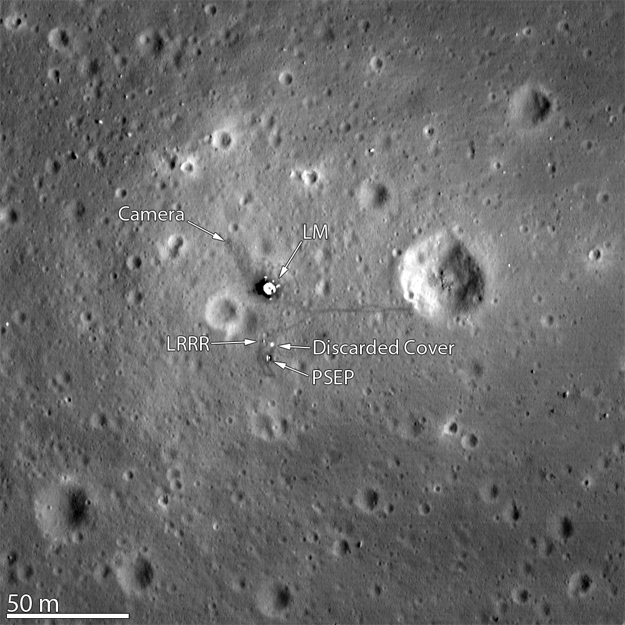
© NASA/GSFC/Arizona State UniversityLROC's best look yet at the Apollo 11 Landing site. The remnants of Armstrong and Aldrin's historic first steps on the surface are seen as dark paths around the Lunar Module (LM), Lunar Ranging RetroReflector (LRRR) and Passive Seismic Experiment Package (PSEP), as well as leading to and from Little West crater. LROC M175124932R.
You can see the remnants of their first steps as dark regions around the Lunar Module (LM) and in dark tracks that lead to the scientific experiments the astronauts set up on the surface. The Passive Seismic Experiment Package (PSEP) provided the first lunar seismic data, returning data for three weeks after the astronauts left, and the Laser Ranging RetroReflector (LRRR) allows precise measurements to be collected to this day. You can even spot the discarded cover of the LRRR.
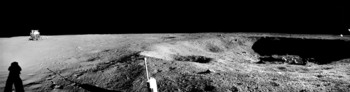
© NASAA panoramic view of Little West crater and the LM in the distance, photographed by Neil Armstrong
Another trail leads toward Little West crater around 50 meters (164 feet) to the east of the LM. This was an unplanned excursion near the end of the two and a half hours spent on the surface. Armstrong ran over to get a look inside the crater, and this was the farthest either astronaut ventured from the landing site. Compared to Apollo 12 and 14, which allowed for more time on the surface, and Apollo 15, 16, and 17, which had the benefit of a Lunar Roving Vehicle, Armstrong and Aldrin's surface activities were quite restricted. Their tracks cover less area than a typical city block!








So, is this like the report that needed to be sealed for 50 years so that people would forget it?
It took 50 years to fake these photos? Wasn't there any talent in Hollyweird that could do the job? or did they refuse to pay union scale?
I have always been told that the surface of the moon was too bright and the equipment left behind was too small to image this from earth (before Hubble) from the time of the 'landing' until now, yet you can get a crisp clear picture of superclusters of galaxies 10 BILLION Light Years away.
It really is a good photo. I made a buckwheat pancake once that looked just like that.