
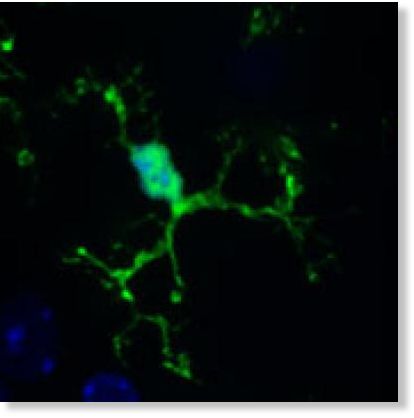
© EMBL/R.PaolicelliThis is microglia (green) in a mouse brain. The nuclei of all cells in the brain are labeled blue
"We're very excited, because our data shows microglia are critical to get the connectivity right in the brain," says Cornelius Gross, who led the work: "they 'eat up' synapses to make space for the most effective contacts between neurons to grow strong."
Microglia are related to the white blood cells that engulf pathogens and cellular debris, and scientists knew already that microglia perform that same clean-up task when the brain is injured, 'swallowing up' dead and dying neurons. Looking at the developing mouse brain under the microscope, Gross and colleagues found proteins from synapses - the connections between neurons - inside microglia, indicating that microglia are able to engulf synapses too.
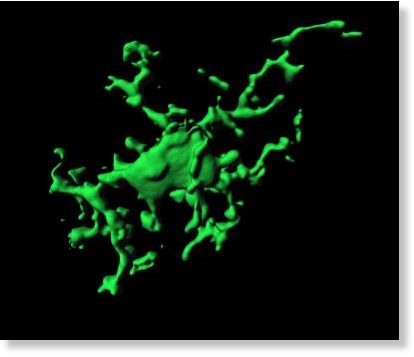
© EMBL/ R.PaolicelliThis is a 3-dimensional reconstruction of a single microglia cell
"What we saw was similar to what others have seen in at least some cases of autism in humans: many more connections between neurons," Gross says. "So we should be aware that changes in how microglia work might be a major factor in neurodevelopmental disorders that have altered brain wiring."
The microglia-limiting mutation the EMBL scientists used has only temporary effects, so eventually the number of microglia increases and the mouse brain establishes the right connections. However, this happens later in development than it normally would, and Gross and colleagues would now like to find out if that delay has long-term consequences. Does it affect the behaviour of the mice behaviour, for example? At the same time, Gross and colleagues plan to investigate what microglia do in the healthy adult brain, where their role is essentially unknown.



But, just like programmed cell death (apopthosis) - it's not very "new" that "micro-glia" (and "astrocytes) carry out the "pruning" function, and they are also part of the brains immunesystem, and supports the neurons structurally and metabolic, like other cells of the white matter.
They have done some interesting discoveries, in the intricate cooperation of various cells in the brain.
How grater interconnectivity leads to disease strates, will be difficult to pinpoint, but the other functions of MGs should not be neglected, I think...