
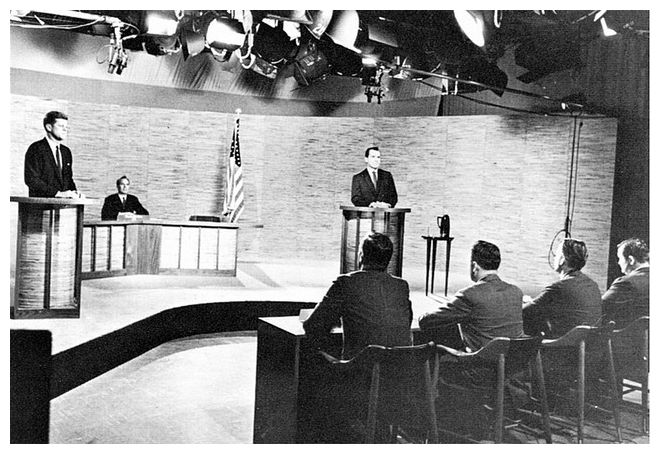
© scriptingnews / Flickr.comPresidential candidates John F. Kennedy and Richard Nixon debate on television for the first time in 1960.
It's obvious that physical appearances still influence viewers' perceptions of political candidates. But are some people easier to charm than others?
A recent study published in the American Journal of Political Science suggests that people who are less informed about politics and those who are heavy TV watchers tend to make more political decisions based on the attractiveness of candidates.
Researchers from the Massachusetts Institute of Technology drew data from two U.S. surveys of more than 36,000 people that measured respondents' political knowledge, TV behavior and voting preferences when shown candidates with differing appearances.
When compared to individuals who watched fewer hours of TV, respondents with lower awareness of political events and frequent TV watching provided 4.8 percent more support for attractive candidates than for unattractive ones.
It seems that TV consumption and low levels of political knowledge result in the greatest reliance on looks while voting.
But there's reason to be cautious. Attractiveness is subjective and hard to quantify, and there are several other factors that might influence people's political preferences, too.
Caveats aside, some may find it unsettling that people vote based on appearances -- consciously or not. Sure, electing an attractive politician may reflect positively on a state or district, but ultimately, the issue seems to unveil the fact that voters may not have the information they need to make informed decisions.
Or does the appearance advantage have a place in modern politics?


If Sarah Palin or Michele Bachmann looked like Ruth Bader Ginsberg, nobody would know or care who they are because the media would ignore them. Unattractive people are not welcome on teevee.