
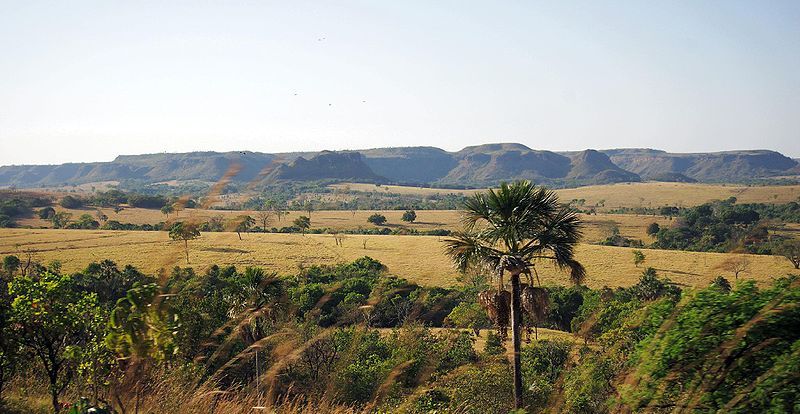
© Wikimedia CommonsFarm in Jataí Serra do Caiapó, Brazil.
More crops are being grown on the Brazilian savannah, where ranchers have traditionally raised their cattle. As crops take the place of cattle on the savannah, the ranchers move into the forest.
Marcelus Caldas, an assistant professor of geography at Kansas State University, and his colleagues at the University of Texas at Austin and Michigan State University analyzed land use data from 2003-2008. They examined geographic information systems, maps and statistics to determine how large scale monocultures were indirectly leading to deforestation.
"Our data shows that the Amazon now has 79 million heads of cattle," Caldas said in a press release. "Fifteen years ago, it had less than 10 million. That means that there's a problem with cattle moving inside the forest."
A growing world population looks to Brazil as a breadbasket and demand for soy has never been higher.
"In the international market, China is buying a lot of soybeans from Brazil," Caldas said.
Tremendous economic pressures push farmers to constantly expand the cultivated lands. And increasing affluence allows more people to afford and demand beef, which gives ranchers an incentive to raise more cattle and encroach on the Amazon forest.
"Because of that, Brazil is going to say they can increase crops here because there's going to be a demand for food," Caldas said. "So if they start to increase food production, it's all going to directly affect deforestation in the Amazon."
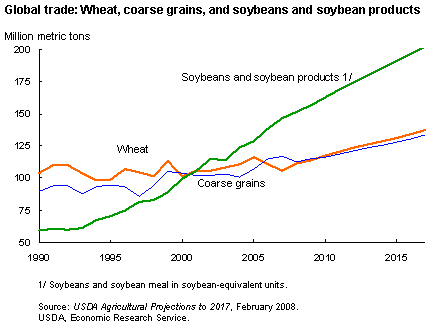
© USDAGlobal trade in soybeans and soybean products has risen rapidly since the early 1990s, and has surpassed not only wheat—the traditional leader in agricultural commodity trade—but also total coarse grains (corn, barley, sorghum, rye, oats, millet, and mixed grains). Continued strong growth in global demand for vegetable oil and protein meal, particularly in China, is expected to maintain soybean and soybean-product trade well above wheat and coarse grains trade throughout the next decade.
The new observations could be used to help set land use guidelines to ensure ranchers, farmers, forest dwellers and the global market can all meet their needs.
"Between 2003-2008 soy production expanded in Brazil by 39,000 square kilometers," Caldas said. "Of this 39,000 square kilometers, our study shows that reducing soybean production by 10 percent in these pasture areas could decrease deforestation in heavily forested counties of the Brazilian Amazon by almost 26,000 square kilometers -- or 40 percent."
Caldas and his colleagues published their findings in a recent issue of the environmental science journal, Environmental Research Letters.



Reader Comments
to our Newsletter