
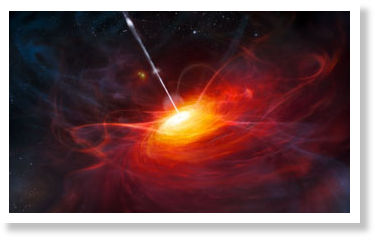
© ESO/M. KornmesserThis artist’s impression shows how ULAS J1120+0641, a very distant quasar powered by a black hole with a mass two billion times that of the Sun, may have looked. This quasar is the most distant yet found and is seen as it was just 770 million years after the Big Bang. It is by far the brightest object yet discovered in the early universe.
The team led by Daniel Mortlock and Stephen Warren (Imperial College, London) published its findings in Thursday's issue of Nature. According to the paper, the quasar's spectrum shows signatures of gases that fogged the early universe, and offers scientists a unique opportunity to study the events that altered the composition of the early cosmos.
At the heart of the quasar, however, lies a conundrum. The black hole that powers it is a monster. With a mass of two billion suns, it strains currently accepted theories on black-hole formation and evolution.
The Discovery
Quasars form when gases swirling around supermassive black holes in distant galaxies heat up and emit radiation. Quasars that are relatively nearby can be observed in optical light. But in the case of very distant quasars, like this one, the expanding universe stretches the visible light into infrared wavelengths.
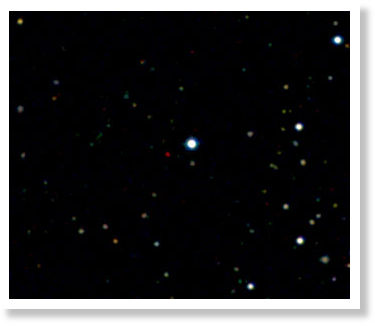
© Liverpool Telescope / United Kingdom Infrared TelescopeImage of the new most distant quasar ULAS J1120+0641. The quasar is the red dot near the centre of the image. The picture is a color composite made from images taken with the Liverpool Telescope and the United Kingdom Infrared Telescope. The quasar lies in the constellation Leo, a few degrees from the bright galaxy Messier 66.
As you go back in time, galaxies and quasars become increasing rare and harder to detect. It took the European team five years to make this discovery. "We expected to find quasars at redshift 7 eventually," said Warren, "We estimated the number of quasars by taking the decline in numbers that is seen between redshifts 3 and 6, and extrapolating to redshift 7."
Quasar ULASJ1120+0641, as it has been named, is not, however, the most distant object known in the deep sky. A gamma-ray burst has been identified at a redshift of 8.2, and a galaxy at a redshift of 8.6.
A probe into the Early Universe
This quasar opens a window into an era when a process called reionization was clearing the early cosmos of dense neutral hydrogen gas.
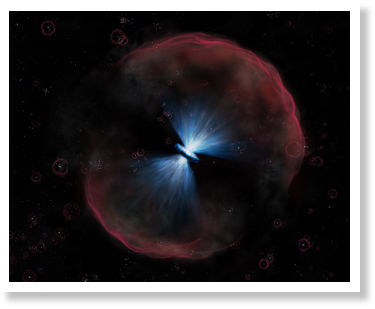
© Gemini ObservatoryArtist's conception of how the new quasar would appear close up. The very hot extremely luminous quasar at the centre of the image is very bright at ultraviolet wavelengths, and light from the quasar is ionizing the surrounding gas, causing the red color, which is the characteristic color of ionized hydrogen. In the background can be seen faint compact galaxies that have just been born; they contain hot stars that are also ionizing their surroundings, but much less effectively than the quasar as they are far less luminous.
The spectrum of this quasar shows both these absorption patterns, indicating active reionization in the galaxy's immediate vicinity. The team discovered that an area of 1.9 megaparsecs around the quasar was completely re-ionized and transparent to light.
"This quasar is a vital probe of the early Universe. It is a very rare object that will help us to understand how supermassive black holes grew a few hundred million years after the Big Bang," said Warren.
The Conundrum within the Quasar
While the discovery offers unprecedented opportunities, it also presents a quandary in the form of the monstrous black hole that powers the quasar.
There are two dominant models of black-hole formation. A star the mass of 10-100 suns can go supernova to spawn these structures. A second theory suggests that accreting clumps of gases can directly undergo core collapse to generate supermassive black holes.
But both these models fail to explain how such an early black hole reached the mass of two billion suns. One possible explanation is a rapidly growing black hole that developed from the explosion of a star the size of half a million suns. But current theories cannot account for a star that size in the early universe. The same is true for large collapsing gas cores.
"This gives astronomers a headache," says Mortlock. "It's difficult to understand how a black hole a billion times more massive than the Sun can have grown so early in the history of the universe. It's like rolling a snowball down the hill and suddenly you find that it's 20 feet across!"
Cosmologist Mitch Begelman (Universitiy of Colorado) voiced another concern. A voracious monster this size could speed up the process of re-ionization beyond expected rates, unless cocooned by a sheath of dust.
Black Hole theorist Priyamvada Natarajan (University of Yale), who spearheaded the model on self-regulating black holes, said that the discovery was exciting for the same reasons that it was challenging. She emphasized the need to find more giant black holes in order to come up with better models in the future. "The finding of a population is key to theoretical understanding (because) we can always come up with explanations for single rare objects, but to explain a population you need a robust mechanism."



Reader Comments
to our Newsletter