
Though people with autism face many challenges because of their condition, they may have been capable hunter-gatherers in prehistoric times, according to a paper published in the journal Evolutionary Psychology in May.One of the really notable parts of this study is a consideration of social changes in America in recent years, many of which may have made autism, especially among high functioning men and women, more problematic. In a speech that was posted on this website by another user, Asperger's speaker and high functioning autistic Temple Grandin talked about how people she met with Asperger's diagnosis who grew up in the 1950s were doing alot better than in generations afterward, when social expectations and norms were made foggier, more subtle and more chaotic but still nevertheless expected to be followed.
The autism spectrum may represent not disease, but an ancient way of life for a minority of ancestral humans, said Jared Reser, a brain science researcher and doctoral candidate in the USC Psychology Department.
Some of the genes that contribute to autism may have been selected and maintained because they created beneficial behaviors in a solitary environment, amounting to an autism advantage, Reser said.
The "autism advantage," a relatively new perspective, contends that sometimes autism has compensating benefits, including increased abilities for spatial intelligence, concentration and memory. Although individuals with autism have trouble with social cognition, their other cognitive abilities are sometimes largely intact.
The paper looks at how autism's strengths may have played a role in evolution. Individuals on the autism spectrum would have had the mental tools to be self-sufficient foragers in environments marked by diminished social contact, Reser said.
The penchant for obsessive, repetitive activities would have been focused by hunger and thirst towards the learning and refinement of hunting and gathering skills.
Today autistic children are fed by their parents so hunger does not guide their interests and activities. Because they can obtain food free of effort, their interests are redirected toward nonsocial activities, such as stacking blocks, flipping light switches or collecting bottle tops, Reser said.
I had a girlfriend who actually told me, in relation to romance, that just because I didn't know what to do didn't mean that I couldn't learn. It was fantastic advice and actually seemed very empathetic and understanding. In the interest of explaining what having Asperger's is like to a neurotypical, imagine that you have been placed in a job as software developer without anyone ever telling you how to use a computer or basic mathematics. That is effectively what you're doing to a kid with Asperger's when you expect him to follow social norms that haven't been spelled out.
In addition to undefined social roles and expectations, there were more fitting options for people like us. Avenues like seminary were effectively perfect for Aspies. Now, children are placed within a faceless public school machine that is programmed to "mainstream" them. For autistics, the natural difference in personality of Aspies disrupts the job of school administrators enough that they'll take on the same mentality of the bullies that terrorize Aspies. In other words, autistics have always been around but there were more places and options for us to fit in to and the expectations were clearer.
© Globa and Mail




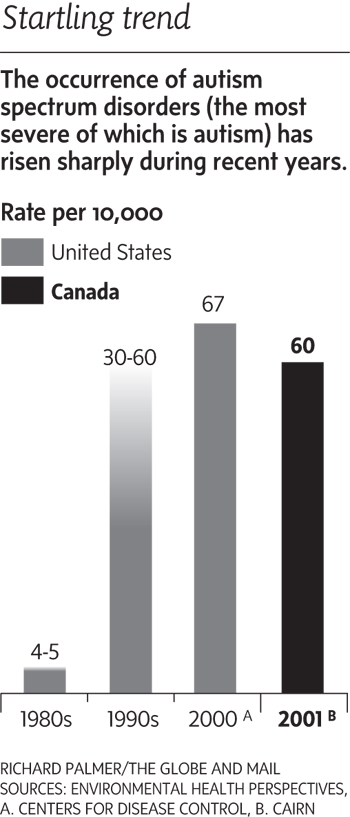
I've wondered if increased occurrences autism could be an evolved response to higher levels of environmental toxins. I wonder if autistic individuals would have any advantage in a hunter-gatherer setting if there was a sudden increase in environmental toxins due to cometary influences or other factors? Because today's toxins are actually man-made - and we are no longer hunter-gatherers - maybe this response is unable to perform its natural purpose?
I don't know; just thoughts that someone with more knowledgeable might be able to verify or refute.