
© Unknown
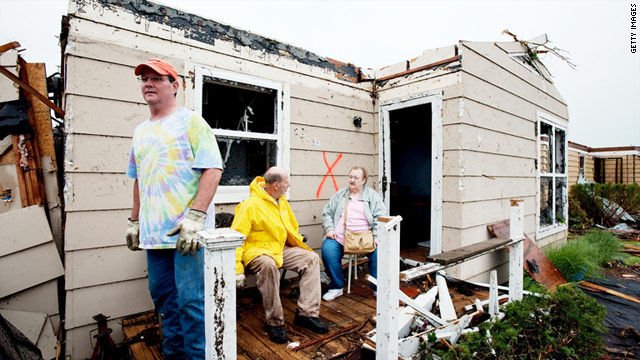
Yet despite warnings, watches and sirens, at least 116 people were killed when the twister roared through the southwestern Missouri city early Sunday evening. While insisting that forecasters' alerts went according to plan, the head of the National Weather Service said Monday that the plan -- and how it is communicated -- was not effective enough.
"We need to ask ourselves, what can we do to protect Americans?" said Jack Hayes, the federal agency's director. "I have to say, it's not enough. We have to do more."
A tornado watch went out for the area at 1:40 p.m. to signal "conditions are favorable for the development of tornadoes," as explained on the weather service's website. At 5:17 p.m., a more grave "warning" was issued indicating that radar showed a more distinct possibility of a tornado forming, said the service's central regional director Thomas Schwein.
At 5:41 p.m., it touched down -- ravaging most everything in its path.
Many people got the message in time: Some survivors told CNN how they sought cover after seeing the clouds and hearing sirens that Gov. Jay Nixon claimed first went off 17 minutes before the twister hit.
Many who had just departed the Joplin High School graduation ceremony, being held at Missouri Southern State University in the northeast part of the city, initially thought little of the sirens, said graduate Alexa Wattelet. In that part of the Midwest, tornado warnings, sirens and preparations are an accepted, expected part of life.
"The sirens always go off, so no one thought anything of it," said Wattelet, 18. "Where we were, nobody really seemed like they were in much of a shock."
But closer to the center of the storm, the problem was different: It was difficult to hear the sirens. That's because at the time they were blaring, buckets of hail two inches in diameter were loudly pelting windows along with torrential rain.
"So when the warning system (activated), when the ... pressure caused those alarms to go off, there was so much rain, so much hail," said Nixon, "many of the folks couldn't even hear it."
Natural disasters can be especially deadly when they strike deep in the night, when people are not awake to watch a TV or radio bulletin or otherwise prepare. But that wasn't the case Sunday, with the tornado striking late on a weekend day, when the sun should have still been shining.
The fact some people didn't know, or react, quickly enough is cause for concern, Hayes said.
One issue is that the high winds hindered the relay of critical information. Electricity was knocked out to as many as 18,000 customers of the city's Empire power company, making it hard for some to track developments on television or radio. Others may have learned by cell phone, at least until the high winds toppled 17 cell towers -- a figure given by Missouri's governor -- to effectively impose radio silence on the city.
Yet while bad-weather conditions sometimes precede a tornado's touchdown, the National Weather Service warning went out 24 minutes before that happened. At that point, in many parts in Joplin, rain and hail hadn't even started to fall.
Hayes notes that the transmissions of such warnings have improved, such that they go out as easily as "a forecaster can push a button." But beyond getting people to take such warnings seriously, the problems arise when people don't receive such messages even if they're communicated via outlets like TV or online.
The weather service director said his agency is working to have alerts sent automatically to cell phones, even though others without a cell phone might benefit more from automated calls to their home phone.
And finding that way -- or multiple ways -- to reach everyone is key, Hayes said. "We've got to keep everyone in mind."
That means rethinking, perhaps, the entire system. Joplin, after all, wasn't the only place that has seen mass fatalities this year after a tornado swept through despite concerted preventing efforts. Last month's tornado that hit Hackleburg and Phil Campbell, Alabama killed 78 people, while the one that struck Tuscaloosa and Birmingham killed 61.
For Hayes, the point is that even one fatality is too much -- especially if it would have been possible for someone to seek cover and survive.
"As long as Americans are dying, we're never going to say we're satisfied with anything," he said.


Unless you have a storm shelter or basement, there's no place safe to hide from a storm this size. Most new track-homes today are built on a slabs or have small crawl-spaces. Neither will offer much protection from a minor twister yet alone a monster this size. I've seen arial footage of another storm this size that sucked away sections concrete from a highway.