
The collisions, which took place long after volcanic activity ceased, deposited ejected material over the lower flanks of the volcanoes, Ceraunius Tholus and the smaller Uranius Tholus.
Permanent and transient features are on display in the images, taken by Mars Express and just released by the European Space Agency (ESA).
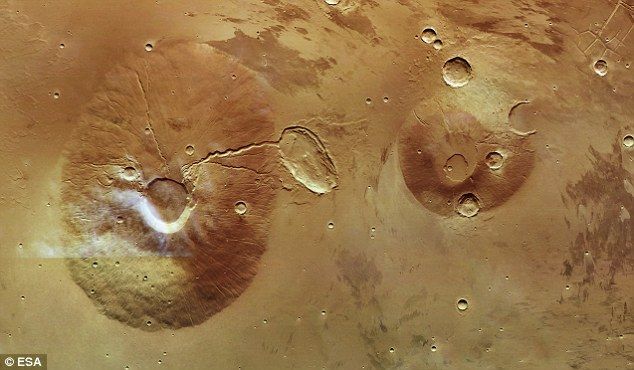
© ESANeighbouring volcanoes: This image taken by Mars Express shows Ceraunius Tholus and the smaller Uranius Tholus, which were caused by meteor impacts
Taken from data acquired during three orbits by the probe between 25 November, 2004 and 22 June, 2006, the dead volcanoes were not expected to change in appearance.
But, during the middle orbit, Mars Express captured icy clouds drifting past the summit of Ceraunius Tholus.
By the time the probe crossed again and took the final strip of data needed for this image, the clouds had long since dispersed and so there is a sharp line across them in the finished mosaic.
The Latin word 'tholus' means a conical dome and the base of Ceraunius Tholus is 80miles across, while the peak rises 3.4miles above the surrounding plains. At its summit is a large caldera that measures 15.5miles across.
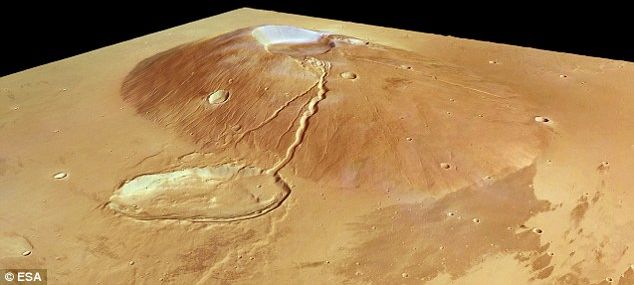
© ESACeraunius Tholus is 80miles across and rises 3.4miles above its surroundings. At its summit is a large caldera that measures 15.5miles across
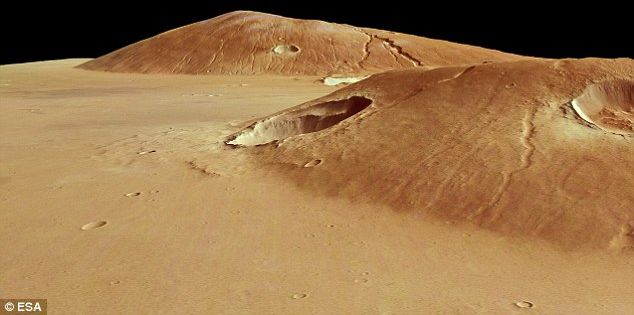
© ESAThe images were taken from data acquired during three orbits by Mars Express between 25 November, 2004 and 22 June, 2006
The flanks of Ceraunius Tholus are relatively steep and are etched with valleys that are deeply cut in many places. This suggests that soft and easily-eroded material, such as layers of ash, were deposited during the volcano's eruptions.
The largest and deepest of these valleys is about 2.2miles wide and 300metres deep. It terminates inside an otherwise unrelated elongated impact crater that happens to lie between the two volcanoes, and has created a fascinating fan shape of deposits.
Although the source of the fan is still being debated in scientific circles, it may have been formed when material from a lava channel or tube was washed downwards by a melting ice cap on the volcano.
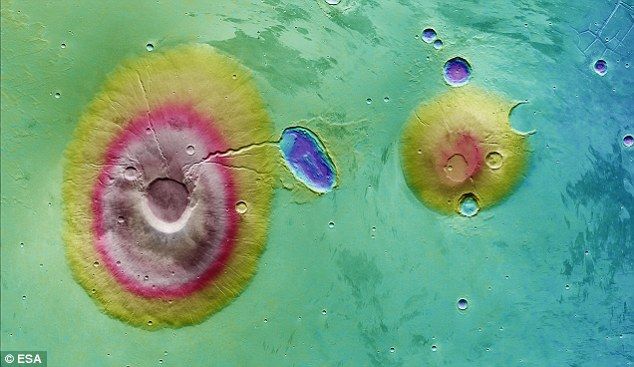
© ESACreated using a Digital Terrain Model obtained from Mars Express' High Resolution Stereo Camera, this colour-coded image shows the lowest lying regions (purple) and the highest (grey)
It is also possible that the water was produced when volcanic activity melted buried ice lenses. An ice lens forms when moisture seeps below the surface and forms a frozen layer between the top 'soil' and the rocky layer below.
Caused by an oblique impact by a meteorite, the elongated crater between the two volcanoes is called Rahe and measures 22miles by 11.2miles.
A smaller impact crater that measures 8 miles across can be seen to the west of Uranius Tholus.
This was also formed after all the volcanic activity ended and served to cover the lower flanks of the volcanoes with ejected material, with the result that only the upper regions of the original structures are now visible.









Why such beautiful pictures so much in detail and focussed, but the moon's pictures all blurry and one has to guess what you see?
Answer: Because there were no Lunar Landings and with pictures like this of Mars, we will certainly see that!!