
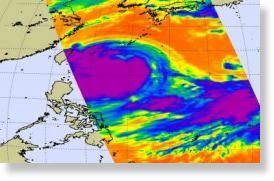
© NASA JPL, Ed OlsenThis infrared satellite image shows Typhoon Morakot's cold clouds (depicted in purple and blue) stretching over 1,000 miles in diameter on Aug. 6 in the East China Sea.
To put it into perspective, 1,056 miles is longer than the distance from Philadelphia, Pennsylvania to Orlando, Florida. Olsen said that it's important to know that satellite image represents the lateral extent of the cold cloud tops and that the winds definitely do not extend over an area 1,000 miles in diameter.
AIRS captured an infrared image of Typhoon Morakot tracking through the East China Sea on August 6 at 12:35 a.m. EDT (0435 UTC). At 11 a.m. EDT on Aug. 6, Morakot was closing in on Taiwan and was located 240 miles east-southeast of Taipei, Taiwan, near 23.2 north and 125.0 east. Morakot the monster has maximum sustained winds near 92 mph (80 knots) and was moving west near 14 mph.
AIRS provides visible, infrared and microwave images of tropical storms. AIRS also measures cloud top temperature and pressure and the profile of water vapor as functions of height. Infrared imagery shows the temperature of the cloud tops which gives a hint about the power of the thunderstorms in a tropical cyclone. The colder the clouds are, the higher they are, and the more powerful the thunderstorms are that make up the cyclone.
Typhoon Morakot is forecast to strengthen more before it crosses northern Taiwan later today and makes a final landfall in China by the weekend.



Reader Comments
to our Newsletter