Fireballs
S


Fireball 2

Meteor fireball over Ohio and 8 other states on November 16

mmmmmm
© Shutterstock/Triff
We received 40 reports about a fireball seen over IN, KY, MD, MI, NC, OH, PA, VA and WV on Sunday, November 16th 2025 around 22:46 UT.

For this event, we received 2 videos.


Fireball 2

Stunning meteor fireball over Spain & Morocco on November 18

mmmmmm
© Shutterstock/Triff
The stunning fireball in this video was recorded from Spain on November 18, at 3:17 local time (equivalent to 2:17 universal time). It was brighter than the full Moon. The event was generated by a rock (a meteoroid) from a comet that hit the atmosphere at about 132,000 km/h. The fireball overflew Granada (Spain), the Mediterranean Sea, and Moroccos. It began at an altitude of about 93 km over the locality of Saleres (province of Granada, Spain), moved southwest, overflew the Mediterranean Sea, and ended at a height of around 41 km over the locality of Ait Hamza (Morocco).

This bright meteor was recorded in the framework of the SMART project, operated by the Southwestern Europe Meteor Network (SWEMN) from the meteor-observing stations located at Huelva, La Sagra (Granada), Sevilla, and Mazagón (Huelva). The event has been analyzed by the principal investigator of the SMART project: Dr. Jose M. Madiedo, from the Institute of Astrophysics of Andalusia (IAA-CSIC). Its code in the SWEMN database is: SWEMN20251118_021744.


Fireball 2

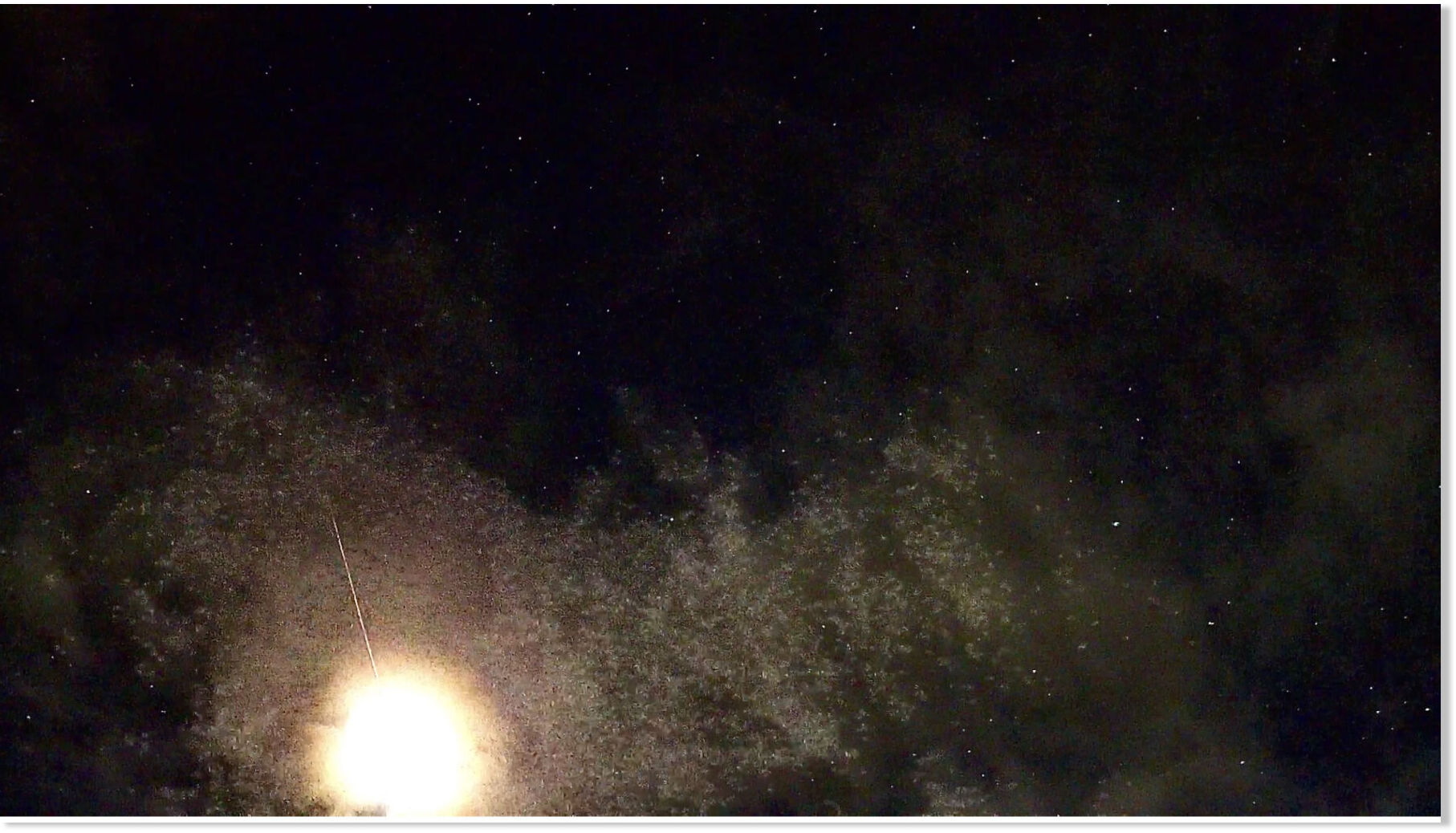
Meteor fireball over Arizona and 2 other states on November 15

mmmmmm
© Shutterstock/Triff
We received 70 reports about a fireball seen over AZ, CA and NM on Saturday, November 15th 2025 around 03:06 UT.

For this event, we received 3 videos.


Fireball 2

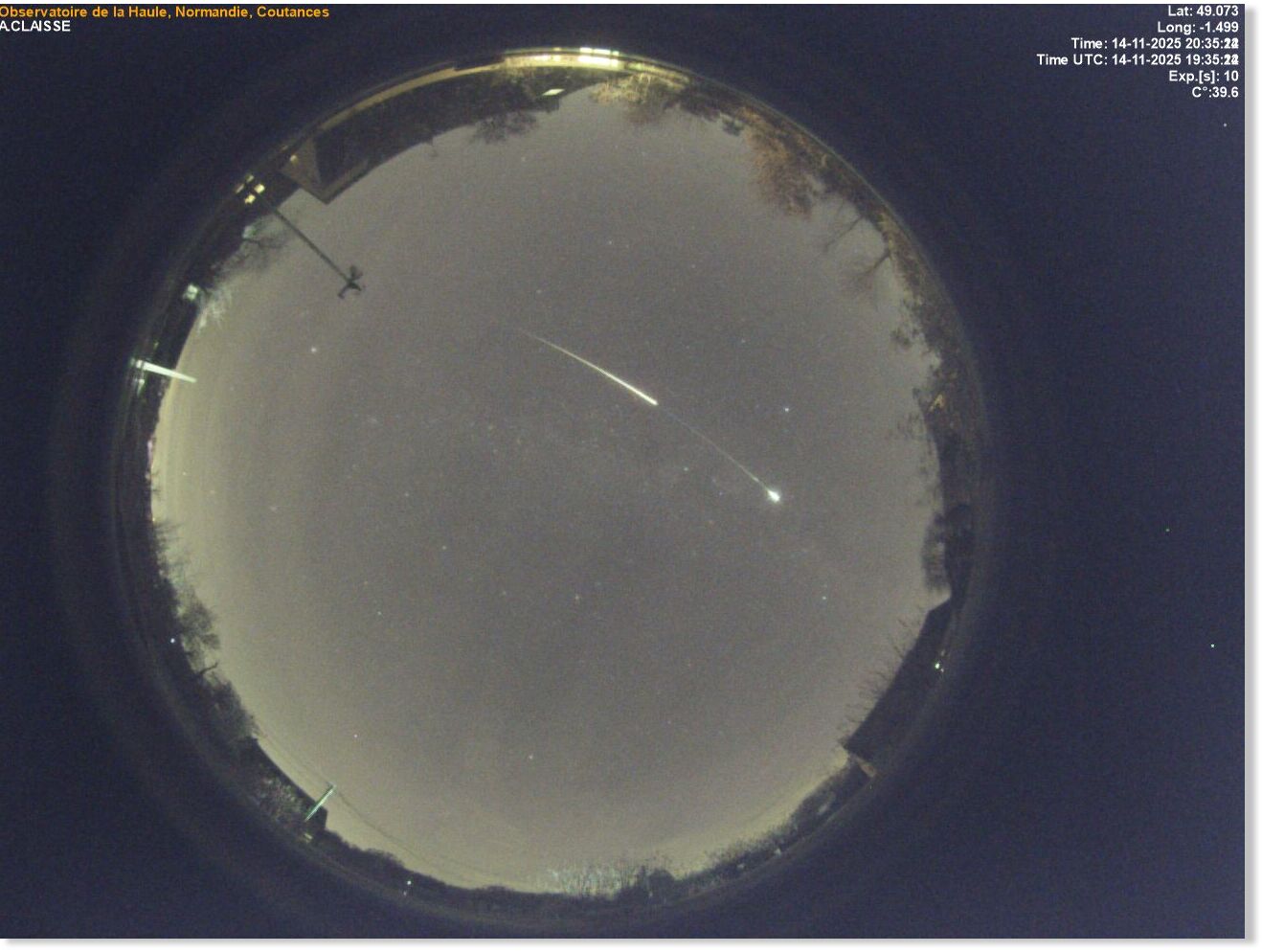
Meteor fireball over England and France on November 14

mmmmm
© arnaud C.
We received 50 reports about a fireball seen over Bretagne, England, Normandie, Nouvelle-Aquitaine and Pays de la Loire on Friday, November 14th 2025 around 19:33 UT.

For this event, we received one video and one photo.


Fireball 2

Very bright meteor fireball over North Island, New Zealand on November 17

A bright fireball was observed over New Zealand's North Island at 09:31 UTC (22:31 NZDT) on November 17, 2025, captured by multiple Fireballs Aotearoa cameras, including the color camera at Tauranga Astronomical Society in Matua and station NZ0033 in Katikati.

Meteor over NZ
© Fireballs AotearoaBright fireball over North Island, New Zealand on November 17, 2025.

A very bright fireball was recorded over New Zealand's North Island at 09:31 UTC on Monday, November 17.

Fireballs Aotearoa reported captures on several network cameras, including the Tauranga Astronomical Society (TAS) color meteor camera in Matua, Tauranga, and the Katikati station.

No trajectory, radiant, absolute magnitude estimate, fragmentation data or potential fall area has been published at this time. The event occurred near the nominal Leonid maximum (active November 6-30 with peak around November 17), but any shower association remains unconfirmed pending analysis of multi-station data.

Note that the audio heard on the clip below is wind noise on the microphone, not sound from the meteor.

Fireball 2

Meteor fireball over Connecticut and 12 other states on November 14

mmmmm
© Mark K.
We received 85 reports about a fireball seen over CT, DC, DE, MA, MD, NH, NJ, NY, OH, PA, RI, VA and VT on Friday, November 14th 2025 around 01:22 UT.

For this event, we received 4 videos and one photo.


Fireball 2

Meteor fireball over Michigan, 6 other states and Ontario on November 14

mmmmmm
© Shutterstock/Triff
We received 48 reports about a fireball seen over IA, IL, MI, OH, Ontario, PA, WI and WV on Friday, November 14th 2025 around 01:13 UT.

For this event, we received 7 videos and one photo.


Fireball

Meteor fireball over Spain (Nov. 16)

mmmmmm
© Shutterstock/Triff
This bright bolide was spotted from Spain on November 16, at 5:01 local time (equivalent to 4:01 universal time). The event was generated by a rock (a meteoroid) from Asteroid 2004 TG10 that hit the atmosphere at about 105,000 km/h. The fireball overflew the province of Cuenca (Spain). It began at an altitude of about 90 km over Pozorrubio (province of Cuenca), moved east, and ended at a height of around 56 km over Villares del Saz (province of Cuenca).

This bright meteor was recorded in the framework of the SMART project, operated by the Southwestern Europe Meteor Network (SWEMN) from the meteor-observing stations located at La Hita (Toledo), La Sagra (Granada), Sevilla, and Mazagón (Huelva). The event has been analyzed by the principal investigator of the SMART project: Dr. Jose M. Madiedo, from the Institute of Astrophysics of Andalusia (IAA-CSIC). Its code in the SWEMN database is: SWEMN20251116_040132.


Fireball 2

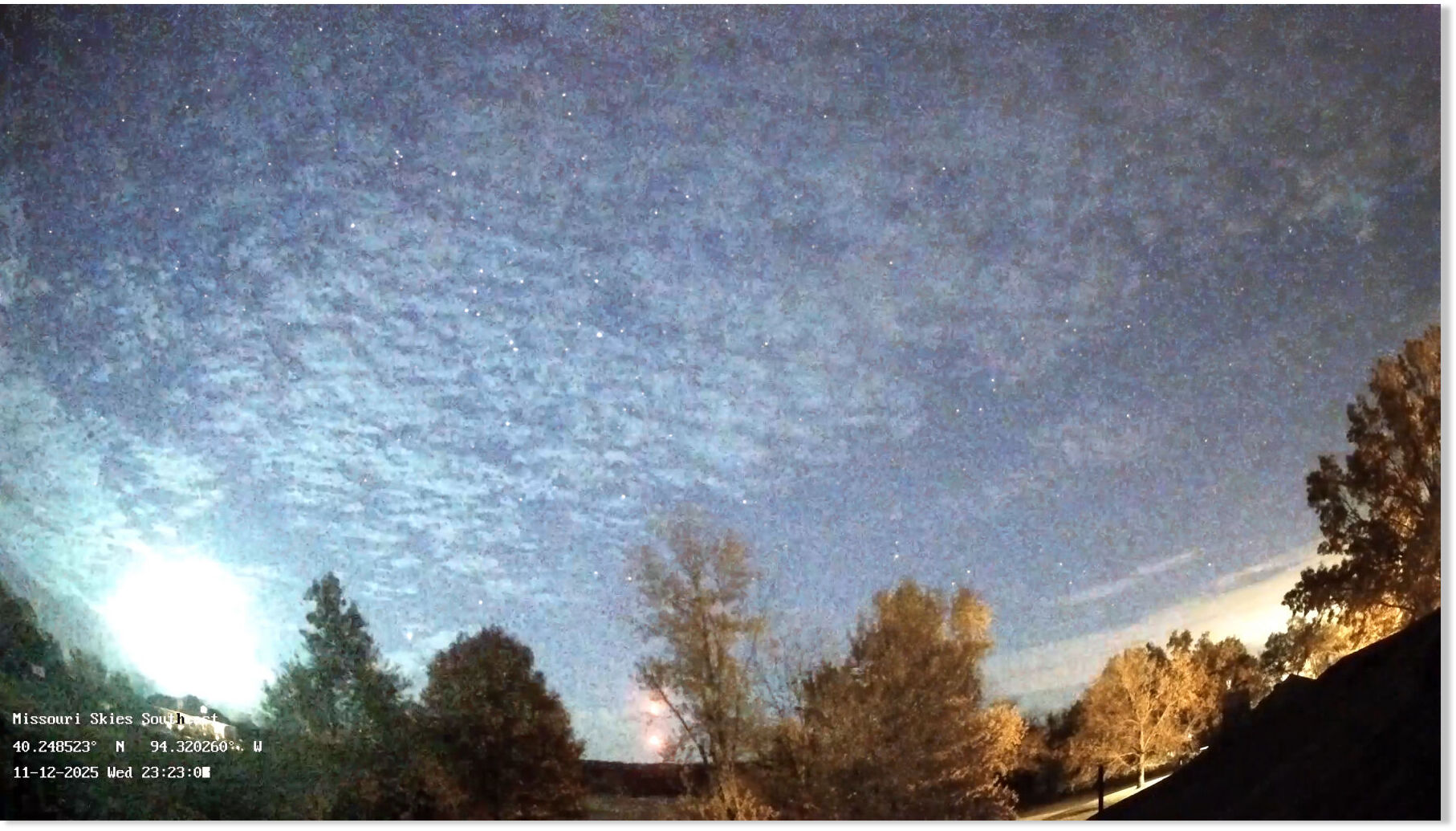
Meteor fireball over Missouri and 11 other states on November 13

mmmmm
© Dan B.
We received 59 reports about a fireball seen over AL, AR, IA, IL, IN, KS, KY, MI, MO, OH, TN and WI on Thursday, November 13th 2025 around 05:25 UT.

For this event, we received 5 videos and 2 photos.


Comet 2

New image of comet C/2025 K1 (ATLAS) reveals it's breaking apart ahead of close approach to Earth

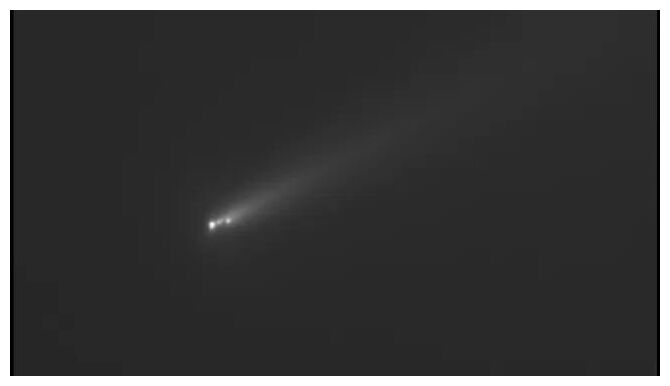
New images show that comet C/2025 K1 (ATLAS) has fragmented after passing its closest point to the sun, ahead of its close approach to Earth later this month. This is not the interstellar comet 3I/ATLAS.
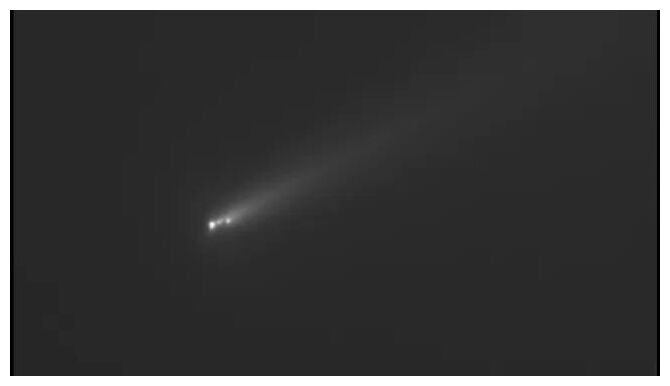
comet C/2025 K1 (ATLAS)
© Gianluca Masi / The Virtual Telescope ProjectA new telescope image of the comet C/2025 K1 (ATLAS) shows it has broken into pieces following its recent close approach to the sun. The comet is not related to the interstellar comet 3I/ATLAS.
The "other" Comet ATLAS has fragmented, transforming into a cloud of debris that's streaming into space, new observations have revealed.

The comet, called C/2025 K1 (ATLAS), was discovered in May by astronomers at the Asteroid Terrestrial-impact Last Alert System (ATLAS) and passed perihelion, or closest point to the sun, on Oct. 8. It has no relation to the famous interstellar comet 3I/ATLAS, other than having been discovered by the same telescope network around the same time.

Initial observations appeared to suggest that Comet K1 survived its passage around our star at a minimum distance of 31 million miles (50 million kilometers), or roughly four times closer than Comet 3I/ATLAS got.

However, new observations taken by astronomer Gianluca Masi in Manciano, Italy, show that the gravitational strain of its voyage around the sun was too much for the comet, causing it to fragment into several pieces, or clouds.

"Several parts (sub-nuclei or clouds of debris) are visible, also a plume just below the leading (the first from the left) fragment," Masi, an astronomer at the Astronomical Observatory of Campo Catino and the founder of The Virtual Telescope Project, wrote in an update.