Storms
S


Radar

US: Seismic Waves Shaking Up Oklahoma,Georgia,Tennessee,& Texas--Sonic Boom-Birds & Bugs Flee

It seems that this past year has been filled with all types of strange weather patterns all across the nation.Between droughts,flooding, tornadoes and rare earthquakes many located in regions not known for seismic activity for 50-150 years.This past week alone reports have been flowing in from worried residents throughout Oklahoma,Georgia,Tennessee,& Texas.The residents reported they heard loud booming sounds while the earth beneath them rattled around .Radar tracking captured birds or bugs fleeing on as the tremors occured.Are these tremors the result caused by seismic waves ? You ask what are seismic waves ?

Seismic waves are waves of energy that travel through the earth, and are a result of an earthquake, explosion, or a volcano that imparts low-frequency acoustic energy. Many other natural and anthropogenic sources create low amplitude waves commonly referred to as ambient vibrations. Seismic waves are studied by seismologists and geophysicists. Seismic wave fields are measured by a seismograph, geophone, hydrophone (in water), or accelerometer.

The propagation velocity of the waves depends on density and elasticity of the medium. Velocity tends to increase with depth, and ranges from approximately 2 to 8 km/s in the Earth's crust up to 13 km/s in the deep mantle.

Igloo

US: Juneau Alaska sees record snowfall- more snow expected

Image
© Michael Penn / Juneau EmpireSnow piles up on top of a downtown business totem on Monday. The 10.7 inches of snow Monday exceeded the previous record of 5.6 inches for Nov. 14.
Record snowfall levels have been reported in Juneau, and more snow was to arrive this morning.

The National Weather Service issued a winter storm warning for Juneau and other parts of southeast Alaska until 5 a.m. today. Six to 10 inches of new snow are possible for Juneau, Petersburg and Wrangell, with slightly lesser amounts in places like Hoonah and Angoon.

Juneau public schools were closed Monday. Eaglecrest Ski Area reminded outdoor enthusiasts it is closed and had no ski patrol or avalanche control onsite.

Several city commission meetings were canceled, as was a lecture sponsored by the Sealaska Heritage Institute. City buses went on winter routes in areas where the city deems it unsafe to operate buses during heavy snow and ice.

Meteorologist Geri Swanson said Monday afternoon the 10.7 inches that had fallen at weather service offices since midnight broke a record for snow falling on Nov. 14. The previous record was 5.6 inches in 2006.

Cloud Lightning

A split jet stream brings severe weather to the U.S.

While D.C. is having a grand ol' weather day, a swatch of land stretching from Illinois through Indiana to Ohio to three other states has fallen under tornado watches and warnings. What's causing this discontent in the atmosphere? Blame it on a disturbed jet stream, a river of wind that can scream along at up to 450 m.p.h. several miles above in the sky.

Image
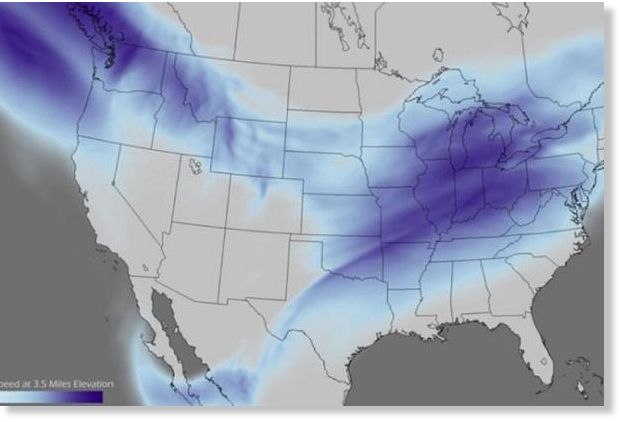
© NOAATornadic weather over the Midwest on Monday, Nov. 14, 2011, can be blamed on a seasonal split in the jet stream.
The jet stream typically flows in a single thick band traveling west to east. But around this time during La Nina years, the stream can become split, with one vein coursing through the north part of the country and the other through the south. A split jet stream is a harbinger of severe weather; look above and you'll see why.

The blue in NOAA's map from today represents wind speed at a height of about 3.5 miles, with the darkest blue/purple areas indicating places where gusts top 100 m.p.h. The fast winds denote the location of the jet stream. The stream begins to split in the Pacific Northwest: One branch loops down into Mexico while the other stays the course at the top of the U.S. Where they rejoin is where the problems start. The northern stream is holding a load of frigid air that it carried in from Canada, whereas the southern one is damp and warm thanks to a nice vacation in the Gulf of Mexico. The combination of these disparate atmospheric conditions forms the recipe for severe storms, and is the reason that one tornado and quarter-sized hail have already been reported in Champaign County, Ill.

Igloo

Canada: British Columbia storm cuts power, jams highways, stops ferries

Image
© CBC News
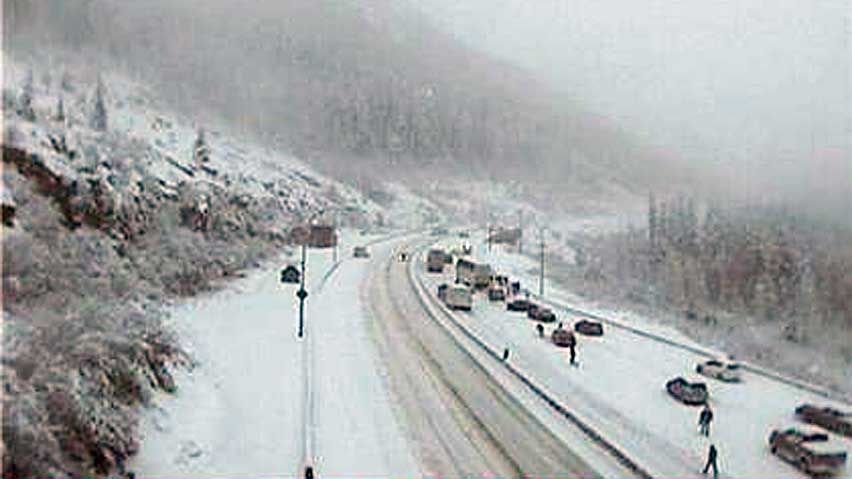
Stormy weather has forced BC Ferries to delay ferries on several routes on Friday afternoon, cut power to thousands and caused havoc on the Coquihalla and other B.C. highways.

Shortly after 2 p.m. BC Ferries began announcing ferries would not be sailing between Vancouver and Vancouver Island, and on several smaller routes until high winds subsided.

About 50,000 BC Hydro customers in the Lower Mainland, the Sunshine Coast and Vancouver Island regions were without power as the wind knocked trees onto power lines during the height of the storm around 3 p.m.

Then by 3:30 p.m. the wind had subsided in some areas and some of the ferries had resumed sailing, including those on the Tsawwassen to Swartz Bay route, but sailings on many routes were running behind schedule.

Bizarro Earth

US: Wanna experience the apocalypse before it happens? Visit Oklahoma!

Image
© Unknown
After one of the strangest local weather days in memory, an Oklahoma woman with a sense of humor asked on Twitter earlier this week:

"Wanna experience the apocalypse before it happens? Visit Oklahoma!"

She posted that on Monday night shortly after a 4.7-magnitude aftershock earthquake shook the state. The temblor occurred not long after six tornadoes ripped through southwest Oklahoma, which was preceded by flash-flooding in an area that's been plagued by a historic drought.

"Seriously, WHAT'S GOING ON?" someone else tweeted that night.

The answers vary. Global warning? Coincidence? Bad luck? Bad timing? End of time?

There's agreement on only one thing: It's been weird all year.

"Even for Oklahoma, this is crazy," said Rick Smith, a National Weather Service meteorologist in Norman. "Since January, we've been setting records. People are just kind of amazed and shocked."

State records set this year have ranged from the lowest temperature (31 degrees below zero in Nowata in northeast Oklahoma) to snowfall in a 24-hour period (27 inches, also in Nowata) to the largest hail stone (a spiky, six-inch piece recovered in Gotebo, in southwest Oklahoma).

This year also produced the state's highest-ever-recorded surface wind speed (151 miles per hour near El Reno, outside of Oklahoma City) and biggest known earthquake (5.6 magnitude, breaking the 1956 record).

Bizarro Earth

US: Oklahoma Struck By Biggest November Tornado on Record

Tornado
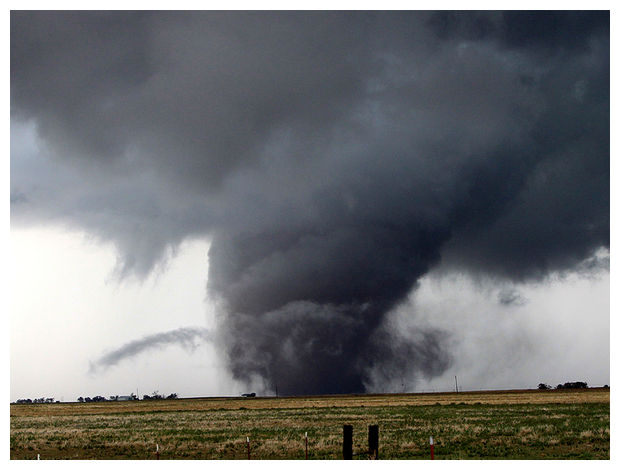
© Steve Grabman/NWSThe biggest November tornado in Oklahoma's history.
Oklahoma earlier this week became witness to the state's biggest November tornado since reliable records began in 1950.

The tornado touched down in Tipton, Okla., earlier this week and was upgraded yesterday (Nov. 10) to an EF-4, the second-highest rating on the Enhanced Fujita Tornado damage scale, after a storm survey team analyzed its destruction.

"We've had some biggies come through from time to time, but never an EF-4 in November," said Gary McManus, of the Oklahoma Climatological Survey, which operates the Mesonet weather data collection towers across the state. One of the 30-foot-tall (10 meters) weather collection towers was toppled by the EF-4 tornado.

The massive fall twister demolished an Oklahoma State University extension office, according to the storm survey report from the National Weather Service (NWS) in Norman, Okla. The tornado had estimated winds between 166 and 200 mph (267 kph to 322 kph), significantly stronger than its EF-2 preliminary rating.

Igloo

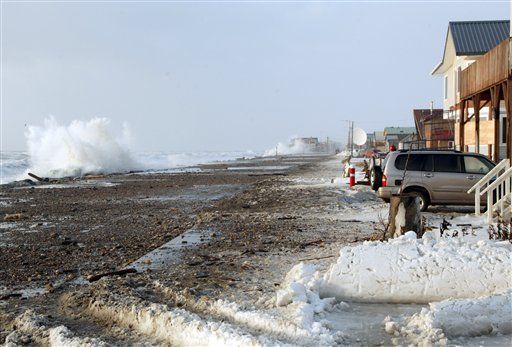
Huge Alaska storm passes, leaves widespread damage

Alaska storm
© AP Photo/Peggy FagerstromWaves splash up on the shore near homes in Nome, Alaska. Wednesday, Nov. 9, 2011.
A massive storm that battered Alaska's western coast with hurricane-strength winds and towering sea surges has passed out of the region in a much weaker state, leaving behind widespread damage and a missing man who may have been swept out to a churning sea.

So far, 37 communities have reported some form of damage, said Jeremy Zidek, spokesman for the state's emergency management agency.

The strongest storm to hit the state in four decades also left behind tales of human endurance.

Bizarro Earth

US: Tornado Season, Part 2, Roars Into Action

Tornado
© Basehunters/Tornadovideosdotnet/YouTubeThe second tornado season kicked off in Oklahoma this week.
With more than two-dozen reported tornadoes across Oklahoma, Texas and Louisiana this week, the so-called "second tornado season" has touched down with a bang.

Tornadoes can strike virtually anywhere and anytime in the United States, and November is known as a particularly big month for twisters, especially in the Southeast area known as Dixie Alley. But this year, it's the traditional Tornado Alley that has taken the November punches.

At least six tornadoes were reported in Oklahoma Nov. 7, combined with baseball-size hail and wind gusts up to 92 mph (148 kph). One twister destroyed an Oklahoma State University extension office.

The barrage continued last night (Nov. 8) with 10 reported tornadoes across Oklahoma, Texas and Louisiana.

The main tornado season runs from spring to early summer, but tornadoes can form under a variety of conditions and strike during fall and winter. Tornadoes have killed 548 people so far in 2011, according to the Storm Prediction Center, making this one of the most active tornado years in U.S. history. A massive outbreak in April killed nearly 250 people in Alabama alone. One month later, another massive twister killed more than 150 in Joplin, Mo.

Last November, severe weather was slow to start, but this year the second tornado season is already in full swing.

While Dixie Alley has been mostly quiet, some scientists are starting to suspect that November is in fact the beginning of the Southeast's only tornado season.

"Sometimes you get started in November and you just keep going all the way to April and May," said meteorologist Steve Wilkinson of the National Weather Service office in Jackson, Miss.

Cloud Lightning

Extreme Weather Events Reported in Skies Over Australia

Victoria's State Emergency Service has responded to more than 1000 calls for help overnight after one of the wildest storms to lash the state this year. SES rescuers responded to cases of flash flooding, hail damage, people trapped in cars, unroofed homes and fallen trees. In one of the worst-hit areas, Frankston received 30 millimetres of rain in 20 minutes yesterday. Residents made more than 200 calls for help, including 150 about flooding and 40 about building damage.
Australia storm sky
© n/a
In Croydon several people had to be rescued from their vehicles after they became stuck in flood waters. There were another 150 reports of fallen trees, many in towns northwest of Melbourne including Castlemaine, Woodend and Maryborough. The northeast endured the worst of the storm, where 65mm of rain fell - the highest rainfall for the state. In Wodonga, several houses had their roofs ripped off. There were also reports of flooded backyards and falling trees.

Record heat

Sydney residents have sweated through what could be the hottest November night on record. Temperatures climbed to a top of 28.4C and never dipped below 26.5C, Bureau of Meteorology (BOM) duty forecaster Dmitriy Danchuk said. Previously, the hottest November night on record was in 1967, when the minimum temperature was 24.8C. The average minimum temperature for November is 15.6C. "So last night we had temperatures that were 10.9 degrees above average," Mr Danchuk said. "That's a pretty rare occasion. The last time we had high temperatures like this was on November 14, 1976. "This could be a record."

Igloo

US: Surge feared next after Alaska coast hit by major storm with hurricane-force winds

Hurricane-force winds cause damage overnight in area's largest town

Anchorage - Initial reports from towns along Alaska's northwest coast early Wednesday indicated that a massive Bering Sea storm had tossed rocks onto roads, eroded beaches and blown off roofs - and that's before water surges expected to peak Wednesday night.