Storms
S


Bizarro Earth

Commuter hell as flood chaos sweeps Dublin, Cork

Image
Chaos reigned this morning after the country downpours and high winds lashed overnight. Torrential rain and high winds caused havoc in Dublin and Cork -- but conditions were expected to improve by this evening. Heavy rain from around 3am was too much for the drainage systems to cope with, causing water to build up on several major roads, particularly in south and west Dublin.

And it was a similar story in Cork this morning where city streets were under as much as two-feet of water as high tide blighted the city.

Impassable

In Dublin, AA Roadwatch reported serious flooding around the Tallaght area, with the road impassable at the Jobstown Inn, and from the Old Bawn junction on the N81 Tallaght Bypass down to the M50 junction.

Several cars stalled on the N81 after driving through flooded areas. Traffic in the area was heavy inbound during morning rush hour as motorists queued to try to negotiate the floods by driving one-by-one on the higher footpaths beside the affected roads.

Further west on the N81 there was heavy flooding from Brittas to Tallaght.

Blue Planet

Hurricane Paul to hit Baja California coast Tuesday afternoon

Image
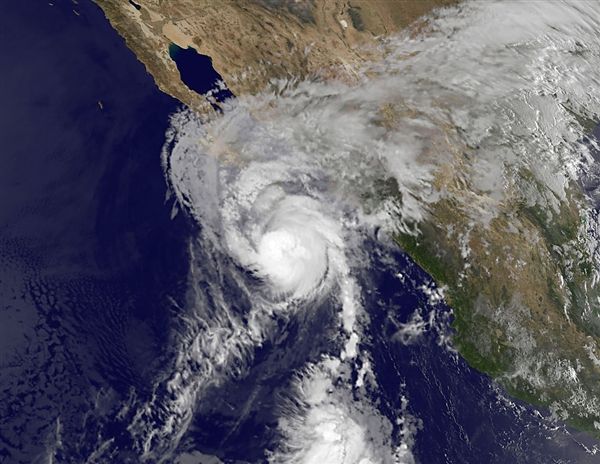
© NASA/AFP/Getty ImagesThis satellite-based image shows Hurricane Paul early Tuesday.
Hurricane Paul was expected to make landfall Tuesday afternoon along a lightly populated area of Mexico's Baja California.

Early Tuesday, the Category 2 hurricane was about 70 miles south of Cabo San Lazaro and was moving north-northeast at 21 miles per hour with maximum wind speeds of 105 mph, the U.S. National Hurricane Center reported.

Up to 10 inches of rain in some places could trigger flooding or mudslides, the center said, warning the storm would cause dangerous coastal waves.

Mexico issued a hurricane warning from Santa Fe northward to Punta Abreojos on the country's western Baja peninsula, the center said. On the east coast, a hurricane warning stretched from Mulege to San Evaristo.

While Paul was expected to weaken once it makes landfall, it should stay over Baja California for up to 36 hours, the hurricane center said.

The storm is not expected to hit the tourist resorts of Los Cabos.

Some rain from Paul should even make it to south Texas on Tuesday, weather.com reported.

Cloud Lightning

"Rare" for October: Tropical Cyclone Anais rages in the Indian Ocean

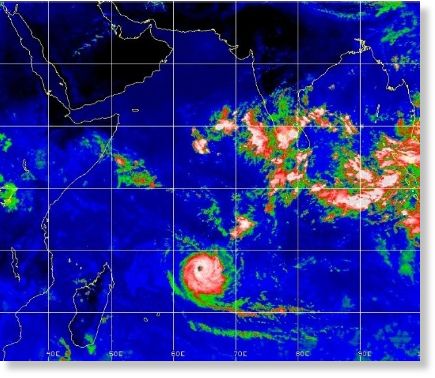
Tropical Cyclone Anais is estimated to have a maximum wind of 115 mph as of early this morning, which is equivalent to a category 3 hurricane in the Atlantic Ocean. The southwestern Indian Ocean is prone to tropical cyclones but what makes Anais so rare is that it is occurring in October, which is early springtime in the southern Hemisphere.
Image
The peak period for tropical events in this part of the world is normally during our winter months of January-March. Anais is forecast to move southwest in the general direction of Madagascar for the next five days and weaken as it moves into cooler waters and unfavorable winds.

Snowflake Cold

Snow causes havoc across eastern Australia -- Video


The Bureau of Meteorology says snow falls have occurred right along the Great Dividing Range and as far north as Queensland's Granite Belt.

At its height, snowfalls of 15 centimetres and wind damage cut roads and rail access to the upper Blue Mountains for more than six hours.

In the Blue Mountains, 300 cars were stranded by the mountain road closures.

But the SES's Jennifer Finlay says most of the 550 calls for help came from further to the south.

"The Illawarra south coast got hit pretty hard with lots of trees down a bit of roof damage, fortunately nothing too severe," she said.

Endeavour Energy reconnected more than 2,000 properties to power on Friday afternoon, but hundreds of outlying properties between Mount Victoria and Medlow Bath and in the Megalong Valley will not get power back until Saturday.

With temperatures predicted to get down to 3 degrees Celsius overnight, the company has urged people in areas where the power is out to check on neighbours who live alone.

Comment: Note how the meteorologist claims "it's not unprecedented" because there were similar conditions in 2008. Well that's alright then! Nothing to worry about!


Snowflake

Arizona October Snow? Strong fall storm headed for northern Arizona

Image
A strong fall storm moving into Arizona on Thursday is expected to drop up to three inches of snow in the higher elevations. The National Weather Service said the greatest likelihood of severe storms will be from Thursday evening through Friday morning. Daytime temperatures Friday will be about 15-20 degrees cooler than earlier this week.

Up to three-quarters of an inch of rain is expected in some areas, with the possibility of tornadoes.

Forecasters said snow levels could drop to as low as 7,500 feet on Friday. The Kaibab Plateau, San Francisco Peaks and the White Mountains could see between one inch and three inches of snow.

Cloud Lightning

Southern California storm will bring severe weather outbreak

Image
A storm system will hit Southern California on Wednesday and Thursday, ejecting into the plains by Friday and Saturday with widespread severe thunderstorms expected out there.

Over at the Southern California Weather Authority we name the Pacific Storms that come into the region, a novelty since 1998-1999. This is Pacific Storm Adam, a category three system for Wednesday into Thursday.

Pacific Storm Adam will hit the Point Conception areas on Wednesday, and Los Angeles overnight Wednesday into Thursday, bringing locally heavy rain in spots under the thunderstorms that form.

Hail, funnel clouds, and waterspouts will also be a concern along with resort level snows for any cells that pass those areas.

After the system moves out on Thursday night, it will quickly eject into the plains where severe thunderstorms will be likely between then and Saturday across a large area.

These storms will contain large hail, damaging winds, and even tornadoes.

Windsock

Waterspout touches down in Rome, 26 August 2012

Image
© YouTube user 2012FromAbove
Waterspout/tornado touches down in Olbia-Rome on 26 August 2012. Sails stripped off their masts.


Snowflake

Minnesota and North Dakota see new snowfall records and power outages in October

An early season snow event produced significant snow amounts for northeast North Dakota into northwest Minnesota for early October. The heaviest snow fell in Roseau county where around a foot of heavy wet snow has been reported as of 3 pm Thursday October 4. This heavy wet snow has also produced numerous power outages across this area.

These snow amounts appear to be record amounts for this early in the season for many areas. The previous record snowfall for October 4 or earlier at the NWS in Grand Forks was 2 inches on October 2, 1950. The NWS at Grand Forks reported 3.5 inches of snow with this storm on October 4, 2012. While records from around the area indicate that the October 2, 1950 storm produced about 2-5 inches around the region with localized higher amounts, with Leeds, ND receiving 7.0 inches on October 2, 1950, and Hallock 4.5 inches.

Attention

Fire, high winds wreak havoc across Tasmania

Tasmania tree fall
© ABC / Linda HuntAurora crews fix powerlines after a tree brings them down at Boyer in southern Tasmania.
Storm-force winds are damaging properties and fanning fires across Tasmania.

Gusts of up to 100 kilometres an hour have brought down powerlines, sparking several fires.

The Tasmania Fire Service (TFS) is attending several fires, while Tasmania Police has issued hazard and road closure alerts.

The wild winds threatened to collapse a wall at Elwick Racecourse, facing Goodwood Road, just after 1pm.

Airlines Virgin and Qantas have diverted flights back to Melbourne, with one plane aborting a landing in Hobart.

About 9,300 households are without power in the Derwent and Huon Valleys and the Channel areas.

Cloud Lightning

Winter storms to be named by Weather Channel

Image
© weather.com
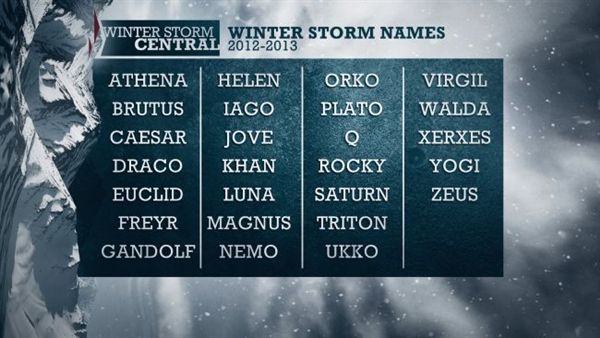
During the upcoming 2012-13 winter season, The Weather Channel will name noteworthy winter storms. Our goal is to better communicate the threat and the timing of the significant impacts that accompany these events. The fact is, a storm with a name is easier to follow, which will mean fewer surprises and more preparation.

Hurricanes and tropical storms have been given names since the 1940s. In the late 1800s, tropical systems near Australia were named as well. Weather systems, including winter storms, have been named in Europe since the 1950s. Important dividends have resulted from attaching names to these storms:
  • Naming a storm raises awareness.
  • Attaching a name makes it much easier to follow a weather system's progress.
  • A storm with a name takes on a personality all its own, which adds to awareness.
  • In today's social media world, a name makes it much easier to reference in communication.
  • A named storm is easier to remember and refer to in the future.
The question then becomes: "Why aren't winter storms named?" In fact, in Europe the naming of weather systems has been going on for a long time. Here in the U.S., summer time storms including thunderstorms and tornadoes occur on such a small time and space scale that there would be little benefit and much confusion trying to attach names to them. However, winter weather is different. Winter storms occur on a time and space scale that is similar to tropical systems.