Animals
S


Hourglass

US: Environmental disaster - every single bat may soon be dead

Alabama farm
© Associated Press/Elizabeth DalzielBats protect Alabama farms from insects.
While the media made a big deal out of honey bees dying last year, bats are quietly suffering a similar fate. And the death of bats is an environmental disaster in the making. Every single bat in the United States may soon be dead. White-nose syndrome (WNS), a mysterious fungus that kills bats wiped out about 90 percent of the bats in Connecticut this past winter and the syndrome is now headed to Alabama and other southern states.

According to a report in the Hartford Courant (Bats Die), officials from the Connecticut Department of Environmental Protection have found "veritable bat catacombs" in the state's caves. The wildlife inspectors discovered thousands of dead bats stacked up along the ledges of cave walls.

Bug

Canada: "Pine Beetle Kill" No Longer Just Dead Wood

2010 Olympic Oval
© Holly Pyhtila/IPSNew 2010 Olympic Oval roof made from salvaged "pine beetle" wood.
Vancouver - The sheer magnitude of the devastation left by this tiny beetle is shocking on its own.

"The pine beetle kill", as it's known to British Columbians, refers to the millions of hectares of trees left for dead in the wake of the voracious insect. Forestry officials in Canada's westernmost province estimate the volume of wood lost to be around 620 million cubic metres - roughly equivalent to 15 million logging truck loads.

According to a B.C. Ministry of Forests report, roughly half of the province's pine trees are now destroyed by the bug, with the most extensive damage occurring in the central Canadian Rockies, where two-thirds of the region's lodgepole pine forests have been transformed into a sea of orange needles.

The beetle's environmental impact is just as impressive, as the death of billions of trees normally involved in capturing carbon have instead released carbon. Canadian Forest Service scientist Werner Kurz estimates the beetle's devastation will release almost a billion megatonnes of greenhouse gases into the atmosphere by 2020, equivalent to about five years of transportation sector emissions from Canada.

Binoculars

One Third of U.S. Bird Species in Peril

Image
© eFluxMedia
There are about 800 species of birds in our country and almost one third of those are "endangered, threatened or in significant decline." These are the findings of a study that not only found the main causes (habitat loss, invasive species and human behavior), but also gave some solutions to the problem: conservation.

Conservation measures were already taken in the case of some bird species and it really showed. Those species of birds showed significant recovery.

Fish

Major Losses For Caribbean Reef Fish In Last 15 Years

Image
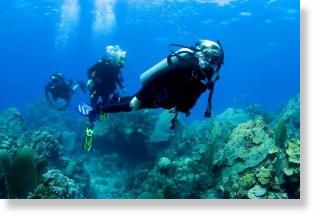
© iStockphoto/David SafandaBy combining data from 48 studies of coral reefs from around the Caribbean, researchers have found that fish densities that have been stable for decades have given way to significant declines since 1995.

By combining data from 48 studies of coral reefs from around the Caribbean, researchers have found that fish densities that have been stable for decades have given way to significant declines since 1995.

"We were most surprised to discover that this decrease is evident for both large-bodied species targeted by fisheries as well as small-bodied species that are not fished," said Michelle Paddack of Simon Fraser University in Canada. "This suggests that overfishing is probably not the only cause."

Rather, they suggest that the recent declines may be explained by drastic losses in coral cover and other changes in coral reef habitats that have occurred in the Caribbean over the past 30 years. Those changes are the result of many factors, including warming ocean temperatures, coral diseases, and a rise in sedimentation and pollution from coastal development. Overfishing has also led to declines of many fish species, and now seems to also be removing those that are important for keeping the reefs free of algae.

Fish

Chinese trawler catches unknown 10-ton fish

Beijing - Fishermen in the eastern Chinese province of Zhejiang caught on Thursday an unknown fish weighing more than 10 tons, the Sina news service reported.

The unusual fish, which was 12 meters (39 feet) in length and more than 1 meter in body diameter, was caught in a trawler's net and towed to the nearest port, where it was pulled from the water by a 15-ton cargo crane, the news service said.

Scientists will not get the opportunity to solve the mystery of the fish as it was sold to a Chinese man for about $220.

The world's biggest fish is believed to be Whale Shark (Rhinodon typus) which can often grow to 13.7 meters (45 feet) and 15 tons.

Frog

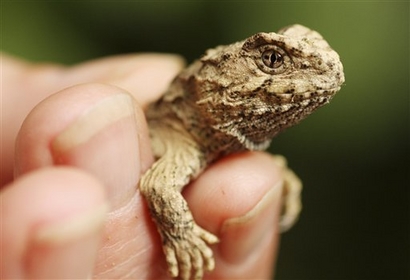
Rare reptile hatchling found on New Zealand

baby tuatara
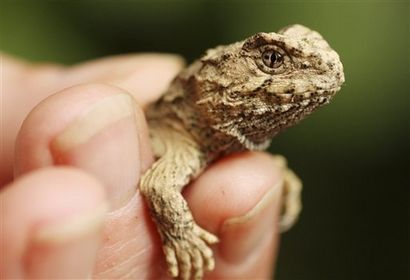
© AP Photo/Karori Wildlife Sanctury,Tom Lynch,HOIn this photo released by the Karori Wildlife Sanctuary, a baby tuatara is held by a staff at the Karori Wildlife Sanctuary in Wellington, New Zealand, Thursday, March 19, 2009.
A hatchling of a rare reptile with lineage dating back to the dinosaur age has been found in the wild on the New Zealand mainland for the first time in about 200 years, a wildlife official said Thursday.

The baby tuatara was discovered by staff during routine maintenance work at the Karori Wildlife Sanctuary in the capital, Wellington, conservation manager Raewyn Empson said.

"We are all absolutely thrilled with this discovery," Empson said. "It means we have successfully re-established a breeding population back on the mainland, which is a massive breakthrough for New Zealand conservation."

Tuatara are the last lizard-like descendants of a reptile species that walked the Earth with the dinosaurs 225 million years ago, zoologists say.


Fish

New "Rainbow Glow" Jellyfish Found

Rainbow Jellyfish
© Martin George/QVMAG
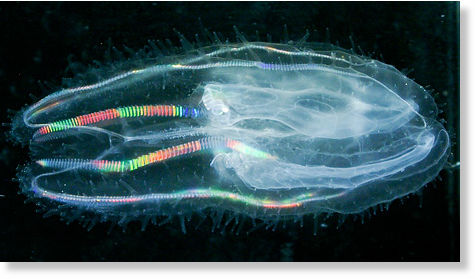
Look on the bright side - this luminous new jellyfish species doesn't sting.

Jellyfish expert Lisa Gershwin caught the unnamed species in early March while swimming near a jetty off the Australian island of Tasmania with a "phototank" - a small aquarium that makes it easy to photograph sea life.

The jellyfish does not emit its own light, as bioluminescent creatures do.

Rather, its rainbow glow emanates from light reflecting off the creature's cilia, small hairlike projections that beat simultaneously to move the jellyfish through the water.

Umbrella

US: Maine skiers warned about late-night owl attacks

Bangor - Cross-country skiers who set out on a crisp, moonlit night for a peaceful outing in Bangor's city forest are being targeted by a least one ornery and territorial owl. Over the past three weeks, at least eight skiers and a few romping dogs apparently have fallen victim to a great horned owl that swoops down from a tree with talons outstretched and smacks them on the head.

Ladybug

US: Colorado wages battle with bark beetles

As sunset softens the vast Colorado sky into warm shades of pink and blue, the sound of chainsaws jars the stillness of this remote and rugged wilderness.

A forest service team works quickly, felling dozens of dead or dying lodgepole pines, the majestic trees that have towered over this region for generations. They are locked in a race against the mountain bark beetle, a tiny insect the size of a rice kernel, which is devouring unprecedented swathes of woodland across the US and Canadian north-west.

"It has reached a level where we cannot do anything to stop the bark beetle," said Clint Kyhl, a bark beetle incident commander for the US Forest Service. "So now our main focus is mitigating the impact of all these dead and dying trees."

Bizarro Earth

India: Mysterious disease affects potato cultivation in West Bengal

Potato cultivators in Hooghly district of West Bengal are facing a crisis with the outbreak of a mysterious disease.

Farmers in Singur, which had caught the global limelight over agricultural land acquisition for the Tatas proposed Nano factory, are worrying about their uncertain future.

The farmers are very nervous. If the crops are good, they find surplus production on hand with no avenues for marketing. If the crops are poor, they do not have any other alternative to sustain their livelihoods.