Animals
S


Attention

US: What's killing the bats?

At least 1 million have died in the past three years from a mysterious disease, posing serious questions for our environment. But one Boston University biologist is leading the hunt for answers.

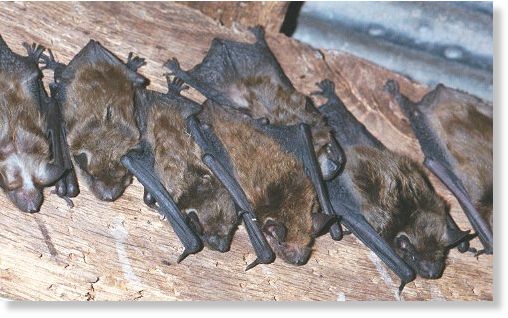
Big brown bats
© Unknown
Thomas Kunz emerges from Aeolus cave in East Dorset, Vermont, with a half-dozen metal ID bands -- smaller than SpaghettiOs -- cupped in the palm of his latex-gloved hand. They're tiny emblems of death, having once been affixed to the forearms of little brown bats.

The renowned bat biologist from Boston University, who bears a passing resemblance to Harrison Ford, minutes earlier had recovered the bands while trudging, like a real-life Indiana Jones, through a slippery mud-like ooze of rotting bat carcasses, liquefied internal organs, toothpick-sized bones, piles of guano, and a strange white fungus on the cave floor.

If bats had come out of hell, it couldn't have been worse than this.

"What we saw was bat soup. There were a lot of bones of wings and skulls and emulsified bodies," Kunz says. "There were dead bats -- decomposing bats -- hanging from the walls of the cave.

"My heart sunk," he says, noting some of the bands bore his initials, THK. "It was as if I had lost family members."

It's late August, when bats are in their swarming phase, and the 71-year-old Kunz and two fellow biologists have trekked, at night, in hard rain, with heavy gear, 2,520 feet up the rugged Taconic Mountains to Aeolus -- the largest bat hibernaculum in the Northeast -- to bleed live bats and collect samples for researchers leading the hunt for clues into the cause of mysterious bat deaths like these.

Fish

Jellyfish Swarm Northward in Warming World

Image
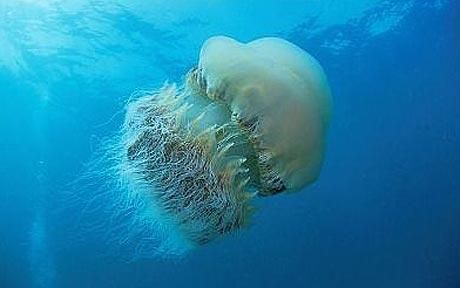
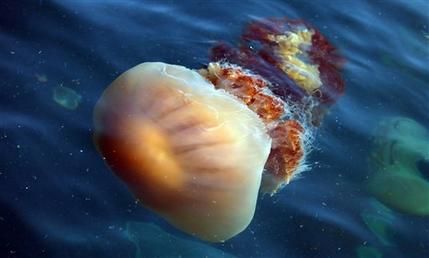
© AP Photo/Junji KurokawaA giant jellyfish drifting off Kokonogi in western Japan.
A blood-orange blob the size of a small refrigerator emerged from the dark waters, its venomous tentacles trapped in a fishing net. Within minutes, hundreds more were being hauled up, a pulsating mass crowding out the catch of mackerel and sea bass.

The fishermen leaned into the nets, grunting and grumbling as they tossed the translucent jellyfish back into the bay, giants weighing up to 200 kilograms (450 pounds), marine invaders that are putting the men's livelihoods at risk.

The venom of the Nomura, the world's largest jellyfish, a creature up to 2 meters (6 feet) in diameter, can ruin a whole day's catch by tainting or killing fish stung when ensnared with them in the maze of nets here in northwest Japan's Wakasa Bay.

"Some fishermen have just stopped fishing," said Taiichiro Hamano, 67. "When you pull in the nets and see jellyfish, you get depressed."

Stop

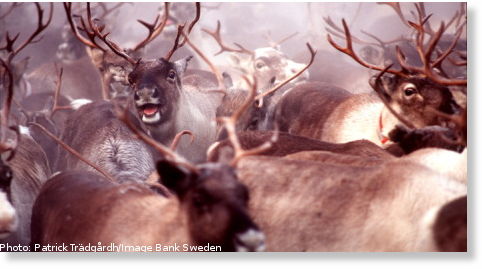
Reindeer herd drowns in icy Lapland waters

Image
© Patrick Tradgardh/Bank Sweden
More than 400 reindeer have drowned in a river in Jokkmokk in northern Sweden after thin surface ice cracked while the herd were moving to their winter pastures.

Reindeer herders in the region were taking around 3,000 animals across the river, a route that has been safely crossed on previous occasions.

"The ice suddenly gave way and hundreds of reindeer fell into the water," said Bertil Kielatis, chairman of the Sirges Sami village in Jokkmokk.

"Now we are working to recover the animals that have drowned," he added.

Fish

Last chance for Tuna - Tagging the tigers of the sea

Pablo Cermeño balances at the back of the small boat, legs braced, harpoon at the ready. Beneath him in the crystal waters his target is clearly visible: a shimmer of metallic turquoise that tacks left, right, left again as it is hauled inexorably towards the surface. The fisherman grunts and sweats as he does battle with the giant fish, reeling, pulling and reeling again.


Arrow Down

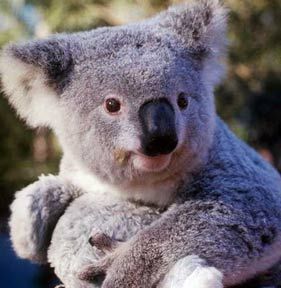
Koalas Face Extinction Within 30 years

Koala
© camelotbears.com
Australia's koalas could be become extinct within 30 years unless urgent action is taken to halt a decline in the population, researchers say.

Development, climate change and bushfires have all contributed in reducing the numbers of wild koalas. The sexually transmitted disease chlamydia has also played a part in the animal's demise. In the past six years alone the population may have dropped by half according to a survey carried out by the Australian Koala Foundation.

Previous estimates put the number of koalas at more than 100,000. However recent estimates show there may be as few as 43,000. The foundation collected field data from 1,800 sites and 80,000 trees to calculate the numbers. In one area in northern Queensland estimated to have 20,000 koalas a decade ago, a team of eight people could not find a single animal in four days of searching.

Binoculars

Rare Brown Panda Cub Discovered

A rare brown baby giant panda has been discovered by researchers in northwest China, according to China Business View today.

The two-month old baby has brown fur where normal pandas sport black. The cub still hasn't opened its eyes nor walked, said experts with Foping Giant Panda Reserve in Shaanxi Province.

The baby's mother is a normal color, said Liang Qihui. The brown panda is the fifth to be recorded in China, he said.

Scientists are still not sure why some rare pandas have brown fur, the report said. The first brown giant panda was also found in Foping in 1985.

Dandan was sick when discovered and was taken back to the Panda Study Center. She later gave birth to three normal giant pandas, yet all died young.

Fish

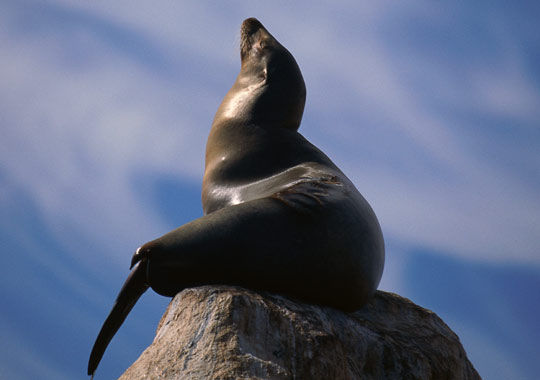
Sea Lion Brain Mapped to Study Toxins' Effects

sea lions
© Getty ImagesChemicals pollutants are causing brain damage in sea lions. However, a new anatomical atlas of these animals may help to identify exactly how they are being affected.
The first detailed anatomical atlas of a living wildlife species has been constructed by researchers.

Mapping the California sea lion's (Zalophus californianus) brain with a combination of magnetic resonance imaging (MRI) and volumetric measuring, scientists want to better understand how toxins in the water are causing neurological damage among marine mammal populations.

Eric Montie, a postdoctoral researcher at the University of South Florida, spearheaded the study, which was published in The Anatomical Record in October.

The brain atlas is a first step toward determining whether exposure to manmade chemicals, such as DDT and polychlorinated biphenyls (PCBs), increase California sea lions' susceptibility to life-threatening brain damage from domoic acid, a neurotoxin naturally produced by certain types of algae.

Fish

Japanese Fishing Trawler Sunk by Giant Jellyfish

Image
Nomura's jellyfish: The crew of the fishing boat was thrown into the sea when the vessel capsized, but the three men were rescued by another trawler
The trawler, the Diasan Shinsho-maru, capsized off Chiba as its three-man crew was trying to haul in a net containing dozens of huge Nomura's jellyfish.

Each of the jellyfish can weigh up to 200 kg and waters around Japan have been inundated with the creatures this year. Experts believe weather and water conditions in the breeding grounds, off the coast of China, have been ideal for the jellyfish in recent months.

The crew of the fishing boat was thrown into the sea when the vessel capsized, but the three men were rescued by another trawler, according to the Mainichi newspaper. The local Coast Guard office reported that the weather was clear and the sea was calm at the time of the accident.

Bizarro Earth

Algae foam killing thousands of sea birds

Image
© UnknownThe bloom, which poses no threat to people or pets, has killed thousands of birds since mid-September from northern Oregon to Washington's Olympic Peninsula, Schirato said.
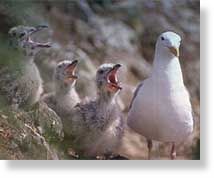
Foam from an unusual algae bloom has killed thousands of birds along the Oregon and Washington coasts in recent weeks, marine biologists said.

Akashiwo sanguinea, a single-cell algae or phytoplankton, strips the birds of their natural waterproofing, said Julia Parrish, a marine biologist and professor at Washington State University.

"It's the largest mortality event of its kind on the West Coast that we know of," Parrish told The (Portland) Oregonian in a story published Friday. "We're getting counts of up to a million cells per liter of water," she said. "Think about that. That's pretty dense."

Storms have whipped the algae into a substance similar to a sticky soap, which washes off the birds' protective waterproofing oils and causes them to die of hypothermia, said Greg Schirato, a manager for the Washington Department of Fish and Wildlife.

Frog

'Gatorade for frogs' could stymie fungal killer

The fungus now decimating frog populations around the world does its damage by impairing the animals' ability to absorb electrolytes through their skin. This discovery may eventually lead to treatments that make the disease less lethal.

Biologists now generally agree that the fungal disease known as chytridiomycosis is responsible for the worldwide die-off of frogs that has caused a conservation crisis in recent years. However, the fungus affects only the outer layers of the skin, leaving few clues to why it is so lethal.

But now Jamie Voyles of James Cook University in Townsville, Australia, and colleagues have an answer. In diseased frogs, the skin's ability to take up sodium and potassium ions from the water decreases by more than 50 per cent, they found. As a result, the concentration of these two ions in the frogs' blood fell by 20 and 50 per cent, respectively. This ion loss - similar to the hyponatraemia that a human athlete might experience from drinking too much water too fast - eventually leads to cardiac arrest and death.