Animals
S


Binoculars

World's Most Ancient Creatures Found in Scottish Field

Image
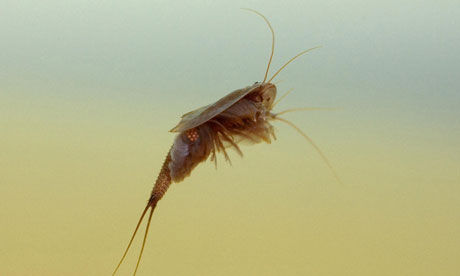
© Edmund Fellowes/Press AssociationThe tadpole shrimp, Triops cancriformis, which was part of two colonies found at Caerlaverock on the Solway Coast of Dumfriesshire.
Two colonies of age-old and endangered tadpole shrimps discovered alive and well near Solway coast

A field near Gretna in Dumfriesshire might not be an obvious place to find the world's oldest living creatures, but a team of scientists has done just that.

Two colonies of a prehistoric shrimp that evolved when the dinosaurs ruled the Earth have been found alive and well in the Caerlaverock nature reserve on the Solway coast.

The discovery has led experts to think there could be more of the little crustaceans, which are listed as endangered species, elsewhere in the area.

The ancient creatures, known as Triops cancriformis or tadpole shrimps, are thought to have the oldest pedigree of any living animal. Fossil evidence suggests they have hardly changed in the more than 200m years that they have been around.

Attention

Plankton, Base of Ocean Food Web, in Big Decline

Washington - Despite their tiny size, plant plankton found in the world's oceans are crucial to much of life on Earth. They are the foundation of the bountiful marine food web, produce half the world's oxygen and suck up harmful carbon dioxide.

And they are declining sharply.

Worldwide phytoplankton levels are down 40 percent since the 1950s, according to a study published Wednesday in the journal Nature. The likely cause is global warming, which makes it hard for the plant plankton to get vital nutrients, researchers say.

The numbers are both staggering and disturbing, say the Canadian scientists who did the study and a top U.S. government scientist.

Binoculars

Montana, US: Woman Recounts Bear Attack as Caught Grizzly ID'd

Image
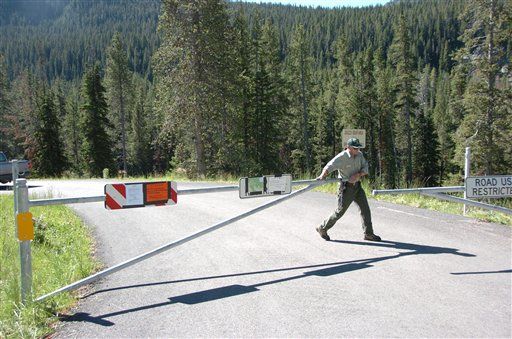
© Matthew Brown/AP PhotoAn unidentified U.S. Forest Service Employee closes the gate at the entrance to the Soda Butte Campground in Cooke City, Mont., Thursday, July 29, 2010.
One of the survivors of a deadly grizzly bear attack said Thursday she realized her only hope was to play dead after feeling the bear's jaw clamp onto her arm in the middle of the night.

Wildlife officials were testing the DNA of a bear captured at the site of the early Wednesday mauling to confirm it was the animal that also killed a Michigan man and hurt another camper near Yellowstone National Park, but they said they were confident they had caught the right animals.

"Something woke me up, and a split second later, I felt teeth grinding into my arm," Deb Freele of London, Ontario, said from her bed at a Wyoming hospital. "I realized, at that split second, I was being attacked by a bear, but I couldn't see it.

"It was behind me and I screamed. I couldn't help it - it's kind of like somebody else was screaming," she told The Associated Press. "And then it bit me harder, and more. It got very aggressive and started to shake me."

Bug

Britain "Facing Tarantula Invasion," RSPCA Warns

Image
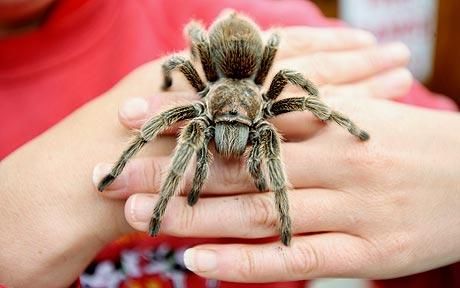
© CascadeRebecca Hall holds the Chilean rose tarantula at Smithills Open Farm
Britain could be facing a tarantula invasion after a number of the spiders were discovered in gardens in some parts of the country, wildlife experts have warned.

The RSPCA has issued an alert urging people to be on their guard amid fears a large batch of the spider has escaped in the north of the country.

The alert came after two separate incidents involving 10cm-wide Chilean Rose tarantulas in Bolton, Greater Manchester.

The rare arachnids, capable of blinding people by spitting hairs in their eyes, were both found in back gardens within two miles of each other.

Both spiders are the same age, breed and gender.

Bizarro Earth

New Zealand: Snapper Wash Up in Mystery Incident

Mystery Incident
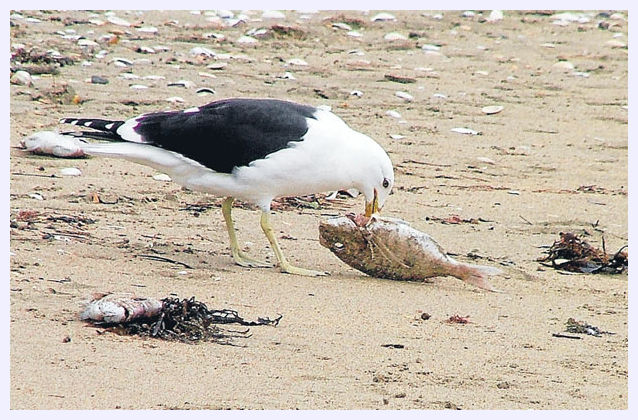
© Stuff.co.nzFish Supper: A seagull feasts on one of the hundreds of snapper washed up on Oneroa Beach.

The Ministry of Fisheries is asking for help from Waiheke residents after hundreds of fish were washed up on one of the island's beaches.

Walkers on Oneroa Beach last Thursday were stunned to discover dead snapper "every couple of steps".

While seagulls enjoyed a five-star feast, an honorary fisheries officer visited the beach to count and check the size of the specimens.

Ministry field operations manager Greg Keys says the incident is under investigation but there are many possible causes.

To rule out one possibility - whether the fish had been poisoned by algae - some of them will be tested for poison.

But Mr Keys says the fish could have escaped from a split net from a commercial fishing boat. Mr Keys says he has heard reports of similar occurrences on the Coromandel.

"It can happen accidentally from split nets or when there are too many fish and they spill over the side of the net, or the fishing boat might dump them."

Meanwhile, Department of Conservation marine ranger Guy Toogood says he understands the fish were too small to have come from a commercial take.

Butterfly

How Monarchs Fly Away Home

Image
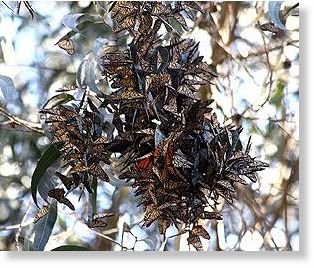
© UnknownBiologists had suspected that monarchs fly back from Mexico west-to-east over the Appalachians but no evidence existed to support the theory.
Monarch butterflies - renowned for their lengthy annual migration to and from Mexico - complete an even more spectacular journey home than previously thought.

New research from the University of Guelph reveals that some North American monarchs born in the Midwest and Great Lakes fly directly east over the Appalachians and settle along the eastern seaboard. Previously, scientists believed that the majority of monarchs migrated north directly from the Gulf coast.

The study appears in the recent issue of the scientific journal Biology Letters.

"It's a groundbreaking finding," said Ryan Norris, a Guelph professor in the Department of Integrative Biology who worked on the study with his graduate student Nathan Miller and two researchers from Environment Canada.

Binoculars

Baboons Learn to Listen for Cars Central Locking Tweet Before Breaking In

Image
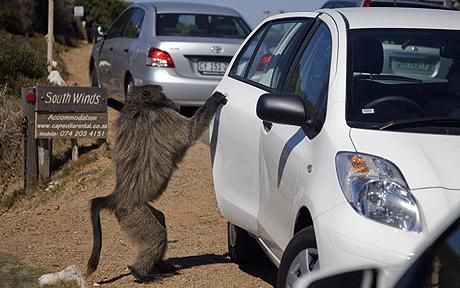
© Getty ImagesIf the Baboons haven't heard the telltale 'tweet' of the locking system, they sneak over and open the car door to plunder its contents
Baboons in Cape Town have learned to listen out for the tweet of a car's remote central locking before deciding whether to break in to search for food, according to the local authorities.

The highly intelligent animals lie in wait as tourists get out of their car to gaze at the view from Cape Peninsula - the thin finger of land in the south westernmost corner of South Africa that juts out into the Atlantic Ocean.

Then, if they haven't heard the telltale "tweet" of the locking system, they sneak over and open the car door to plunder its contents.

So many picnics have now been lost to the simian raiders that the local authorities are pushing the government to commission an official baboon warning road sign as they have done for hippos, elephants, warthogs and kudus.

Theuns Vivian, Cape Town's Destination Development Manager, said humans and baboons would get along fine provided they were equally aware of each other.

Arrow Down

Amazon River Dolphins Threatened with Extinction

Image
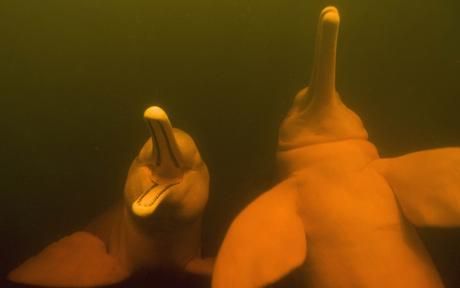
© Kevin Schafer/Barcroft A pair of Boto, or Amazon river dolphins in Rio Negro, Amazonia, Brazil.
The pink dolphins of the Amazon are being threatened with extinction as fishermen kill them to use their flesh as bait.

Scientists believe that 1,500 dolphins are being killed annually in the western Amazon to fuel a lucrative trade in catfish, which feeds on dead animals.

"The population of the river dolphins will collapse if these fishermen are not stopped from killing them," said Vera da Silva, the top aquatic mammals expert at the government's Institute of Amazonian Research.

"We've been studying an area of 27,000 acres for 17 years, and of late the population is dropping seven per cent each year."

The dolphins, which can be eight feet long and weigh the same amount as an adult man, are the largest of four species known to exist in South America and Asia. The cause of their pinkish hue is debated, with some scientists saying it is due to blood vessels being close to the skin and others citing scarring as the reason for their coloring.

Question

Forty-Ton Whale Lands on Yacht During Cape Town Sailing Trip

Image
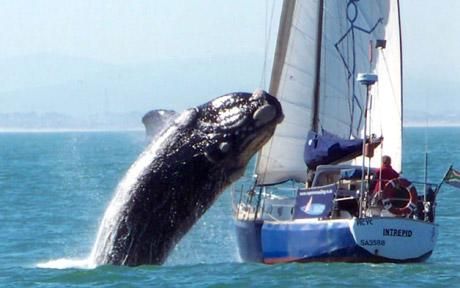
© The TelegraphThe 40-ton whale crash-landed on couple's boat.
A couple who took a yacht for a quiet sailing trip were stunned when a 40-ton whale crash-landed on their boat off Cape Town.

The pair were enjoying calm seas off the South African coast when the animal flipped into the air and smashed into their mast.

Ralph Mothes, 59, and Paloma Werner, 50, were helpless as the beast thrashed around on their 33ft vessel before slipping back into the water.

Miss Werner said: "It really was quite incredible but very scary. The whale was about the same size as the boat.

"We'd spotted it about 100 metres away and thought that was the end of it. Then suddenly it was right up beside us.

"I assumed it would go underneath the boat but instead it sprang out of the sea. We were very lucky to get through it, as the sheer weight of the thing was huge.

Arrow Down

Mysterious Plague Killing Off Bats, Bugs Get Free Rein

Image
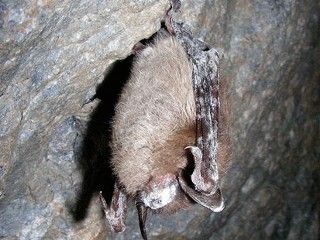
© Marvin Moriarty/U.S. Fish and Wildlife ServiceThis little brown bat is seen hibernating in Greeley Mine, Vermont with the white fungus visible on its muzzle, wings, and ears.
Experts Don't Know How To Stop Spread of Deadly Fungus

A spreading plague has killed more than a million bats across the eastern U.S., and wildlife experts have no clue how to stop it.

As it rolls across the country and into Canada, the mysterious fungus threatens to disrupt the ecological balance, which could result in the spread of bugs that destroy crops and force swatting barbequers to flee indoors.

Called White-Nose Syndrome because of the white substance found on the noses of bats, it causes bats to move around and burn calories during the winter months when they should be hibernating and reserving energy. Scientists are not exactly sure why the fungus affects bats, where it came from originally, or how to stop its spread. One thing is for sure -- bat populations are being decimated by the fungus. Among some bat species, the mortality rate is 99 percent.

"There might be regional extinctions of particular bat species," said Noelle Rayman, assistant national White-Nose Syndrome coordinator at the U.S. Fish and Wildlife Service, told ABCNews.com.