Comets


Meteor

Comet Garradd Still Going Strong

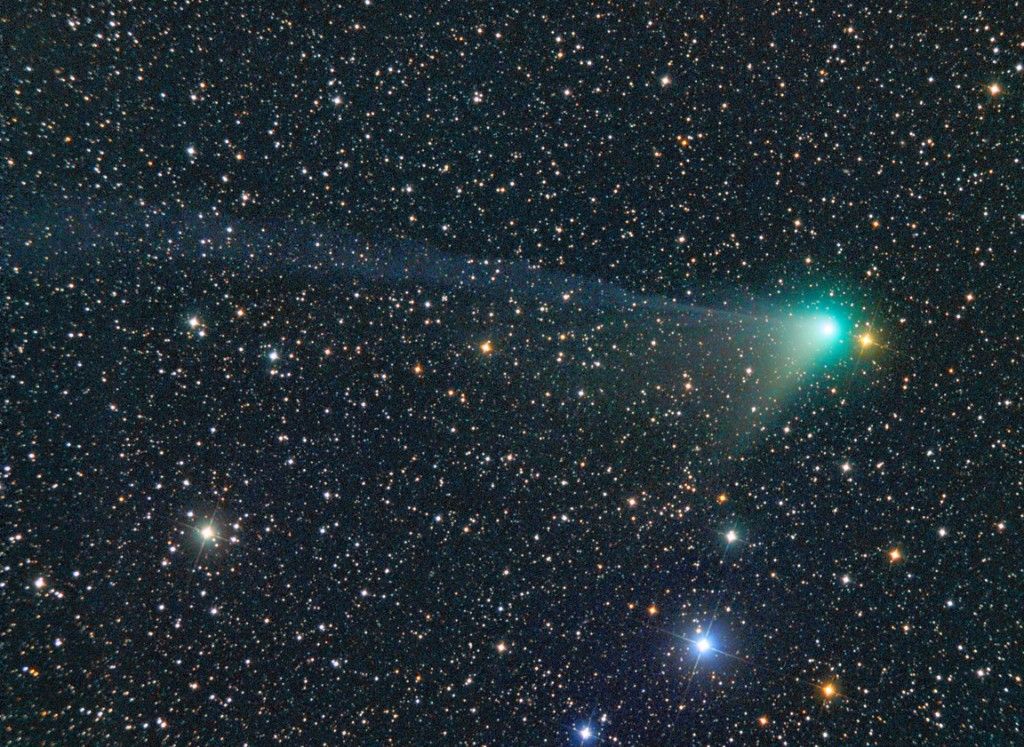
Comet Garradd on November 19
© Michael JaegerComet Garradd on November 19 shows a classic dual tail. The longer, blue streak is the ion tail. The dust tail is shorter and glows pale yellow from reflected sunlight.
Remember Comet Elenin? Hopes were high it would become the best comet of 2011, but instead it dissolved into a cloud of dust. Amateur astronomers are still tracking its fading remnants as the comet passes the Pleiades star cluster in Taurus this week.

The brightest comet of the year never received the dire publicity that stuck with Elenin to the end. Comet Garradd was well-placed and easily visible in binoculars this summer as it crossed the Milky Way en route to its current residence in the sprawling constellation Hercules. Underdog Garradd remains a 7th magnitude fuzzball in binoculars this month. I looked it up recently on one of the few clear nights we've had in November and was thrilled to see two tails sticking out of the comet's bright, fuzzy head or coma. Both show wonderfully in Michael Jaeger's photo and were just as pretty in my 15-inch scope though much more subtle.

Meteor

Sun Diving Comet, October 30th

A small comet dove into the sun during the late hours of Oct. 30th. Blasted by intense solar heat, the 'dirty snowball' disintegrated in plain view of the Solar and Heliospheric Observatory (SOHO). Watch the movie below and note how the comet shrinks to a pinprick just before it vanishes.


Meteor

Comets - Not What We Expected

This video highlights recent discoveries about comets that shatter existing theories in favour of the Electric Comet Theory.

Supporting documentation and links to all the NASA quotes, web sites, and papers used in the video can be found here.

Part 1

Meteor

Best of the Web: Three for the Show: Assessing the Potential Effects of Comets Elenin, Levy and Honda

Three For The Show Pt.1

August 16, 2011

Intro

Image
I sat down today with the full intention of writing about the comet Elenin. I started my research, first speaking with my very close friend and associate, Raymond Ward. He's incredibly informed and talented. I went through page after page on the Internet. The comments and the conclusions about these three comets that are coming put me over the top. I know, I know... We have published some pretty over the top kind of material ourselves. But we were really one of the first sites to challenge the status quo on the Internet. So what. Anyway...

One site was very slick, cool looking and had a lot of opinions; a beautifully designed and organized page. Another belonged to a former TMG friend/member, not very well done. But... well... I was going to write something very crass and very nasty... But I'll keep my boundaries intact! I'll let his design and conclusion stand for themselves and like we always say, 'you decide for yourself'! Anyway...

If you're reading this page, you are more likely than not going to be a return visitor. So you know more than the usual reader concerning comets and astronomy (but if you're new, welcome! read on!). But let me cut to the chase, save you some time, give you the facts and let you deal with what I've got to say. Here are the particulars we have seen:
1. Comets Elenin
2. Dramatic increase in the number of earthquakes
3. Dramatic increase in the number of strong earthquakes
4. Elenin positions and EQ dates coincide
5. We have been documenting clashes in our upper atmosphere
6. There has been some evidence larger ships have been over EQ sites
7. It now appears that there are three comets coming into a "conjunction" in the very near future

Meteor

Comet Elenin cloud corpse spotted in space

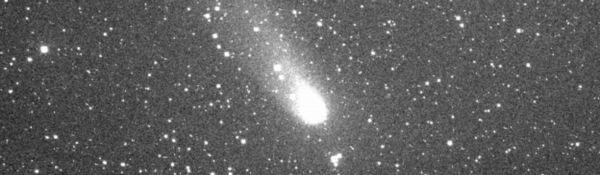
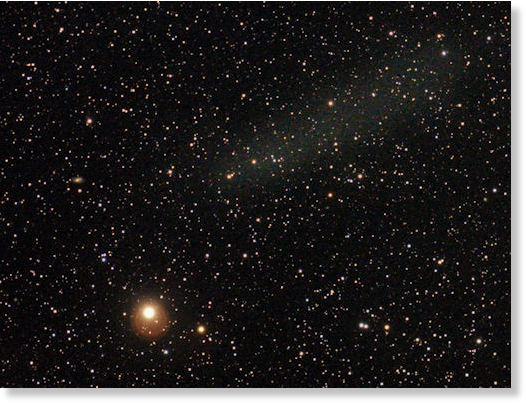
"Doomsday Comet" Elenin was briefly famous for inaccurate predictions that it might hit Earth. Instead it disintegrated as it approached the sun last month. (Doomsday canceled.) Over the weekend, Italian astronomer Rolando Ligustri spotted the comet's remains. It's the elongated cloud in this Oct. 22nd photo of the star field where Elenin would have appeared if it were still intact:

Image
© Rolando Ligustri
Another team of astronomers--Ernesto Guido, Giovanni Sostero and Nick Howes--spotted the cloud on the same night. At first they were skeptical. "The cloud was extremely faint and diffuse," says Guido. "We wondered if it might be scattered moonlight or some other transient artifact." But when the team looked again on Oct. 23, the cloud was still there. A two-night blink animation shows that the cloud is moving just as the original comet would have. Note: Some readers have noticed a fast-moving streak to the to the lower right of the debris cloud. That is an unrelated asteroid, 2000 OJ8 (magnitude 14), which happened to be in the field of view at the same time as the cloud of Elenin.

Meteor

Faulkes Team Images Trojan Jupiter Comet

New Comet
© Universe Today

Jupiter Comet

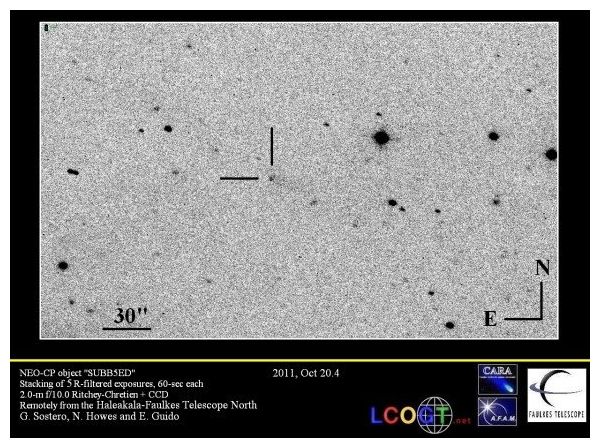
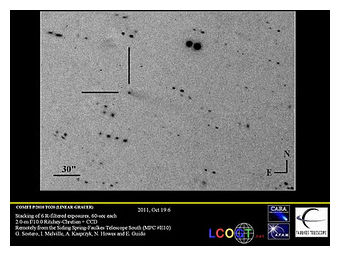
Based on an observation posted on the Near Earth Object confirmation page from an image taken by A. D. Grauer using the mount Lemmon observatory, Faulkes telescope team members Nick Howes, Giovanni Sostero and Ernesto Guido along with University of Glamorgan student Antos Kasprzyk and amateur astronomer Iain Melville, imaged what is potentially some of the first direct evidence for a Trojan Jupiter Comet.

Comet P/2010 TO20 (LINEAR-GRAUER) was immediately recognised by the team from looking at the orbit to be a highly unusual object, but it was only when the images came through from the Faulkes observations that the true nature of the object became clear.

The observations showed a distinct cometary appearance, with a sharp central condensation, compact coma and a wide, fan-shaped tail.

This is no ordinary comet, and supports the theory and initial spectral observation work by a team using the keck telescope in Hawaii. Closer analysis of their object (part of a binary known as the Patroclus pair) showed that it was made of water ice and a thin layer of dust, but at the time of writing, no direct images of a Jupiter Trojan showing evidence of a coma and tail had been taken.

The Faulkes teams above image, combined with the original observations by Grauer clearly show a cometary object, thus confirming the Keck team's hypothesis.

Meteor

Comets are raining down water on neighbouring Eta Corvi solar system

Image
© NASA/JPL-Caltech
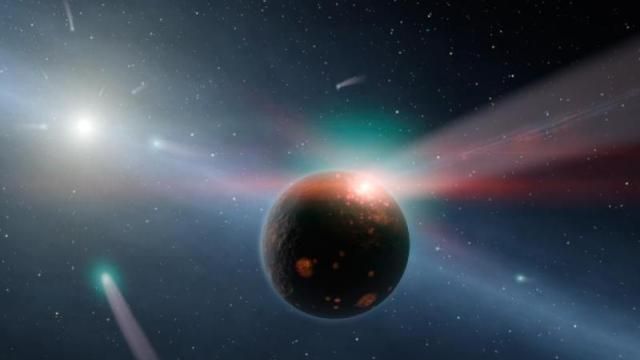
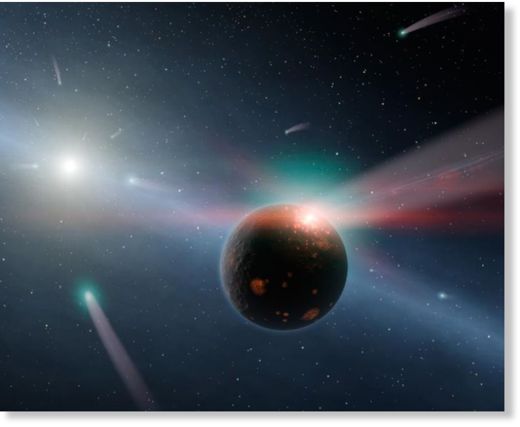
The Eta Corvi solar system is like a window into how our own solar system looked billions of years ago. All of Eta Corvi is being bombarded by giant comets - the exact same process that created Earth's oceans.

What's more, observations by NASA's Spitzer telescope show signs of huge dust clouds close to the system's star. The most obvious way to create dust clouds like that is if a huge comet collided with a planet near the star. Analysis of the light coming from the dust suggests it's composed of water ice, organic compounds, and rock, all of which points very strongly to a big comet.

We can't be sure, but it's certainly possible that this comet actually hit a planet located in Eta Corvi's habitable zone. If that's the case, then we're witnessing what is essentially a reenactment of the formation of our planet's oceans. Earth got huge amounts of its water and carbon-based organic compounds during an epoch known as the Late Heavy Bombardment, in which comets from the Kuiper Belt beyond Neptune began hurtling towards the inner solar system due to gravitational disturbances from Jupiter and Saturn.

Meteor

New Comet Discovered: P/2010 TO20 (LINEAR-GRAUER)

Linear-Grauer
© Remanzacco Observatory

Cbet nr.2867, issued on 2011, October 21, announces the discovery of a new comet (discovery magnitude 19.1) by A. D. Grauer on CCD images obtained on September 19, 2011 with the Mount Lemmon 1.5-m reflector.

According to the CBET: "After two nights of observations of Grauer's comet had been received at the Minor Planet Center, T. Spahr realized that this object was identical with an object discovered a year ago by the LINEAR project (discovery observation tabulated below; cf. MPS 351583) that appeared to be a Jupiter Trojan minor planet."

The new comet has been designated P/2010 TO20 (LINEAR-GRAUER).

We performed follow-up measurements of this object on 2 different nights, while it was still on the neocp.

Arrow Down

Mainstream Science catching up: Most Planets' Oceans are Probably Seeded by Comets

Image
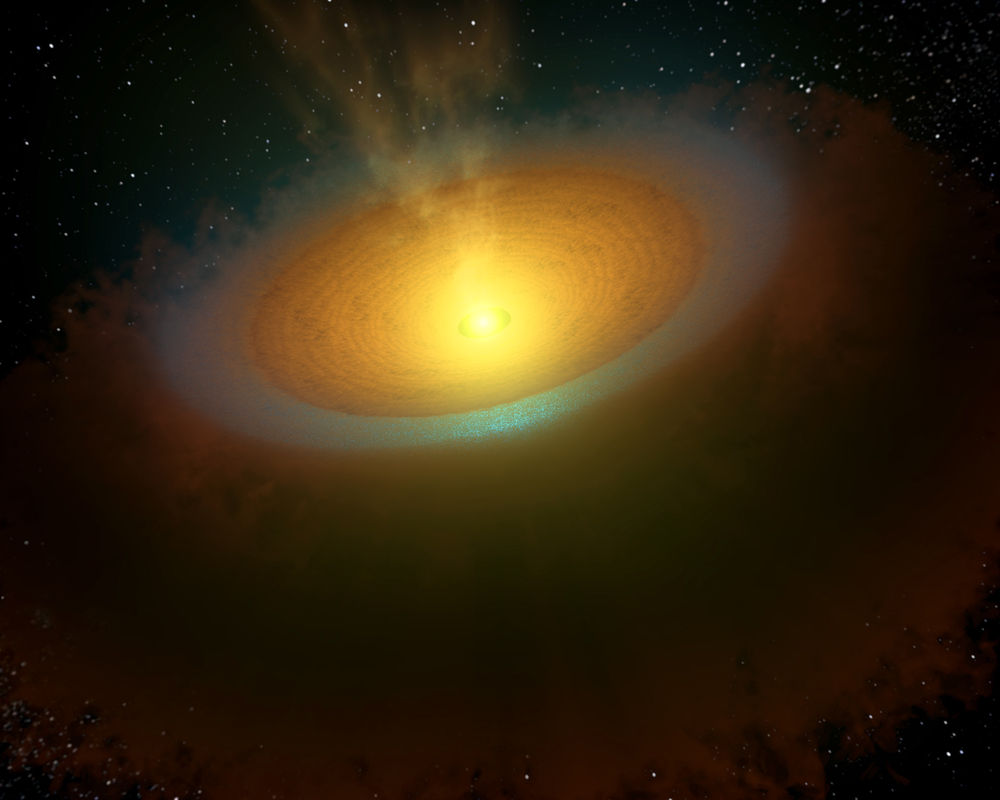
© NASA/JPL-CaltechArtist's concept illustrating an icy planet-forming disk around the star TW Hydrae, located about 175 light-years away in the constellation Hydra. Astronomers found huge stores of cool water vapor (illustrated in blue) in the frigid outer regions of the star system, where comets will take shape.
A still-forming alien solar system has enough water in its outer reaches to fill Earth's oceans several thousand times over, a new study finds.

The discovery marks the first time astronomers have detected water in a dusty planet-forming disk so far from its central star, in the frigid region where comets are born. Scientists think comet impacts delivered most of Earth's water, and the new study hints that alien planets may commonly acquire oceans in the same way.

"We now know that large amounts of water ice are available in planet-forming disks, ready to be incorporated in comets," said Michiel Hogerheijde, of Leiden Observatory in the Netherlands, the study's lead author. "Ultimately, some of this water may end up on Earth-like planets that form completely dry but this way may end up with life-supporting oceans."

Meteor

Comet Armageddon Detected in Nearby Star System

Image
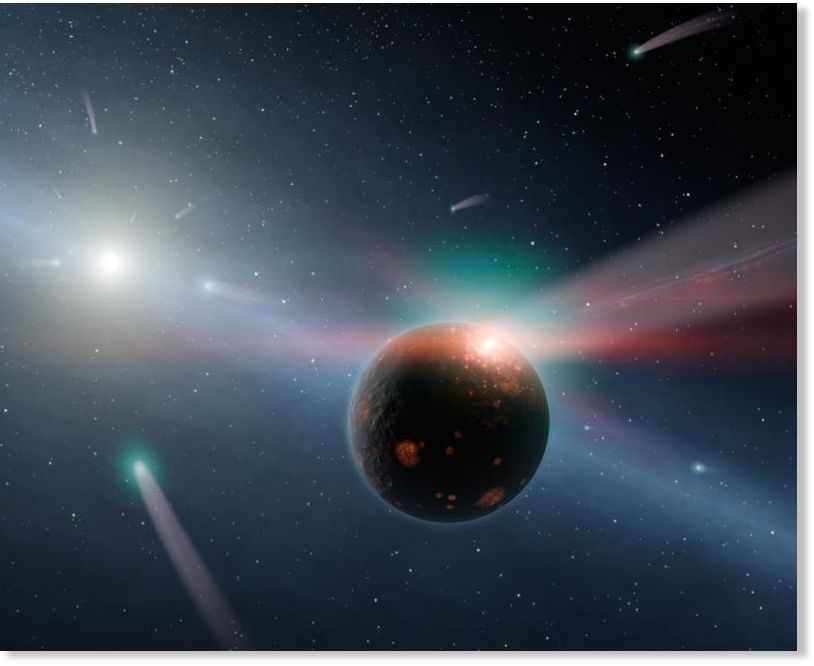
© NASA/JPL/Cal-TechA nearby star system is currently going through hell, as hinted at by NASA's Spitzer Space Telescope. Through its infrared eye, Spitzer has detected the dusty remains of comet impacts around the star Eta Corvi -- reminding us what it must have been like during the early evolution of our own solar system.
During our solar system's "Late Heavy Bombardment" (LHB) some four billion years ago, the inner planets were constantly peppered with massive comets impacting their surfaces. Earth would have been unrecognizable -- the planet's surface was a burning, molten mess; young atmosphere constantly punctuated by incoming cometary fragments.

Devoid of any eroding atmosphere, the moon's surface bears the scars of this epic cometary onslaught -- huge impact craters providing a reminder of how violent the "early years" of our solar system really was.

Despite the continuous cycle of cataclysmic impact events generating a hellish cauldron on Earth, the LHB has been linked with the genesis of life -- evidence points to a cometary source for the organic ingredients. Needless to say, the growing pains inflicted by the LHB on our planet is of huge importance to scientists.

Therefore, to spot the signs of similar cometary bombardments in other star systems would be pretty awesome. Not only would that help us understand the evolution of planetary systems orbiting other stars, it would provide a "time capsule" for us to have a glimpse of the early life of our own solar system. Of course, it would also give us an idea of how many other stars could be "ripe" for life (as we know it).

Now, scientists using observations by Spitzer have detected cometary Armageddon around Eta Corvi, a star some 50 light-years away in the constellation Corvus.