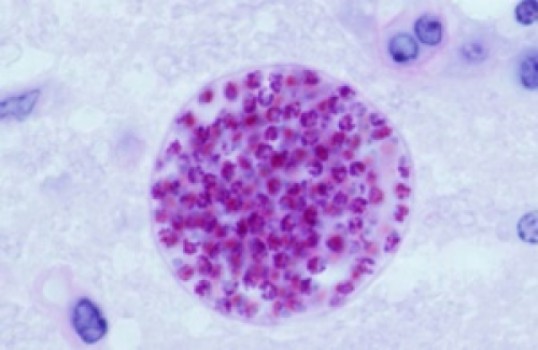
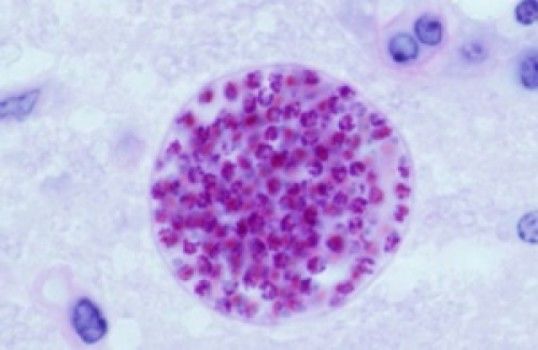
© University of PennsylvaniaThe parasite T. gondii has been shown to alter behavior in rodents. Smith's study supports a link to schizophrenia in humans.
Many factors, both genetic and environmental, have been blamed for increasing the risk of a diagnosis of schizophrenia. Some, such as a family history of schizophrenia, are widely accepted. Others, such as infection with
Toxoplasma gondii, a parasite transmitted by soil, undercooked meat and cat feces, are still viewed with skepticism.
A new study by Gary Smith, professor of population biology and epidemiology at the University of Pennsylvania's School of Veterinary Medicine, used epidemiological modeling methods to determine the proportion of schizophrenia cases that may be attributable to
T. gondii infection. The work, published in the journal
Preventive Veterinary Medicine, suggests that about one-fifth of cases may involve the parasite.
"Infection with Toxoplasma is very common, so, even if only a small percentage of people suffer adverse consequences, we could be talking about problems that affect thousands and thousands of people," Smith said.
In the United States, just over a fifth of the population is infected with
T. gondii.
The vast majority aren't aware of it. But there are some populations that need to be concerned. For example, if a woman becomes infected for the first time during pregnancy, her fetus can die or suffer serious developmental problems. People with HIV or other diseases that weaken the immune system are susceptible to a complication of
T. gondii infection called toxoplasmic encephalitis, which can be deadly.
Though the medical community has long believed that most healthy people suffer no adverse effects from a T. gondii infection, recent studies have found evidence of worrisome impacts, including an association with schizophrenia because the parasite is found in in the brain as well as in muscles. Other work has shown that some antipsychotic drugs can stop the parasite from reproducing. In addition, field and laboratory studies in mice, rats and people have shown that
infection with T. gondii triggers changes in behavior and personality.

















Comment: Read more:
Toxoplasmosis Parasite May Trigger Schizophrenia And Bipolar Disorders
Brain parasite hosted by cats linked to increased suicidal behaviour threat: study
Scientists claim 40% of population infected with "mind control parasite"
You are what you're infected with?