TAIPEI, Taiwan - A strong earthquake struck off the eastern coast of Taiwan Thursday, rocking buildings in the capital Taipei.
There were no immediate reports of injuries or damage.
The Central Weather Bureau measured the quake at 6.2-magnitude.
Rebecca Palsha
KTUU.comThu, 25 Jan 2007 08:52 UTC
Anchorage, Alaska - Anchorage has been hit with more than 74 inches of snow this season, and according to the city, it's reaching a crisis level, with snow removal on the streets becoming a big problem.
The roads are looking smaller these days around town, as two-lane roads are quickly becoming one. The city can plow the roads, but where it can remove the snow to another location is a problem.
Taipei - A strong earthquake measuring 6.2 on the Richter scale shook eastern Taiwan on Thursday, but there were no immediate reports of casualties or damage, seismologists and police said.
'The quake with a depth of 5 kilometres occurred undersea at 6:59 pm (1059 GMT). It was located 61.9 kilometres south-east of Taitung in eastern Taiwan,' the Earthquake Centre under the Central Weather Bureau said in a news release.
THE strange death of 11 seagulls in Aylesbury remains unresolved this week, despite investigations by wildlife experts.
The Bucks Herald launched an inquiry after we were contacted by a number of readers who discovered the dead birds - all in the Southcourt area of the town.
"Picture Japan, suffering from flooding along its coastal cities and contamination of its fresh water supply, eyeing Russia's Sakhalin Island oil and gas reserves as an energy source . . . Envision Pakistan, India and China - all armed with nuclear weapons - skirmishing at their borders over refugees, access to shared river and arable land."
This might look like the minutes from a meeting of Hollywood executives. In fact, it is from a Pentagon memo on the possible consequences of global warming. Climate change is not just an environmental question, it could have a massive impact on international security.
OSLO - Confronted by new evidence of global warming, will people react like frogs?
According to an often-told story, a frog will try to jump out if you drop it into hot water but the hapless creature will stay, and eventually die, if you put it in a pan of cool water and slowly bring it to a boil.
A United Nations report to be released in Paris on Feb. 2 will include the strongest warning yet that humans are stoking global warming that may cause colossal damage to nature if, like the doomed frog, they ignore rising temperatures.
Ex-US Vice President Al Gore tells the story with croaking cartoon frogs in his movie 'An Inconvenient Truth' to urge more action to save the planet. In his version, a hand dips in and rescues a swooning frog just as the water starts to bubble.
"It's important to rescue the frog," he says. And UN officials also sometimes mention the boiled frog as a cautionary tale of the dangers of human complacency about global warming.
There is only one problem -- it's not true.
"The 'boiled frog'...is definitely an urban myth," said Victor Hutchison, a professor emeritus at the zoology department at the University of Oklahoma in the United States.
"I have investigated the thermal tolerance in reptiles and amphibians for many years. If one places the animal in a container and slowly heats it, the animal will at some point invariably try to escape," he told Reuters.
BANGKOK - Nearly half of the world's waterbird species are in decline, mostly because of rapid economic development and the effects of climate change, according to a global survey released Tuesday.
The fourth Waterbird Population Estimate found that 44 per cent of the 900 species globally have fallen in the past five years, while 34 per cent were stable, and 17 per cent rising.
APTue, 23 Jan 2007 06:50 UTC
Human-caused global warming is visible in the air, water and melting ice and destined to get much worse in the future, an authoritative world report will warn.
"The smoking gun is definitely lying on the table as we speak," said top US climate scientist Jerry Mahlman, who reviewed all 1,600 pages of the first segment of a giant four-part report. "The evidence ... is compelling."
Andrew Weaver, a Canadian climate scientist and study co-author, went even further: "This isn't a smoking gun. Climate is a battalion of intergalactic smoking missiles."
The first phase of the Intergovernmental Panel on Climate Change is being released in Paris next week.
The segment, written by more than 600 scientists and reviewed by another 600 experts and edited by bureaucrats from 154 countries, includes "a significantly expanded discussion of observation on the climate", said co-chairman Susan Solomon, a senior scientist for the US National Oceanic and Atmospheric Administration.
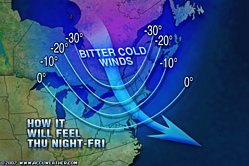
Comment: More and more talk of "global warming", yet precious few are making clear that the effect will be dramatic cooling in large areas.
See here for more.








Comment: See: Fire and Ice: The Day After Tomorrow...