Earth ChangesS


Coffee

Scientists find that VOLCANOES were responsible for past increases in atmospheric CO2 levels

Image
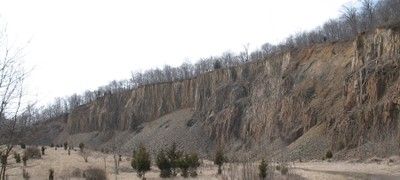
© Morgan Schaller, Rutgers UniversityOutcroppings like this one near Martinsville, New Jersey, US allow geologists to read geological history with the naked eye.
Pour enough magma out through Earth's crust, and you can change the atmosphere radically.

Twenty thousand years of massive volcanic eruptions doubled the level of carbon dioxide (CO2) in Earth's atmosphere 200 million years ago, according to research by Rutgers geologists published recently in the journal Science.

Morgan Schaller, Jim Wright and Dennis Kent report that the level of atmospheric CO2 went from about 2,000 parts per million to 4,000 parts per million and then shrank back to pre-eruption levels over the next 300,000 years. This implies that events of this scale have the potential to rapidly double the concentration of CO2 in earth's atmosphere. Their work, funded by a grant from the National Science Foundation, was based on measurements on cores taken from sites in northeastern New Jersey. Schaller is a PhD student, Wright an associate professor and Kent a professor of earth and planetary sciences in Rutgers' School of Arts and Sciences.

Comment: These are the volcanic eruptions observed on land in the past two months:
Alaska, US: Aleutian Volcano Shows Signs of Impending Eruption

Indonesia Mount Lokon Volcano Spews Ash in Biggest Eruption

Sicily, Italy: Etna Volcano Erupts Again on July 9 2011

Eritrea-Ethiopia: Thousands need aid after volcano eruption

Mt Soputan Volcano Spews Smoke, Gas in Indonesia

Chilean Volcano Colors Southern Hemisphere Skies

Ecuador: Reventador Volcano Activity Increases

Kamchatka Shiveluch Volcano erupts in Russia

Prehistoric East African Volcano Roars to Life

Mexico's Popocatepetl Volcano Erupts
Most volcanoes are under the world's oceans. Still think localised warming is man-made?


Bizarro Earth

U.S.: Mississippi Runoff Expands Gulf Dead Zone

dead zone
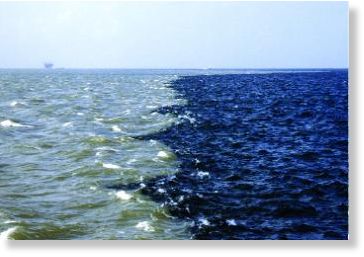
© courtesy of Nancy Rabalais Hypoxic zone in the Gulf of Mexico. The brown water is enriched in nutrients and sediments from the Mississippi River. Algal blooms from the enriched water create the hypoxic zone.

The Gulf Dead Zone is the biggest ever this year. It's about 3,300 square miles right now, or roughly the size of Delaware and Rhode Island combined, but researchers at Texas A&M University say it's likely to become much larger, TG Daily reported.

The dead zone is caused by hypoxia, a condition in which oxygen levels in seawater drop to dangerously low levels. Severe hypoxia can potentially result in widespread fish kills.

"This was the first-ever research cruise conducted to specifically target the size of hypoxia in the month of June," oceanography professor Steve DiMarco told TG Daily.

Bizarro Earth

Australia: Dugong deaths 'ecological disaster'

Image
© David Hannan

Environmentalists have again warned of an ecological disaster at the southern end of Queensland's Great Barrier Reef, following the discovery of a dead dugong.

It was found washed up on a beach in Gladstone Harbour, the fourth dugong, along with three dolphins and 40 turtles that have been found washed up around the harbour since May.

Friends of the Earth spokesman Drew Hutton said he had seen first-hand the destruction around the harbour since construction of the LNG facilities had started.

Fish

U.S.: Alarming 'dead zone' grows in the Chesapeake

Chesapeake bay
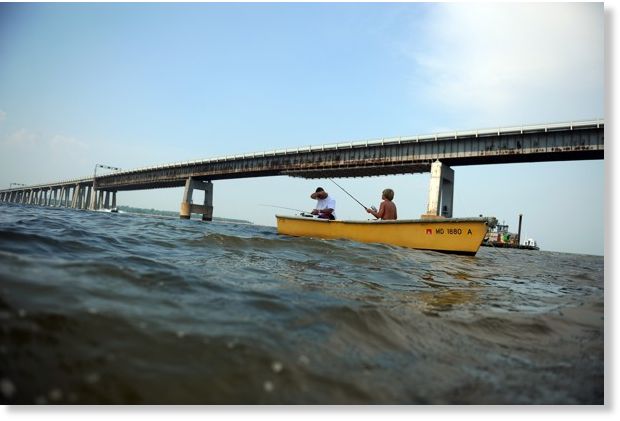
© Ricky Carioti/The Washington PostMike Kirschner and his son Zachary, 10, of Bel Air, Md., fish below the Chesapeake Bay Bridge in Annapolis, Md.

A giant underwater "dead zone" in the Chesapeake Bay is growing at an alarming rate because of unusually high nutrient pollution levels this year, according to Virginia and Maryland officials. They said the expanding area of oxygen-starved water is on track to become the bay's largest ever.

This year's Chesapeake Bay dead zone covers a third of the bay, stretching from the Baltimore Harbor to the bay's mid-channel region in the Potomac River, about 83 miles, when it was last measured in late June. It has since expanded beyond the Potomac into Virginia, officials said.

Especially heavy flows of tainted water from the Susquehanna River brought as much nutrient pollution into the bay by May as normally comes in an entire average year, a Maryland Department of Natural Resources researcher said. As a result, "in Maryland we saw the worst June" ever for nutrient pollution, said Bruce Michael, director of the DNR's resource assessment service.

Bizarro Earth

New Zealand: Wintry Blast Brings Worst Snow in Decade

Image
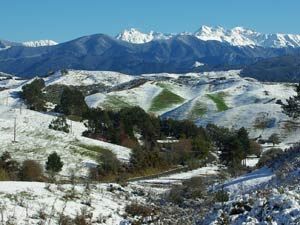
© Oliver StedingDovedale, looking towards Mt Arthur
The worst snow in at least 16 years brought parts of the country to a standstill today.

Heavy snow, sleet and high winds made conditions treacherous throughout the country and motorists were urged to avoid all but urgent travel.

The South Island was hardest hit with many roads closed, flights cancelled and people told to stay home.

A number of state highways around the country were closed, however many are now re-opening and will be reassessed in the morning.

For the full list of closures visit NZTA .

Wellington also recorded its lowest temperature ever and the polar storm is taking another swipe at the North Island tonight.

Arrow Up

Heatwave Breaks Records in Parts of US and Canada

Image
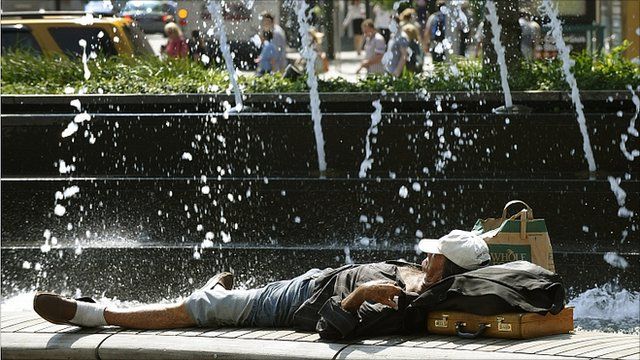
© BBCOne New Yorker says being outside is like "sitting in a sauna all day long"
A heatwave has baked eastern parts of the US and Canada, as temperatures surged to record-breaking highs in some parts.

The mercury in Newark, New Jersey, reached 108F (42C) on Friday, the highest ever recorded in the city.

In Canada, an extreme heat alert remained in effect, a day after two dozen cities and towns broke their previous single-day heat records.

At least 22 deaths have been blamed on the heat.

Across the US alone, where nearly half of the population was under a heat advisory, more than 220 heat records have tumbled.

Binoculars

US: Teens Mauled by Grizzly in Alaska

Image
© Photodisc
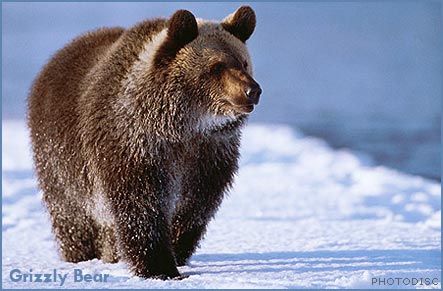
The teenage outdoor education students, having progressed to the point of being on their own in the vast Alaska wilderness, were lined up single file for a river crossing when the grizzly burst with fury into the front of the line, badly mauling two in the group and injuring two more.

Those in the front screamed of the bear's presence. The bear was with her cub when she attacked, according to state troopers.

The teens were in a group of seven participating in a 30-day backcountry course conducted by the National Outdoor Leadership School when the attack occurred Saturday night in the Talkeetna Mountains north of Anchorage. They were rescued early Sunday after activating their emergency locator beacon and tending to their most seriously wounded.

Those in the back of the line heard the warning, with the two at the front of the line taking the brunt of the attack, trooper spokeswoman Megan Peters said.

Another group of seven students and three instructors was waiting about six miles away for a helicopter hired by the Lander, Wyo.-based NOLS, said Bruce Palmer, a spokesman for the organization, which leads many such excursions in Alaska and elsewhere.

Radar

Strong 6.2 Magnitude Earthquake Strikes off Papua New Guinea

A strong earthquake has struck off the coast of the Pacific nation of Papua New Guinea. There are no immediate reports of damage or injuries and no tsunami alert was issued.

The U.S. Geological Survey says the magnitude-6.2 quake struck Monday 46 miles (73 kilometers) south of the town of Kavieng on the island of New Ireland. The earthquake struck at a depth of 21 miles (34 kilometers).

The Pacific Tsunami Warning Center did not issue a tsunami alert.

The Pacific island nation of Papua New Guinea lies on the "Ring of Fire" - an arc of earthquake and volcanic zones that stretches around the Pacific Rim and where about 90 percent of the world's quakes occur.

Source: The Associated Press

Stop

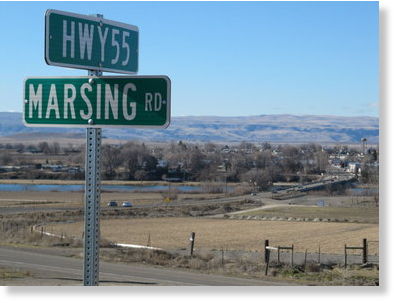
US, Idaho: Giant Hole Closes Hwy 55 Near Marsing

Image
© Jessie L. Bonner/The Associated Press
The Idaho Transportation Department closed a section of Highway 55 east of Homedale Sunday evening after a culvert failed and irrigation waters ate a 20-foot wide hole into the side of the road.

Until it is repaired, drivers must take detours along Pershall, Edison and Thompson roads.

A Department of Transportation spokesman listed two probable causes for the culvert's failure: holes in the pipe allowed water to seep through or debris plugged the pipe so pooling water undermined surrounding earth.

No Entry

US, Illinois: Sinkhole Causes Hicks Lane Closures

Image
© Jennifer Mondy
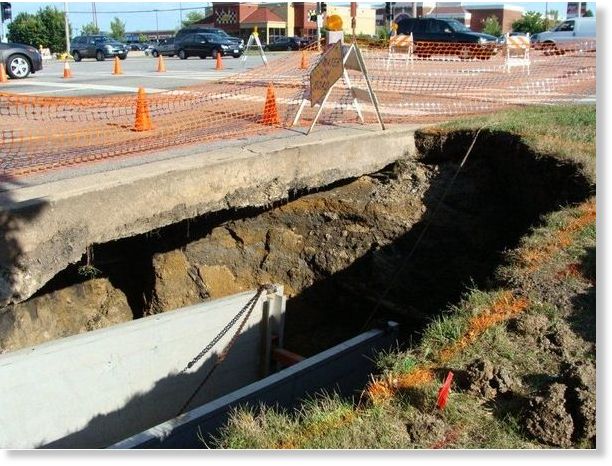
A 20-foot sinkhole has appeared under Hicks Road near Dundee Avenue. Residents are encouraged to avoid the intersection if possible.

A 20-foot sinkhole has opened along and under Hicks Road near Dundee Road, Palatine police said.

The sinkhole forced the closure of all northbound lanes on Hicks. Traffic has been shifted to the southbound lanes, reducing Hicks to one lane of traffic in each direction, Palatine Fire Department Battalion Chief William Gabrenya said.

Gabrenya said the sinkhole opened because of a sewer line collapsed beneath the street following the Saturday, July 23 rain that caused flooding throughout Palatine.

Motorists are advised to avoid the Hicks and Dundee intersection if at all possible.