© AP Photo / ISNA
The tensions in the Middle East are back up to boiling point after a second incident involving tankers along the world's most important oil choke-point. So, here's a round-up of all the relevant news that broke this day.
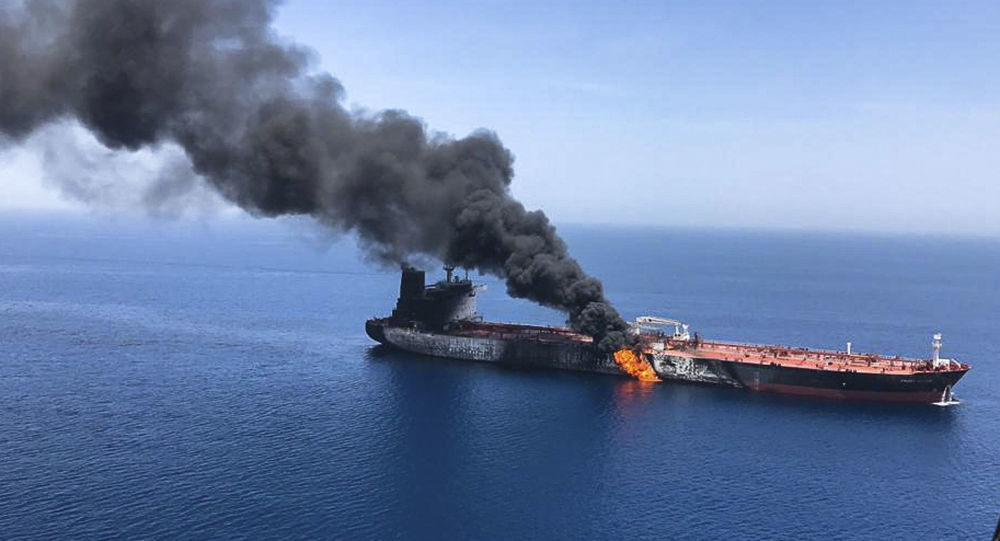
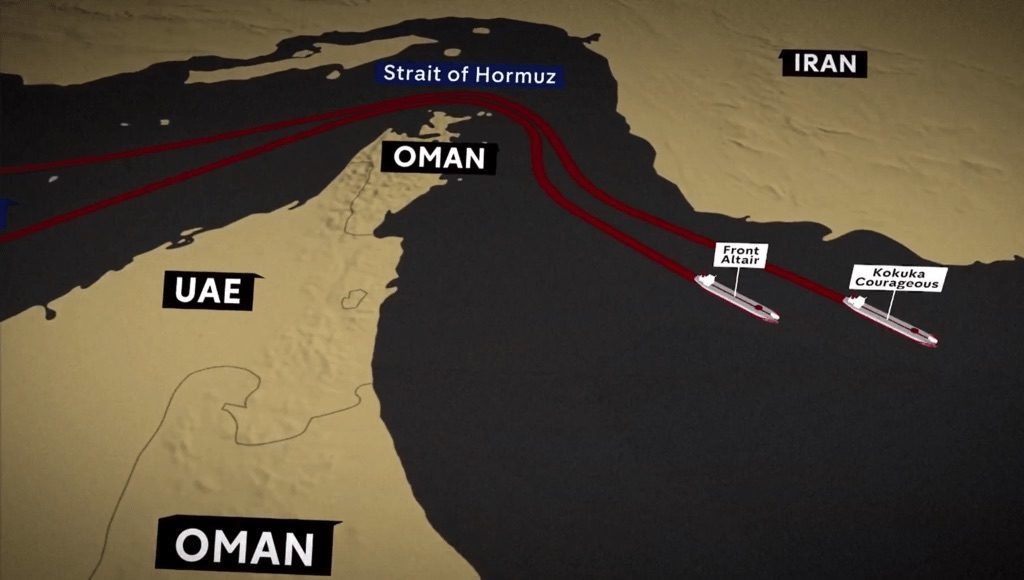
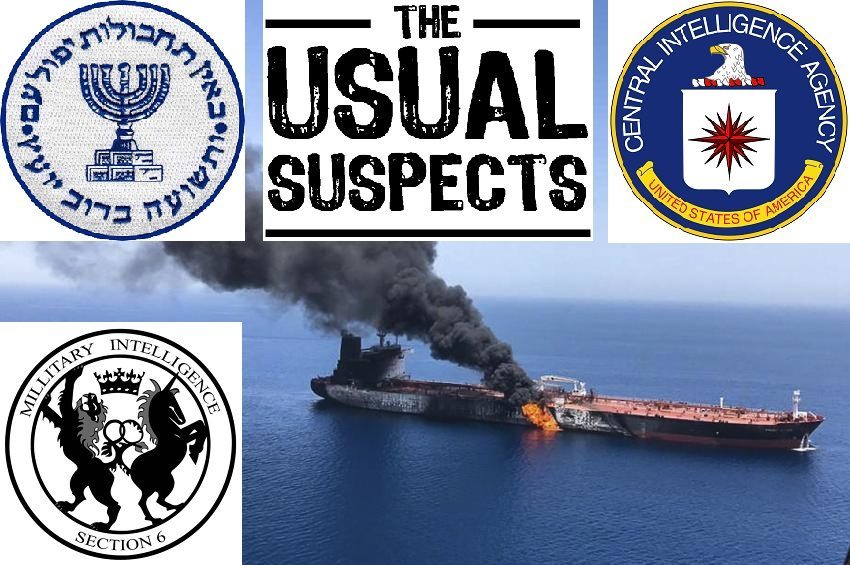
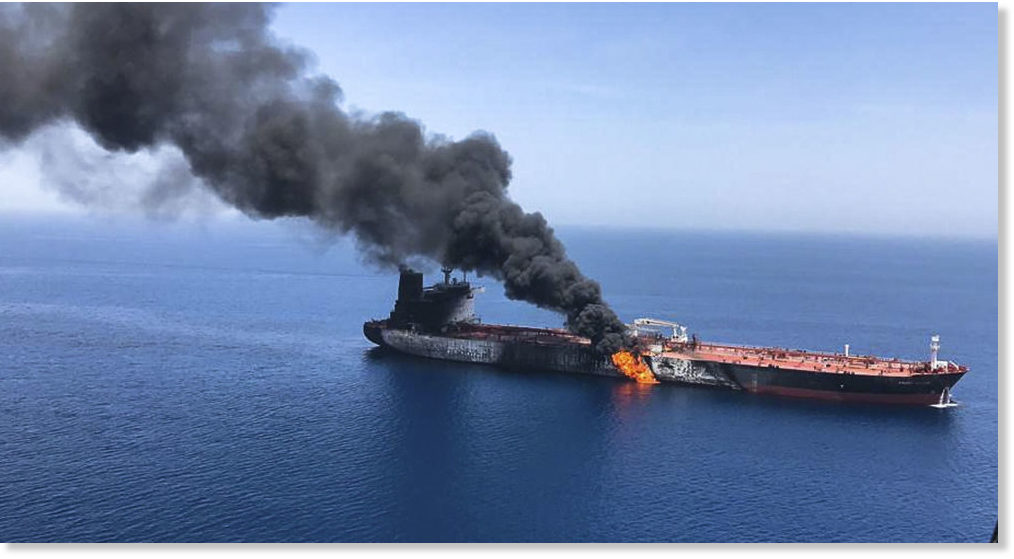
What Happened?Two oil tankers were hit in an apparent attack in the Strait of Hormuz, about 70 nautical miles from the UAE port of Fujairah and about 14 nautical miles off Iran's coast.
One of the vessels was the Aframax-class
Kokuka Courageous tanker, registered in Panama and operated by the Singapore-based Bernhard Schulte Shipmanagement.
The other was the
Front Altair, a Marshall Islands-flagged crude oil tanker owned by Norway's Frontline.
Comment: Israel has motive, obviously. And means. Germany has gifted that regime 6 nuclear-powered subs free of charge in the last decade...
As the saying goes, nothing in politics happens by accident. One tanker union said that oil shipments to the West
could be jeopardized if the Strait of Hormuz becomes unsafe:
"We need to remember that some 30% of the world's (seaborne) crude oil passes through the Straits. If the waters are becoming unsafe, the supply to the entire Western world could be at risk."
In response to the latest provocation in one of the most strategically important regions in the entire world, Iran has
called for an international effort to protect important waterways in the region.
It is highly unlikely that Iran is behind these attacks. Sabotage is not their MO, but it certainly is the MO of certain 'Western' intel agencies.
A false-flag to demonize Iran is right in the CIA/Mossad's wheelhouse.
A great deal of interested parties have noted how a Gulf of Tonkin-style attack could take place in the Strait of Hormuz to escalate tensions and get the Western population to accept a war against Iran. Could this be part of that plan?
UPDATE 13/06/2019 19:18: Warmonger Pompeo sticks to the neocon playbook and
blames Iran
US Secretary of State Mike Pompeo has said Washington believes Iran is behind the attack on two Japanese tankers in Gulf of Oman. He believes Tehran wants to end "successful maximum pressure campaign" of Washington's sanctions.
"This is only the latest in the series of attacks instigated by the Republic of Iran and its surrogates against American allies and interests. They should be understood in the context of four years of unprovoked aggression against freedom-loving nations," Pompeo said.
Pompeo didn't provide any proof for his claims, but reminded reporters that back in April Iran threatened to interrupt the flow of oil through the Strait of Hormuz.
He listed a series of incidents in the Middle East, including the attack on tanker ships at port in the United Arab Emirates, that US has blamed on Iran. There has been no proof offered by the US that Tehran is behind the attacks, and Iran denies any involvement.
Pompeo, however, claimed that Tehran was "lashing out" at Washington's "successful maximum pressure campaign" which has consisted of several layers of sanctions.
US ambassador to the UN Jonathan Cohen has been instructed to bring up "Iran's attacks" in the UN Security Council session on Thursday afternoon.
UPDATE 14/06/2019: The finger pointing has begun as the various countries involved put out their versions of the incident.
Yutaka Katada, president of Kokuka Sangyo, owner of the
Kokuka Courageous,
disputes US claims that the vessel was damaged by a naval mine. He said the ship's crew spotted "flying objects" before the attack in the Gulf of Oman. He believes the flying objects seen by the sailors could have been bullets. He
denied any possibility of mines or torpedoes because the damage was above the ship's waterline.
In the meantime the US released a video purporting to show a limpet mine being removed from the stricken ship. However many comments below the tweet dispute the US' characterization of the video, pointing out discrepancies in the Navy's interpretation
Iran's foreign minister
tweeted that the attack "suspiciously" came at the same time as the Japanese prime minister was sitting down for
"extensive and friendly" discussions with Iran's supreme leader, Ayatollah Seyed Ali Khamenei.
Defense Minister Takeshi Iwaya said, " At this moment, we haven't been asked to send Japan's Self Defense Forces. So, we don't have a plan to send the units to the region near the Strait of Hormuz to respond to this incident."
NHK's position in itself reveals that Japan-US relations are strained, as Japanese authorities would neither encourage NHK nor allow workers of the vessel to make public reportage and claims which contradict those of Pompeo and the American administration.
Indeed, many fingers are being pointed at the US as the perpetrator of the attacks, in its drive to begin a war with Iran:
German Foreign Minister Heiko Maas has
said the video released by the US is "not enough" to prove Iranian involvement in a series of oil tanker attacks in the Gulf of Oman. Even staunch US ally Great Britain
equivocated on the US pronouncement of Iran's guilt for the attack.
Ass-covering diplomatic doublespeak was in evidence when the UK's foreign secretary was asked whether he shared the US view that Iran was behind an attack on two oil tankers in the Gulf of Oman.
On the BBC's Today programme on Friday morning Jeremy Hunt was asked: "You backed the US assessment that Iran is behind this attack. Do you have independent evidence of that?"
Hunt replied: "We are going to make our own independent assessment, we have our processes to do that."
You'll notice the distinct absence of the word 'yes' in his reply. Cynical observers may suggest that the UK doesn't fully back America's claims on this one, but is in no place to say so explicitly and publicly.
Why would Britain be so quick to get behind allegations from Washington that could potentially trigger a new Middle East war? Well, Hunt explained that as well.
He said: "We have no reason not to believe the American assessment. And our instinct is to believe it because they are our closest ally."
So, the British government's stance on this one is to believe Washington not because there is any definitive proof, but because they are "our closest ally". That's the kind of loyalty money can buy.
Also the term "we have no reason not to believe" is in no way the same as saying 'we definitely do believe,' it's that diplomatic speak again which means 'we can't be sure either way, but we're going to back America until we're forced not to.'
Peter Ford, the former UK ambassador to Syria and a big critic of western foreign policy,
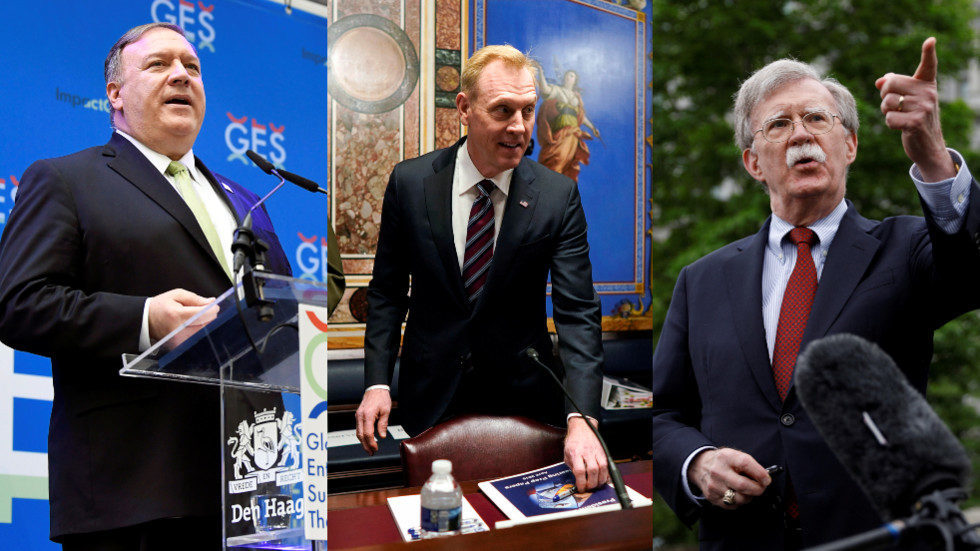
envisions a desperate Iran lashing out under the pressure of US sanctions, but the blowback has caught Pompeo and Bolton off guard:
"I think... that Iran has been behind all these attacks. Just a couple of weeks ago, US spokespeople were beating their chests and boasting about the policy of maximum pressure [on Iran] and how they were going to apply more pressure. They dispatched a mighty fleet, and now after these attacks, they are retreating, it seems to me," Ford told hosts John Kiriakou and Brian Becker.
On June 7, the US announced that it would be imposing sanctions on Iran's Persian Gulf Petrochemical Industries Company (PGPIC). The move comes after the US ordered the deployment of an additional 1,500 troops, a task force of B-52 bombers and one of its aircraft carrier strike groups to the region last month. Iran responded by threatening to close the Strait of Hormuz.
"The people who will be feeling their collars at the moment is [National Security Adviser] John Bolton and Pompeo, who only seven days ago were boasting about the policy of maximum pressure. If Iran did it [committed the attacks], they just administered a master class of what you get when you boast about maximum pressure," Ford said.
According to Ford, the theory that the attacks were carried out by the US to deter Japanese Prime Minister Shinzo Abe from improving diplomatic relations with Iran can be ruled out.
"A sophisticated, coordinated operation like this would have taken weeks to prepare. But the Abe visit was only set up days ago. There simply wouldn't have been time to mount an operation if it was designed to somehow exploit Abe's visit," Ford noted.
"Iran's message is simple: if you choke off our exports with your sanctions, then we will make sure that nobody else is able to export from the Gulf," he said.
Iran has threatened repeatedly that if necessary, it will close the Strait of Hormuz. As the Norwegian Shipowners' Association
pointed out, this would "negatively affect world trade", to put things mildly. Oil prices could double. Japan's economy minister, at least, is
not concerned about the current situation in the Gulf affecting his own countries supply.
Secretary of State Mike Pompeo is
undeterred:
"It is the assessment of the United States government that the Islamic Republic of Iran is responsible for the attacks that occurred in the Gulf of Oman today," Pompeo said during a Thursday press briefing.
"Iran is lashing out because the regime wants our successful maximum pressure campaign lifted," Pompeo added. "No economic sanctions entitle the Islamic Republic to attack innocent civilians, disrupt global oil markets and engage in nuclear blackmail."
The Iranian mission to the UN had
this to say:
"Neither fabrications and disinformation campaigns nor shamelessly blaming others can change the realities. The US and its regional allies must stop warmongering and put an end to mischievous plots as well as false flag operations in the region. Warning, once again, about all of the US coercion, intimidation, and malign behavior, Iran expresses concern over suspicious incidents for the oil tankers that occurred today", the statement issued on Thursday read.
The Chinese Foreign Ministry says "Nobody wants to see war in the Gulf", and
urged restraint.
As for the tankers themselves, Iranian officials
say the fires are out. Press TV released footage of 23 of the 44 sailers they rescued from the Front Altair:
UPDATE 15/06/2019: Unsurprisingly, Saudi Arabia is calling for a "
swift response" after the incident - swift indeed, given that no one knows for sure yet who is responsible:
A "swift and decisive response to the threat to energy supply" is needed to ensure "the stability of markets and the confidence of consumers," Energy Minister Khalid al-Falih was quoted in a tweet from his office. He also claimed "the recent terrorist acts" in Middle Eastern waters "must be directed against the global energy supply chain."
At least it should be clear by now that if it wanted to, Iran COULD disrupt the global energy supply train. They've threatened to do so repeatedly in response to the overbearing anti-Iranian policy of the Trump administration. Is that something the Americans and their allies are willing to risk, all in the service of Israeli policy?
In contrast, Japan for one
isn't buying it (along with EU reps like Maas, quoted in the previous update). "The [Japanese] government
does not share the US view of Iran's involvement in attacking tankers near the Strait of Hormuz and, as it turned out, appealed to the American side for additional evidence. The opinion is that
the US statements are not sufficiently convincing", according to the Kyodo news agency. Yutaka Katada, president of the Japanese company operating the Kokuka Courageous tanker, doesn't think the US-released video shows what they're saying it shows:
"I do not think there was a time bomb or an object attached to the side of the ship. A mine doesn't damage a ship above sea level. We aren't sure exactly what hit, but it was something flying towards the ship", Katada was cited as saying by the Japanese media.
Bernie Sanders is
warning against the attacks being used as a pretext for a 'disastrous' war with Iran:










Comment: Also keep in mind the following, from Moon of Alabama: And this: Consider this news, too. Perhaps it's relevant, perhaps it's not. But if Magnier and MoA are correct, that's just how things will be for the coming months: