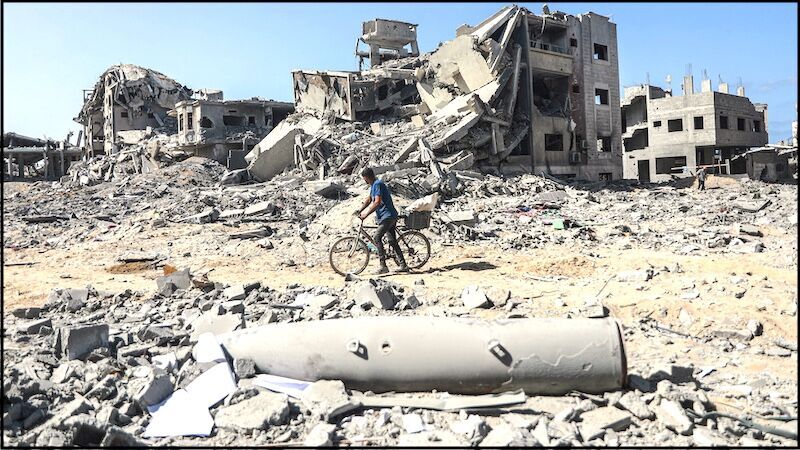
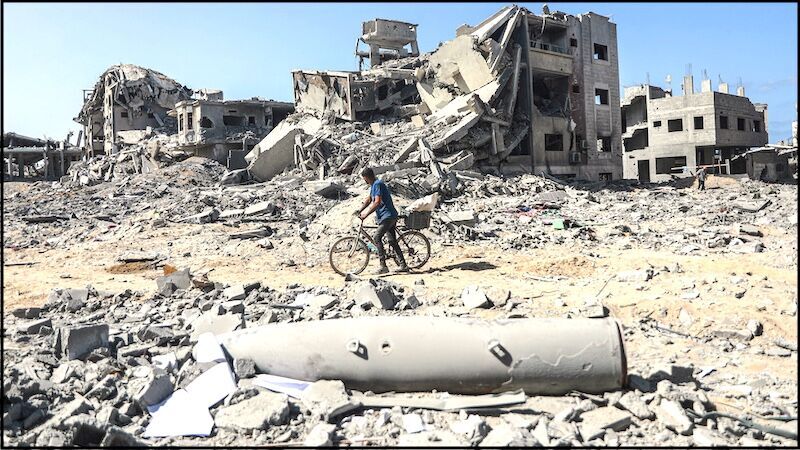
© Abdalhkem Abu Riash/Anadolu/Getty ImagesAmmunition left behind by the Israeli Army in Gaza
The US is trying to establish a 'multinational stabilization force' to decide who will handle the Middle East's hottest potato.
In Doha on December 16, behind closed doors and without the usual diplomatic fanfare,
the US - via CENTCOM - convened representatives of around 45 Arab, Muslim, and Western states to discuss what official language renders blandly as
an International Stabilization Force (ISF) for Gaza, but what in practice is an attempt to work out
who will assume responsibility for the combustible 'day after tomorrow' in the Middle East
- and how.
Israel was neither invited nor involved in the discussions - a detail that in and of itself became a political statement, even if it can formally be attributed to the need for a 'working atmosphere' and confidentiality.
The agenda was conspicuously practical: The prospective mission's structure, rules on the use of force, weapons policy, deployment zones, training sites, and the scope of authority 'on the ground'. In other words, this was not a conversation about principles and slogans, but about the things soldiers and lawyers usually settle - who answers to whom, what constitutes a threat, when firing is permitted, how incidents are prevented, and who bears responsibility if incidents occur anyway.
It is precisely this 'technical' frame that carries the political meaning: Once parties are arguing not about an abstract 'peace' but about rules for using force,
they are implicitly accepting that forces may actually be deployed, and that conditions on the ground will be harsher than any declaration.















Comment: Right on cue, libtard and DEI appointee for CBS, Bari Weiss flips out: In the meantime: