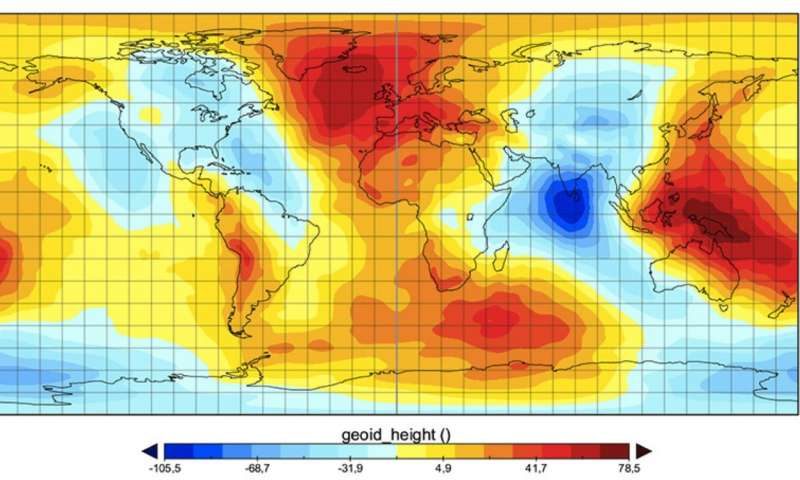
© European Space AgencyA map modelling the geoid surface. The map shows how water elevation and distribution would change by removing the effects of tides and currents.
The Earth's interior is still a mystery to us. While we have sent missions to probe the outer reaches of our Solar system, the deepest boreholes on Earth go down to only a few kilometres. The only way to learn what's going on deep inside our planet, in the core and the mantle, is by indirect methods.
Many of us might have seen those beautiful pictures of our round, blue planet taken from space, but did you know that our planet actually looks like a bumpy potato? It has its own share of deformations, non-uniform gravity because of the unequal distribution of mass and occasionally, mountains and valleys created by the movements of tectonic plates. Considering that around three-fourths of our planet's surface is made up of oceans, these deformities affect the shape of the oceans too. If we removed the tides and currents from the oceans on the planet, they would settle onto a smoothly undulating shape called a
geoid, rising wherever there is high gravity, and sinking where gravity is low, creating what are known as "geoid anomalies." These highs and lows are generated by uneven mass distribution within the deep Earth.
One such point of low gravity is found just south of the Indian peninsula, called the Indian Ocean Geoid Low (IOGL). The geoid low spans a vast extent south of the Indian subcontinent, and is dominated by a significant low of minus 106 metres, or roughly 348 feet, south of Sri Lanka.
"The existence of the Indian Ocean geoid low is one of the most outstanding problems in Earth Sciences," said Attreyee Ghosh, an assistant professor at the Centre for Earth Sciences, Indian Institute of Science, in Bangalore, India.
"It is the lowest geoid/gravity anomaly on Earth and so far no consensus existed regarding its source. It is remarkable as it means that there is some mass deficit in the deep mantle that's causing the low.""A low gravitational potential would mean that the ocean surface itself would go down," she said. "So, for a 100 meter (328 feet) geoid low the
ocean surface would dip down by 100 meters at that region."















Comment: Russia has also been considering lunar caves as bases: Russia Eyes Caves on Moon for Setting Up a Lunar Base