Science & TechnologyS


Question

The Evolution of Aversion: Why even children are fearful of snakes

Some of the oldest tales and wisest mythology allude to the snake as a mischievous seducer, dangerous foe or powerful iconoclast; however, the legend surrounding this proverbial predator may not be based solely on fantasy. As scientists from the University of Virginia recently discovered, the common fear of snakes is most likely intrinsic.

Evolutionarily speaking, early humans who were capable of surviving the dangers of an uncivilized society adapted accordingly. And the same can be said of the common fear of certain animals, such as spiders and snakes: The ancestors of modern humans were either abnormally lucky or extraordinarily capable of detecting and deterring the threat of, for example, a poisonous snake.

Pharoah

Mystery of 'Maya blue' dye tied to human sacrifice

Archaeologists may have at last cracked the mystery of how and why Mayans produced "Maya blue", a pigment famed for its sky-blue colour and remarkable durability.

The Mayans produced the fabled pigment as part of their ritual sacrifices - including that of humans - at their ancient centre of power, the city of Chichén Itzá, suggests a new study of artefacts.

Display

European commission fines Microsoft record £680m

The EU today imposed a record €899m (£680m) fine on Microsoft for charging "unreasonable" prices to rivals for access to its dominant software.

The fine, the largest imposed on a single company, brings the total levied on the world's leading software group close to €1.7bn in the past four years.

Neelie Kroes, EU competition commissioner, who said she had no pleasure in imposing the fine, told journalists she could have charged Microsoft €1.5bn in the latest penalty.

Robot

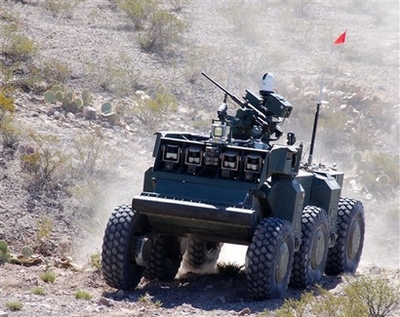
Killer robots pose latest militant threat: expert

LONDON - Killer robots could become the weapon of choice for militants, a British expert said on Wednesday.

Noel Sharkey, professor of artificial intelligence and robotics at the University of Sheffield said he believed falling costs would soon make robots a realistic option for extremist groups.

Killer robot
©Associated Press

Telescope

US team wins asteroid tracking competition


Apophis craft
©Unknown
The mission aims to tag the asteroid 99942 Apophis

A US team has won a $50,000 (£25,000) competition to design a spacecraft to rendezvous with and track the path of an asteroid which may threaten Earth.

The winning entry, led by SpaceWorks Engineering, will shadow asteroid Apophis for 300 days.

Magnify

Fresh tests on Shroud of Turin

The Oxford laboratory that declared the Turin Shroud to be a medieval fake 20 years ago is investigating claims that its findings were wrong.

Frog

Life Forms Ejected on Asteroid Impact Could Survive to Reseed Earth According to a Study Published in Astrobiology

New Rochelle - In the event that an asteroid or comet would impact Earth and send rock fragments containing embedded microorganisms into space, at least some of those organisms might survive and reseed on Earth or another planetary surface able to support life, according to a study published in the Spring 2008 (Volume 8, Number 1) issue of Astrobiology, a peer-reviewed journal published by Mary Ann Liebert, Inc. The paper is available free online.


Light Saber

Students from the Technion-Israel Institute of Technology to save the Earth

Nine students from the Technion-Israel Institute of Technology have developed a model spacecraft for deflecting objects falling from space.

The model has been created in response to the asteroid Apophis which scientists believe will collide with Earth in 2036, and was presented at a competition of NASA and the American Institute of Aeronautics and Astronautics.

Display

Google, Others to Build Massive Under-sea Internet Link to Asia

A new group comprised of six companies including Google publicly revealed plans to build an undersea fiber-optic cable that will link Japan to the west coast of the United States.

The ultimate aim of the cable is to be able to allow companies to send large amounts of data across the world at a lower price. Consortium companies will utilize a five fiber pair cable system, which can be upgraded to eight fiber pairs later down the road.

Clock

Ruins of 5,500-year-old plaza found in Peru

A group of archaeologists have discovered the ruins of an ancient ceremonial plaza in Peru, built 5,500 years ago, local media said Tuesday.

The ruins, measuring 180 by 120 meters, were found at Sechin Bajo in Casma, north of the country's capital Lima. The plaza, believed to have been built between 3,500 B.C. and 3,000 B.C., is one of the oldest discoveries in Latin America.

Image
©Unknown