Science & TechnologyS


Clock

Innovative archaeological survey reveals unknown aspects of China's past

Imagine future archaeologists trying to understand Illinois, California or New York based on a few excavations in each of those states. They might excavate small areas in city centers, since those sites would probably be the first ruins they would come across. Meanwhile, the archaeologists they might fail to notice or study farms, suburbs, shopping malls, canals and airports.

Image
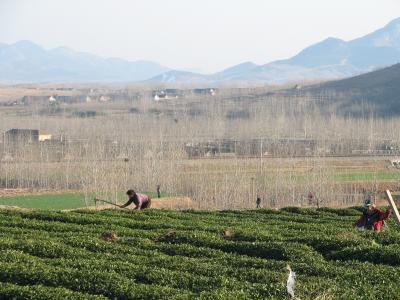
©Photo by Anne Underhill, courtesy of The Field Museum
Scientists walk through tea fields in southeastern Shandong as part of an innovative settlement pattern regional survey that uncovered important new evidence about how this region of China developed. This photograph was taken in 2006, and the team has completed 13 years of survey to date, making it one of the longest running collaborations of any kind between Chinese and American scientists. On the right, Linda Nicholas, Adjunct Curator of Anthropology at The Field Museum, carries a map on which she marks the distribution of the prehistoric and Early Bronze Age sherds found during the survey.

Heart

SOTT Focus: The Hope


Comment: We have decided to re-run this article published April of last year. For some curious reason, searching for it on google gives no returns even when specific phrases from the text are used in quotes for the search. We suspect that this particular piece is being suppressed stringently for some reason and hope that as many of you as possible will share it around, cross-post it, link to it, and otherwise make the information contained herein widely available in spite of google.


©Signs of the Times

My last contribution to the Blogosphere must have been pretty scary. Geeze! You shoulda seen my mail! People going bananas and writing "what to do? what to do!?"

Well, this one's not going to be any better. But let me say in advance that today's particular collection of items will lead us to a certain point of hope which I wish to elucidate at the end.

Cloud Lightning

Flashback Solar Activity Diminishes; Researchers Predict Another Ice Age

Global Cooling comes back in a big way

Dr. Kenneth Tapping is worried about the sun. Solar activity comes in regular cycles, but the latest one is refusing to start. Sunspots have all but vanished, and activity is suspiciously quiet. The last time this happened was 400 years ago -- and it signaled a solar event known as a "Maunder Minimum," along with the start of what we now call the "Little Ice Age."

Tapping, a solar researcher and project director for Canada's National Research Council, says it may be happening again. Overseeing a giant radio telescope he calls a "stethoscope for the sun," Tapping says, if the pattern doesn't change quickly, the earth is in for some very chilly weather.

Robot

Can Robots Commit War Crimes?

Researchers debate where the fault divides between the operator and the machine

Telescope

NASA Baffled by Unexplained Force Acting on Space

Mysteriously, five spacecraft that flew past the Earth have each displayed unexpected anomalies in their motions.

Better Earth

The New Cartographers -- What does it mean to map everything all the time?

It's flu season, and you're feeling woozy. Have you caught that thing that's going around?

To find out, head over to Who is Sick?, a Google map-based tool that lets users report their symptoms. Plug in your zip code to find nodes of contagion near you.

Or maybe you're depressed. Misery loves company. Check the local emotional temperature at We Feel Fine to see data-mined sentiments from blogs, organized geographically.

Maps are everywhere these days. The ubiquity of global positioning systems (GPS) and mobile directional devices, interactive mapping tools and social networks is feeding a mapping boom. Amateur geographers are assigning coordinates to everything they can get their hands on - and many things they can't. "Locative artists" are attaching virtual installations to specific locales, generating imaginary landscapes brought vividly to life in William Gibson's latest novel, Spook Country. Indeed, proponents of "augmented reality" suggest that soon our current reality will be one of many "layers" of information available to us as we stroll down the street.

Like other technological innovations, this trend gives with one hand and takes with the other.

For some, mapping has become a vibrant new language - a way to interpret the world, find like-minded folks and make fresh, sometimes radical, perspectives visible. For others, maps portend threats to privacy and freedom of movement. Just see Privacy International's Map of Surveillance Societies Around the World, which classifies the United States as an "endemic surveillance society."

Wolf

Steps towards warship invisibility

Naval warships might look like all-powerful vessels but they are also highly vulnerable to being spotted by the enemy. That fear of being detected has led the military to develop new stealth technologies that allow ships to be virtually invisible to the human eye, to dodge roaming radars, put heat-seeking missiles off the scent, disguise their own sound vibrations and even reduce the way they distort the Earth's magnetic field, as senior lecture in remote sensing and sensors technology at Britannia Royal Navy College, Chris Lavers, explains in March's Physics World.

Bulb

Darwin was wrong about the wild origin of the chicken

Charles Darwin maintained that the domesticated chicken derives from the red jungle fowl, but new research from Uppsala University now shows that the wild origins of the chicken are more complicated than that.

The researchers mapped the genes that give most domesticated chickens yellow legs and found to their surprise that this genetic heredity derives from a closely related species, the grey jungle fowl. The study is being published today in the Web edition of PLoS Genetics.

"Our studies show that even though most of the genes in domesticated fowls come from the red jungle fowl, at least one other species must have contributed, specifically the grey jungle fowl," says Jonas Eriksson, a doctoral student at Uppsala University.

Snowman

Study Shows Bacteria Are Common in Snow, Especially in France, Montana and Yukon

Those beautiful snowflakes drifting out of the sky may have a surprise inside bacteria. Most snow and rain forms in chilly conditions high in the sky and atmospheric scientists have long known that, under most conditions, the moisture needs something to cling to in order to condense.

Now, a new study shows a surprisingly large share of those so-called nucleators turn out to be bacteria that can affect plants.

Better Earth

Researcher may have discovered key to life before its origin on Earth

An important discovery has been made with respect to the mystery of "handedness" in biomolecules. Researchers led by Sandra Pizzarello, a research professor at Arizona State University, found that some of the possible abiotic precursors to the origin of life on Earth have been shown to carry "handedness" in a larger number than previously thought.

The work is being published in this week's Early Edition of the Proceedings of the National Academy of Sciences (PNAS). The paper is titled, "Molecular asymmetry in extraterrestrial chemistry: Insights from a pristine meteorite," and is co-authored by Pizzarello and Yongsong Huang and Marcelo Alexandre, of Brown University.