Science & TechnologyS


Target

Flashback Tree rings challenge history

Could a comet hitting the Earth 1,500 years ago have triggered a global disaster in which millions of people lost their lives?

Arrow Down

Flashback The day the sky fell in

A metallic asteroid may have coincided with the fall of Rome

In the early fifth century, rampaging Goths swept through Italy. Inviolate for 1,100 years, Rome was sacked by the hordes in 410 AD. St Augustine's apologia, the City of God, set the tone for Christians for the next 16 centuries.

Star

Flashback Scientists Say Comet Smashed Into Southern Germany In 200 BC

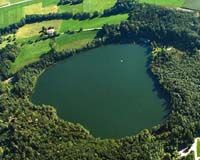
A comet or asteroid smashed into modern-day Germany some 2,200 years ago, unleashing energy equivalent to thousands of atomic bombs, scientists reported on Friday.

crater Chiemgau
© Chiemgau Impact Research TeamThe largest crater in the Chiemgau field in Bavaria is water-filled Tuttensee, located near the village of Marwang. At the water surface, Tüttensee measures 1,200 feet across. but the original crater may have been twice as large. Photo credit: Chiemgau Impact Research Team.

Info

Dinosaur Graveyard as Tourist Draw

As Jorge Calvo strode along the dusty banks of this Patagonian lake, he scanned the reddish dirt, pointing to the remains of a dinosaur in the desert sun.

Continuing on, he scampered down into an eight-foot pit and waved to Marcela Milani, a technician working with a thick nail and a hammer. She was chipping away at a rock looking for a missing hip bone believed to be part of Mr. Calvo's most famous discovery, Futalognkosaurus, a new genus of plant-eating dinosaur more than 100 feet long from tail to nose. It is one of the three biggest dinosaurs ever found.

dinosauars
©Joao Pina for The New York Times
Museums like El Chocón have sprung up in the past two decades around Neuquén, Argentina.

Binoculars

Study Says Grand Canyon Older Than Thought

Coming upon the Grand Canyon long ago, an old prospector is supposed to have said in amazement, "Something awful happened here."

The something appears to have started happening some 17 million years ago, geologists concluded in a study reported in Friday's issue of the journal Science. If correct, that is at least 11 million years earlier than previous estimates.

grand canyton
©Victor Polyak
Marble Canyon at Vasey's Paradise in the eastern Grand Canyon.

Bulb

Universe submerged in a sea of chilled neutrinos


Univese Neutrinos Dark Matter Energy Atoms
©NASA/WMAP Science Team
WMAP measures the composition of the universe by observing the cosmic microwave background, radiation that was emitted just 380,000 years after the big bang. Dark matter and atoms have become less dense as the volume of the universe has increased over time. Photons and neutrino particles also lose energy as the universe expands, but dark energy now dominates the universe even though it was a tiny contributor 13.7 billion years ago.

Better Earth

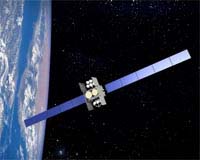
Earth's rotation may account for wayward spacecraft


boeing wideband global SATCOM satellite
©Unknown

Ark

Ancient Tomb Found on Greek Island

ATHENS, Greece - Road construction on the western Greek island of Lefkada has uncovered and partially destroyed an important tomb with artifacts dating back more than 3,000 years, officials said on Wednesday.

Star

Evidence Confirms Electric Comet Model

It appears that predictions made by Wal Thornhill and the Electric Comet model are being quickly confirmed, whether mainstream astronomers like it or not. In the end, it seems nature will be the arbiter of which model is the most accurate and predictive.

Snowman

New Method to Estimate Sea Ice Thickness

Scientists recently developed a new modeling approach to estimate sea ice thickness. This is the only model based entirely on historical observations.

The model was developed by scientists with the U.S. Geological Survey and the Russian Academy of Sciences, Moscow.

Using this new technique, the thickness of Arctic sea ice was estimated from 1982 to 2003. Results showed that average ice thickness and total ice volume fluctuated together during the early study period, peaking in the late 1980s and then declining until the mid-1990s. Thereafter, ice thickness slightly increased but the total volume of sea ice did not increase.