Science & TechnologyS


Pistol

Introducing the world's smallest gun that fires deadly 300mph bullets - but is just TWO inches long

Meet the pistol that fits in your pocket - and packs a hell of a punch.

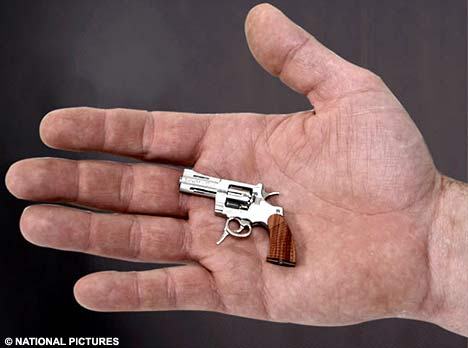
The SwissMiniGun is the size of a key fob but fires tiny 270mph bullets powerful enough to kill at close range.

Officially the world's smallest working revolver, the gun is being marketed as a collector's item and measures just 2.16 inches long (5.5cm). It can fire real 4.53 bullets up to a range of 367ft (112m).

The stainless steel gun costs £3,000 although the manufacturers also produce extravagant, made-to-order versions made out of 18-carat gold with customised diamond studs which sell for up to £30,000.
Image
©National Pictures
At just over two inches long it is the world's smallest gun - but the 300mph bullets it fires mean it is still deadly

Star

Mars and Venus are surprisingly similar

Using two ESA spacecraft, planetary scientists are watching the atmospheres of Mars and Venus being stripped away into space. The simultaneous observations by Mars Express and Venus Express give scientists the data they need to investigate the evolution of the two planets' atmospheres.

Scientists call this work comparative planetology. Mars Express and Venus Express are so good at it because they carry very similar science instruments. In the case of the Analyser of Space Plasmas and Energetic Atoms (ASPERA), they are virtually identical. This allows scientists to make direct comparisons between the two planets.

Image
©ESA - D. Ducros
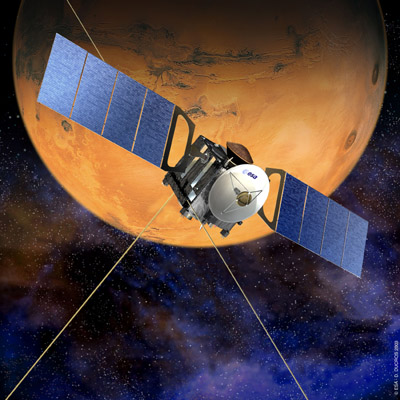
An artist's impression of Mars Express. The spacecraft left Earth for Mars on 2 June 2003. It reached its destination after a 6-month journey, and has been thoroughly investigating the planet since early 2004.

Star

Spitzer's Eyes Perfect For Spotting Diamonds In The Sky

Diamonds may be rare on Earth, but surprisingly common in space -- and the super-sensitive infrared eyes of NASA's Spitzer Space Telescope are perfect for scouting them, say scientists at the NASA Ames Research Center in Moffett Field, Calif.

Using computer simulations, researchers have developed a strategy for finding diamonds in space that are only a nanometer (a billionth of a meter) in size. These gems are about 25,000 times smaller than a grain of sand, much too small for an engagement ring. But astronomers believe that these tiny particles could provide valuable insights into how carbon-rich molecules, the basis of life on Earth, develop in the cosmos.

Image
©NASA/JPL-Caltech
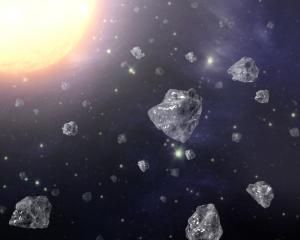
This artist's concept shows a multitude of tiny diamonds next to a hot star. Diamonds are abundant in space.

Star

Beautiful death-star could threaten Earth


Binary star
©Unknown

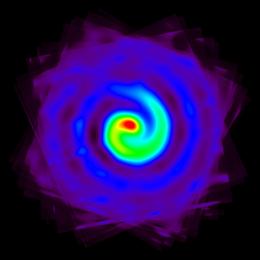
The Earth may be in the firing line when one of the sky's most beautiful objects explodes, according to University of Sydney astronomer Peter Tuthill.

Dr Tuthill discovered the elegant rotating pinwheel system, named WR104, eight years ago in the constellation Sagittarius. It includes a highly unstable star known as a Wolf-Rayet, widely regarded by astronomers as ticking bombs - the last stop in a star's life before a cataclysmic supernova explosion.

"When it finally explodes as a supernova, it could emit an intense beam of gamma rays coming our way", says Dr Tuthill, whose work is published in the latest edition of the Astrophysical Journal.

Ladybug

Plants Evolving to Self Destruct

The relentless advance of urban sprawl across the planet is forcing plants to spread fewer seeds which could place them at even greater risk of extinction.

* Self destructing palm tree found in Madagascar

Info

Windmill With A Twist Can Provide Fresh Water From Seawater Directly

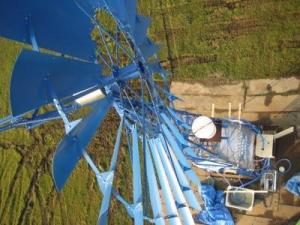
A traditional windmill which drives a pump: that is the simple concept behind the combination of windmill/reverse osmosis developed by the Delft University of Technology (TU Delft) in The Netherlands.

In this case, it involves a high-pressure pump which pushes water through a membrane using approximately 60 bar. This reverse osmosis membrane produces fresh water from seawater directly.

windmill seawater
©Delft University of Technology
The first prototype has been built and is already working at a location near the A13 motorway near Delft. This prototype is to be dismantled and transported to Curaçao the first week of March. There the concept will be tested on seawater.

Magnify

Technology Uses Live Cells To Detect Food-borne Pathogens, Toxins

Researchers have developed a new technology that can simultaneously screen thousands of samples of food or water for several dangerous food-borne pathogens in one to two hours.

food born toxins
©Purdue Agricultural Communication photo/Tom Campbell
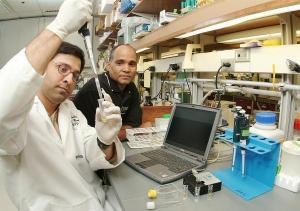
Purdue researcher Pratik Banerjee, at left, measures fluid as he and professor of food science Arun Bhunia work in the lab. Their technology uses common lab materials to quickly screen food and water samples for several food-borne pathogens and toxins.

Telescope

Avalanches On Mars Photographed By NASA Spacecraft

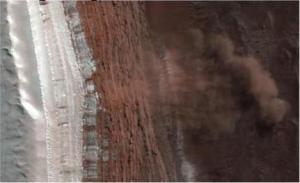
A NASA spacecraft in orbit around Mars has taken the first ever image of active avalanches near the Red Planet's north pole. The image shows tan clouds billowing away from the foot of a towering slope, where ice and dust have just cascaded down.

Image
©NASA/JPL-Caltech/University of Arizona
Image of one of at least four Martian avalanches, or debris falls, captured in action. It was taken on February 19, 2008, by the High Resolution Imaging Science Experiment (HiRISE) camera on NASA's Mars Reconnaissance Orbiter.

Info

HIV Breakthrough: Protein That Fights Immunodeficiency Identified

A Canada-U.S. research team has solved a major genetic mystery: How a protein in some people's DNA guards them against killer immune diseases such as HIV. In an advance online edition of Nature Medicine, the scientists explain how the protein, FOX03a, shields against viral attacks and how the discovery will help in the development of a HIV vaccine.

HIV Virus
©Produced by Richard Feldmann; NIH/National Institute of Allergy and Infectious Diseases
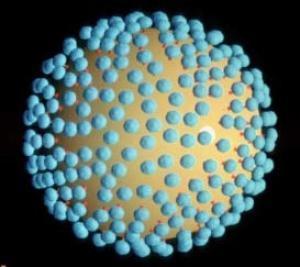
Computer model of AIDS virus (HIV).

Bulb

140-year-old math problem solved by researcher

A problem which has defeated mathematicians for almost 140 years has been solved by a researcher at Imperial College London.

Professor Darren Crowdy, Chair in Applied Mathematics, has made the breakthrough in an area of mathematics known as conformal mapping, a key theoretical tool used by mathematicians, engineers and scientists to translate information from a complicated shape to a simpler circular shape so that it is easier to analyse.

This theoretical tool has a long history and has uses in a large number of fields including modelling airflow patterns over intricate wing shapes in aeronautics. It is also currently being used in neuroscience to visualise the complicated structure of the grey matter in the human brain.

A formula, now known as the Schwarz-Christoffel formula, was developed by two mathematicians in the mid-19th century to enable them to carry out this kind of mapping. However, for 140 years there has been a deficiency in this formula: it only worked for shapes that did not contain any holes or irregularities.