Science & TechnologyS


Info

New Properties Discovered In Entire Class Of Non-magnetic Materials

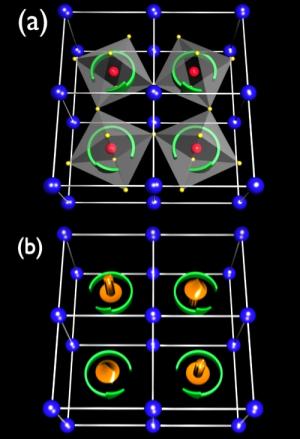
A team of Penn State researchers has shown for the first time that the entire class of non-magnetic materials, such as those used in some computer components, could have considerably more uses than scientists had thought. The findings are important because they reveal previously unknown information about the structure of these materials, expanding the number of properties that they potentially could have. A material's properties, such as electrical conductivity and mechanical strength, are what determine its usefulness. The research will be published in the journal Physical Review Letters.

Image
©Sava Denev, Penn State
A non-magnetic lattice, shown in Figure A, can have the same symmetry as a magnetic lattice, shown in Figure B. Both lattices, in this case, are described as having the point group symmetry that the scientists call 4'mm'.

Magic Wand

Researchers Devise Plan To Squeeze Water From Rock

Water from rock, easier than blood from stone

Gypsum, a rocky mineral is abundant in desert regions where fresh water is usually in very short supply but oil and gas fields are common. Writing in International Journal of Global Environmental Issues, Peter van der Gaag of the Holland Innovation Team, in Rotterdam, The Netherlands, has hit on the idea of using the untapped energy from oil and gas flare-off to release the water locked in gypsum.


Display

Ransomware: Malware Armageddon approaches

Some day soon, you may go in and turn on your Windows PC and find your most valuable files locked up righter than Fort Knox.

You'll also see this message appear on your screen:

"Your files are encrypted with RSA-1024 algorithm.
To recovery your files you need to buy our decryptor.
To buy decrypting tool contact us at: ********@yahoo.com"

That's right, ransomware is back and it promises to be nastier than ever.

Info

Washing machine that uses just a cup of water

A washing machine that cleans clothes by pounding them with plastic chips could save billions of litres of water a year, its inventors claim.

The Xeros uses less than 2 per cent of the water - and energy - of a conventional model and leaves clothes almost dry, doing away with the need for a tumble drier.

The machine uses thousands of reusable plastic chips to remove and absorb dirt. Tests have shown the machine can shift virtually all types of everyday stains, according to a team at Leeds University.

Bomb

Big Bang at the atomic lab after scientists get their maths wrong

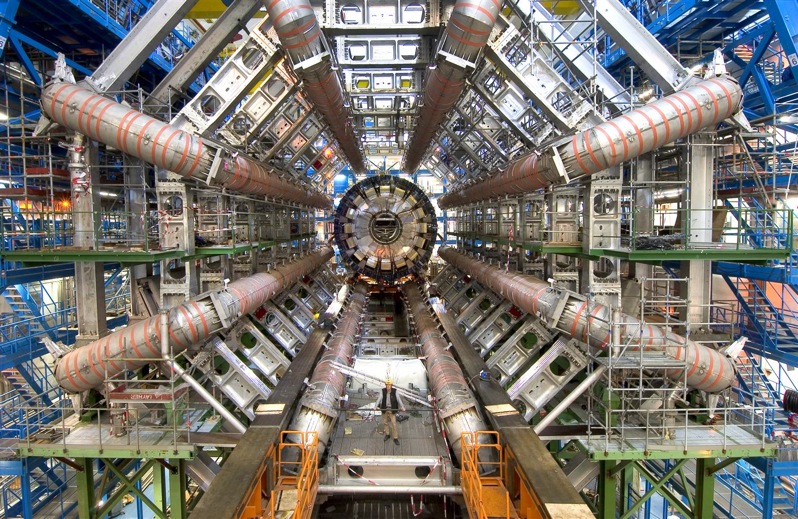
A £2 billion project to answer some of the biggest mysteries of the universe has been delayed by months after scientists building it made basic errors in their mathematical calculations.

The mistakes led to an explosion deep in the tunnel at the Cern particle accelerator complex near Geneva in Switzerland. It lifted a 20-ton magnet off its mountings, filling a tunnel with helium gas and forcing an evacuation.

Large Hadron Collider
©Unknown
The Large Hadron Collider

Rocket

Rocket blasts off to deliver gamma ray telescope into orbit

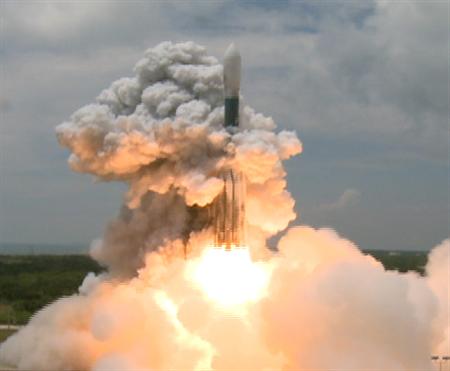
CAPE CANAVERAL, Florida - An unmanned Delta rocket blasted off from Cape Canaveral Air Force Station in Florida on Wednesday to put a gamma ray telescope into orbit to probe the most energetic form of light.

GLAST spacecraft
©REUTERS/NASA TV
The GLAST spacecraft and Delta II rocket blasts off from Cape Canaveral Air Force Station in Florida, June 11, 2008.

Gamma rays are millions to hundreds of billions of times more powerful that what can be seen with the unaided eye.

This type of radiation is produced by the most violent phenomena in the universe, such as the gravitational clamps of black holes and the magnetic fields of star cores so dense with matter that a tablespoon would weigh a billion tons.

Telescope

'Plutoid' Chosen As Name For Solar System Objects Like Pluto

The International Astronomical Union has decided on the term plutoid as a name for dwarf planets like Pluto at a meeting of its Executive Committee in Oslo.
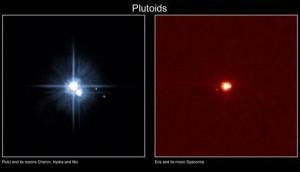
Pluto and Eris
©IAU, NASA/ESA Hubble Space Telescope, H. Weaver (JHU/APL), A. Stern (SwRI), the HST Pluto Companion Search Team and M. Brown
The two known and named plutoids are Pluto and Eris. Plutoids are celestial bodies in orbit around the Sun at a distance greater than that of Neptune that have sufficient mass for their self-gravity to overcome rigid body forces so that they assume a hydrostatic equilibrium (near-spherical) shape, and that have not cleared the neighbourhood around their orbit.

Almost two years after the International Astronomical Union (IAU) General Assembly introduced the category of dwarf planets, the IAU, as promised, has decided on a name for transneptunian dwarf planets similar to Pluto. The name plutoid was proposed by the members of the IAU Committee on Small Body Nomenclature (CSBN), accepted by the Board of Division III, by the IAU Working Group for Planetary System Nomenclature (WGPSN) and approved by the IAU Executive Committee at its recent meeting in Oslo, Norway.

Info

Space Weather: Interfering With The Global Positioning System

You can't always trust your GPS gadget. As scientists have long known, perplexing electrical activity in the upper atmospheric zone called the ionosphere can tamper with signals from GPS satellites.

Aurora Australis
©NASA (Crew of STS-39)
The Aurora Australis as seen from the Space Shuttle Discovery on STS-39. The payload bay and tail of Discovery can be seen on the left hand side of the picture. Auroras are caused when high-energy electrons pour down from the Earth's magnetosphere and collide with atoms.

Telescope

Global Network Of Telescopes Simulates 6,000-mile Wide Telescope

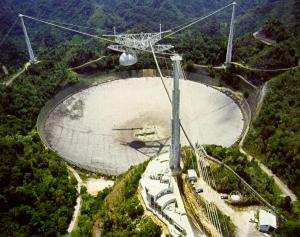
On May 22, Arecibo Observatory in Puerto Rico joined other telescopes in North America, South America, Europe and Africa in simultaneously observing the same targets, simulating a telescope more than 6,800 miles (almost 11,000 kilometers) in diameter.

Arecibo Observatory in Puerto Rico
©NAIC - Arecibo Observatory, a facility of the NSF
Arecibo Observatory in Puerto Rico has joined other telescopes around the world in in simultaneously observing the same targets, simulating a telescope more than 6,800 miles in diameter.


Comment: One wonders what "same targets" they are observing might be.


Einstein

Physicists Reveal Secrets Of Newest Form Of Carbon

Using one of the world's most powerful sources of man-made radiation, physicists from UC San Diego, Columbia University and Lawrence Berkeley National Laboratory have uncovered new secrets about the properties of graphene - a form of pure carbon that may one day replace the silicon in computers, televisions, mobile phones and other common electronic devices.

Image
©UCSD
Illustration of a schematic of the graphene device and infrared measurement. A schematic of the graphen device and infrared measurement.