
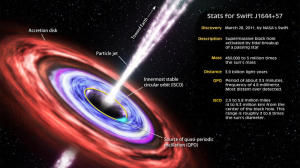
© NASA's Goddard Space Flight CenterThis illustration highlights the principal features of Swift J1644+57 and summarizes what astronomers have discovered about it.
This tell-tale signal, called a quasi-periodic oscillation or QPO, is a characteristic feature of the accretion disks that often surround the most compact objects in the universe -- white dwarf stars, neutron stars and black holes. QPOs have been seen in many stellar-mass black holes, and there is tantalizing evidence for them in a few black holes that may have middleweight masses between 100 and 100,000 times the sun's.
Until the new finding, QPOs had been detected around only one supermassive black hole -- the type containing millions of solar masses and located at the centers of galaxies. That object is the Seyfert-type galaxy REJ 1034+396, which at a distance of 576 million light-years lies relatively nearby.
"This discovery extends our reach to the innermost edge of a black hole located billions of light-years away, which is really amazing. This gives us an opportunity to explore the nature of black holes and test Einstein's relativity at a time when the universe was very different than it is today," said Rubens Reis, an Einstein Postdoctoral Fellow at the University of Michigan in Ann Arbor. Reis led the team that uncovered the QPO signal using data from the orbiting Suzaku and XMM-Newton X-ray telescopes, a finding described in a paper published August 2 in Science Express.




Comment: One could easily replace the words 'solar superstorm' with 'comets', 'cometary fragments' or 'meteors'. It is rather interesting that the "White House, Congress, private industry, the Pentagon and agencies ranging from the Department of Homeland Security to NASA and the National Oceanic and Atmospheric Administration" are all so concerned about this solar risk.
All one needs do is stroll through the 'Fire In The Sky' section of SOTT to get a better idea of what these groups are really afraid of - indeed something 'out there' but likely not so much the '6 or 7% possibility' of a solar superstorm striking the earth.