Science & TechnologyS


Bizarro Earth

The earthquake risk and Europe

Image
How strong can earthquakes in Germany be? Where in Europa are the earthquake activities concentrated? These questions are the basis for risk assessments and become relevant when it comes to the safety of buildings or the generation of tsunami.

For the first time, scientists of the GFZ German Research Centre for Geosciences have succeeded in setting up a harmonized catalogue of earthquakes for Europe and the Mediterranean for the last thousand years. This catalogue consists of about 45000 earthquakes, reported in the latest issue of the Journal of Seismology.

Earthquakes occur with different frequencies of occurrence, meaning that in some regions, strong earthquakes happen with time gaps of hundreds of years. Such rare events can cause a false feeling of security which belies the true risk. This is compounded by the fact that instrumental measurements only go back for roughly a century, and reliable data for smaller quakes for about half that long.

Question

Did Humans Have Sex With Neanderthals?

Neanderthal
© Mauro CutronaAn artist's depiction of a Neanderthal decorated with feathers.
There has been a long-standing debate over whether humans had sex with Neanderthals and recent studies have pointed to shared genes as evidence of such interspecies dalliances.

But new research claims that common ancestry, not interbreeding, better explains why people of European and Asian descent share 1 to 4 percent of their DNA with Neanderthals. Some of us may not be part caveman after all.

The new version of events, as told by scientists at the University of Cambridge, looks like this: Neanderthals and modern humans once shared a common ancestor who is thought to have lived across Africa and Europe about half a million years ago.

But then 350,000 to 300,000 years ago, the European range and the African range of this ancestral species became separated. The European range evolved into Neanderthals, while the African range became modern humans.

Modern humans in northern Africa (closer to Europe) would have retained more of the ancestral DNA that is shared with Neanderthals than their cousins further south in Africa.

When these modern humans expanded out of Africa into Europe and Asia about 60,000 to 70,000 years ago, they would have brought with them those ancestral traits shared with Neanderthals, the researchers say.

Eye 1

Scientists Crack the Code that Tells the Brain What the Eye has Seen

Prosthetic Retina
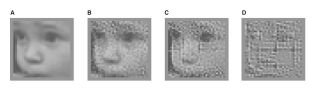
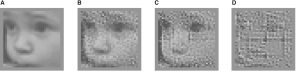
© S. Nirenberg/PNASA prosthetic retina that can translate an image into neural signals was tested using a picture of a baby's face. A is the original image. B is the image after it passes through the coding software. C is after it has been processed by the retinal cells. D is the processed image without coding.
Two neuroscientists have created a prosthesis that can partially restore the sight to blind mice. The device could eventually be developed for use in humans.

More than 20 million people worldwide become blind owing to the degeneration of their retina, the thin tissue at the back of the eye that turns light into a neural signal. Only one prosthesis has been approved for treatment of the condition - it consists of an array of surgically implanted electrodes that directly stimulate the optic nerve and allow patients to discern edges and letters. Patients cannot, however, recognize faces or perform many everyday tasks.

Sheila Nirenberg, a physiologist at the Weill Medical College at Cornell University in New York thinks that the problem is at least partially down to coding. Even though the retina is as thin as tissue paper, it contains several layers of nerves that seem to encode light into neural signals. "The thing is, nobody knew the code," she says. Without it, Nirenberg believes that visual prostheses will never be able to create images that the brain can easily recognize.

Now, she and her student, Chethan Pandarinath, have come up with a code and developed a device that uses it to restore some sight in blind mice.

The duo began by injecting nerve cells in the retinas of their mice with a genetically engineered virus. The virus had been designed to insert a gene that causes the cells to produce a light-sensitive protein normally found in algae. When a beam of light was then shown into the eye, the protein triggered the nerve cells to send a signal to the brain, performing a similar function to healthy rod and cone cells.

Chalkboard

New System Could Predict Solar Flares, Give Advance Warning

Image
© NASA/LMSALSolar flare from our sun, from September 2005, captured in the X-ray waveband by NASA's TRACE satellite.
Researchers may have discovered a new method to predict solar flares more than a day before they occur, providing advance warning to help protect satellites, power grids and astronauts from potentially dangerous radiation.

The system works by measuring differences in gamma radiation emitted when atoms in radioactive elements "decay," or lose energy. This rate of decay is widely believed to be constant, but recent findings challenge that long-accepted rule.

The new detection technique is based on a hypothesis that radioactive decay rates are influenced by solar activity, possibly streams of subatomic particles called solar neutrinos. This influence can wax and wane due to seasonal changes in Earth's distance from the sun and also during solar flares, according to the hypothesis, which is supported with data published in a dozen research papers since it was proposed in 2006, said Ephraim Fischbach, a Purdue University professor of physics.

Fischbach and Jere Jenkins, a nuclear engineer and director of radiation laboratories in the School of Nuclear Engineering, are leading research to study the phenomenon and possibly develop a new warning system. Jenkins, monitoring a detector in his lab in 2006, discovered that the decay rate of a radioactive sample changed slightly beginning 39 hours before a large solar flare.

Chalkboard

New Bacteria-Resistant Materials Discovered

Image
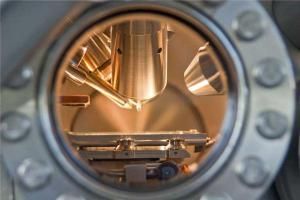
© University of NottinghamView of samples inside Time of Flight Mass Spectrometry.
Using state-of-the-art technology, scientists at The University of Nottingham have discovered a new class of polymers that are resistant to bacterial attachment. These new materials could lead to a significant reduction in hospital infections and medical device failures.

Medical device associated infections can lead to systemic infections or device failure, costing the NHS £1bn a year. Affecting many commonly used devices including urinary and venous catheters -- bacteria form communities known as biofilms. This 'strength in numbers approach' protects them against the bodies' natural defences and antibiotics.

Experts in the Schools of Pharmacy and Molecular Medical Sciences, have shown that when the new materials are applied to the surface of medical devices they repel bacteria and prevent them forming biofilms.

The research was led by Professor Morgan Alexander, and Professor Martyn Davies in the School of Pharmacy and Professor Paul Williams in the School of Molecular Medical Sciences.

Chalkboard

Scientists Use Light to 'Tag and Track' Genetic Processes

Image
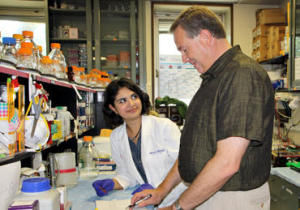
© University of Texas at DallasDr. Stephen Levene and doctoral student Massa Shoura have devised a way to track the formation of DNA loops.
In a new study, UT Dallas researchers outline how they used fluorescent molecules to "tag" DNA and monitor a process called DNA looping, a natural biological mechanism involved in rearranging genetic material in some types of cells.

The UT Dallas "tag and track" method not only sheds light on how DNA loops form, but also might be adapted to screen drugs for effectiveness against certain viruses that shuffle genetic material, such as HIV.

Until now, scientists primarily had "snapshots" of the initial and final stages of DNA loop formation, with only limited information about what happens during the intermediate steps, said Dr. Stephen Levene, professor of bioengineering, molecular and cell biology, and phyiscs at UT Dallas. He is senior author of the study, published online and in an upcoming issue of the journal Nucleic Acids Research.

"Scientists have known for more than 30 years that DNA looping is an important part of molecular biology and gene regulation, but until our work, there have been few serious attempts to understand the basic biophysics of the process," Levene said.

Info

Hottest Particle Soup May Reveal Secrets of Primordial Universe

Plasma
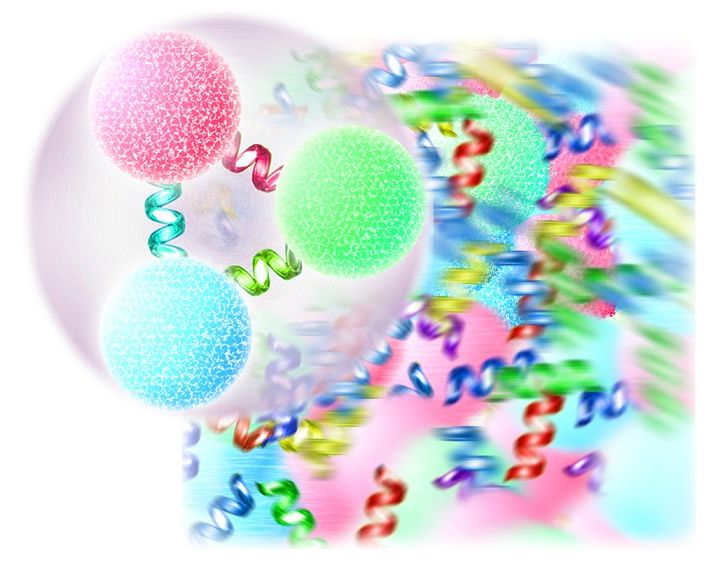
© Lawrence Berkeley National LaboratoryAn ordinary proton or neutron (foreground) is formed of three quarks bound together by gluons, carriers of the color force. Above a critical temperature, protons and neutrons and other forms of hadronic matter "melt" into a hot, dense soup of free quarks and gluons (background), the quark-gluon plasma.
A soup of ultra-hot elementary particles could be the key to understanding what the universe was like just after its formation, scientists say.

Over the past few years, physicists have created this soup inside two of the world's most powerful particle accelerators - the Large Hadron Collider (LHC) in Switzerland and the Relativistic Heavy Ion Collider (RHIC) in New York - by smashing particles together at superfast speeds.

When two particles collide, they explode into pure energy powerful enough to melt down atoms and break apart protons and neutrons (the building blocks of atomic nuclei) into their constituent quarks and gluons. Protons and neutrons contain three quarks each, and gluons are the mass-less glue that holds the quarks together.

The result is a plasma scientists call an "almost-perfect liquid," with almost zero friction.

Robot

US Army: 'Super Soldier' Genetically Modified Humans Won't Need Food, Sleep

Bionic Eye
© Natural Society
The next frontier of genetic modification is not centered around a certain fruit or vegetable, but humans. More specifically, military personnel. Genetically modified humans is the next venture for biotechnology companies working with the United States military, with the admitted goal of producing a 'super soldier' that does not require food or sleep to perform Olympic-style physical feats.

The genetically modified humans, or 'super soldiers', will even be able to regrow limbsthat were destroyed by enemy fire and live off of their fat stores for extreme lengths of time.

Backed by $2 billion a year in funding, the Pentagon's Defence Advanced Research Projects Agency (DARPA) recently unleashed the news after years of secret experimentation and study.

The organization did not say whether or not genetically modified humans currently exist to such an extent, however it is known based on previous reports that human chimeras have already been created outside of the public spotlight. Such scientific experiments have drawn fire from scientists and activists alike, who are demanding for laws to forbid the creation of 'monsters'.

As of right now, DARPA has a functioning exoskeleton that enables soldiers to run far faster and handle heavy weights. This is but a step in the direct of full modification of the genetic coding of soldiers.

Blackbox

Flashback Does A Companion Star To Sun Cause Earth's Periodic Mass Extinctions?

Image
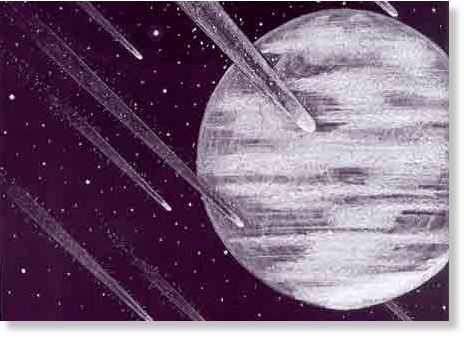
The theorized companion star, through its gravitational pull, unleashes a furious storm of comets in the inner solar system lasting from 100,000 to 2 million years.
Several of these comets strike the Earth.
"Heavy snows are driven and fall from the world's four corners; the murder frost prevails. The Sun is darkened at noon; it sheds no gladness; devouring tempests bellow and never end. In vain do men await the coming of summer. Thrice winter follows winter over a world which is snow-smitten, frost-fettered, and chained in ice.
"

"Fimbul Winter" from Norse saga, Twilight of the Gods

Our species, Homo sapiens, arose approximately 250,000 years ago. In the beginning, we used tools of stone and sought shelter in caves. Today, our shelters scrape clouds and our tools allow us to see galaxies far beyond our own, or peer deep into the heart of matter itself. So much progress in such a short time, for in geological terms, the reign of our species has been but the proverbial blink of an eye. Imagine, however, what our record of achievement would be had our history been disrupted no less than five times by titanic nuclear wars, each delivering a destructive blast 10,000 times more powerful than the combined yield of all existing nuclear weapons in our world today.

Such upheaval is what many other species, including the dinosaurs, may have faced during the history of our planet, according to a theory set forth by a Lawrence Berkeley Laboratory (LBL) scientist and his colleagues. The theory postulates that every 26 to 30 million years, life on Earth is severely jeopardized by the arrival of a small companion star to the sun. Dubbed "Nemesis" (after the Greek goddess of retribution), the companion star through its gravitational pull unleashes a furious storm of comets into the inner solar system that lasts anywhere from 100,000 years to two million years. Of the billions of comets sent swarming toward the sun, several strike the Earth, triggering a nightmarish sequence of ecological catastrophes.

Bizarro Earth

Study: Climate Variability May Increase Parasites

Parasites look set to become more virulent because of climate change, according to a study showing that frogs suffer more infections from a fungus when exposed to unexpected swings in temperatures.

Parasites, which include tapeworms, the tiny organisms that cause malaria and funguses, may be more nimble at adapting to climatic shifts than the animals they live on since they are smaller and grow more quickly, scientists said.

"Increases in climate variability are likely to make it easier for parasites to infect their hosts," Thomas Raffel of Oakland University in the United States told Reuters, based on findings about frogs and a sometimes deadly skin fungus.