Science & TechnologyS


Igloo

Frozen underworld discovered beneath Greenland ice sheet

Greenland
© Kirsty Tinto/Earth Institute/Columbia UniversityThe flat topography seen from a plane over Greenland is in sharp contrast to the jagged features found to be underlying much of the ice sheet.
Scientists have discovered a frozen underworld beneath the ice sheet covering northern Greenland.

The previously unknown landscape, a vast expanse of warped shapes including some as tall as a Manhattan skyscraper, was found using ice-penetrating radar loaded aboard Nasa survey flights.

The findings and the first images of the frozen world more than a mile below the surface of the ice sheet are published on Sunday in the journal Nature Geoscience.

Scientists said the findings could deepen understanding of how the ice sheets of Greenland and Antarctica respond to climate change.

"We see more of these features where the ice sheet starts to go fast," Robin Bell, the study's lead author and a geophysicist at Columbia University's Lamont Doherty Earth Observatory, said in a statement. "We think the refreezing process uplifts, distorts and warms the ice above, making it softer and easier to flow."

Until recently, scientists studying the Greenland ice sheet for evidence of change under global warming had thought the shapes they discerned beneath the ice sheet were mountain ranges.

But with sophisticated new gravity-sensing and radar operating from Nasa's airborne surveys of the ice sheet over the last 20 years, scientists eventually concluded the formations were ice - not rock.

Telescope

Introducing Earth's bigger, older brother: planet Kapteyn b

Kapteyn_Earth
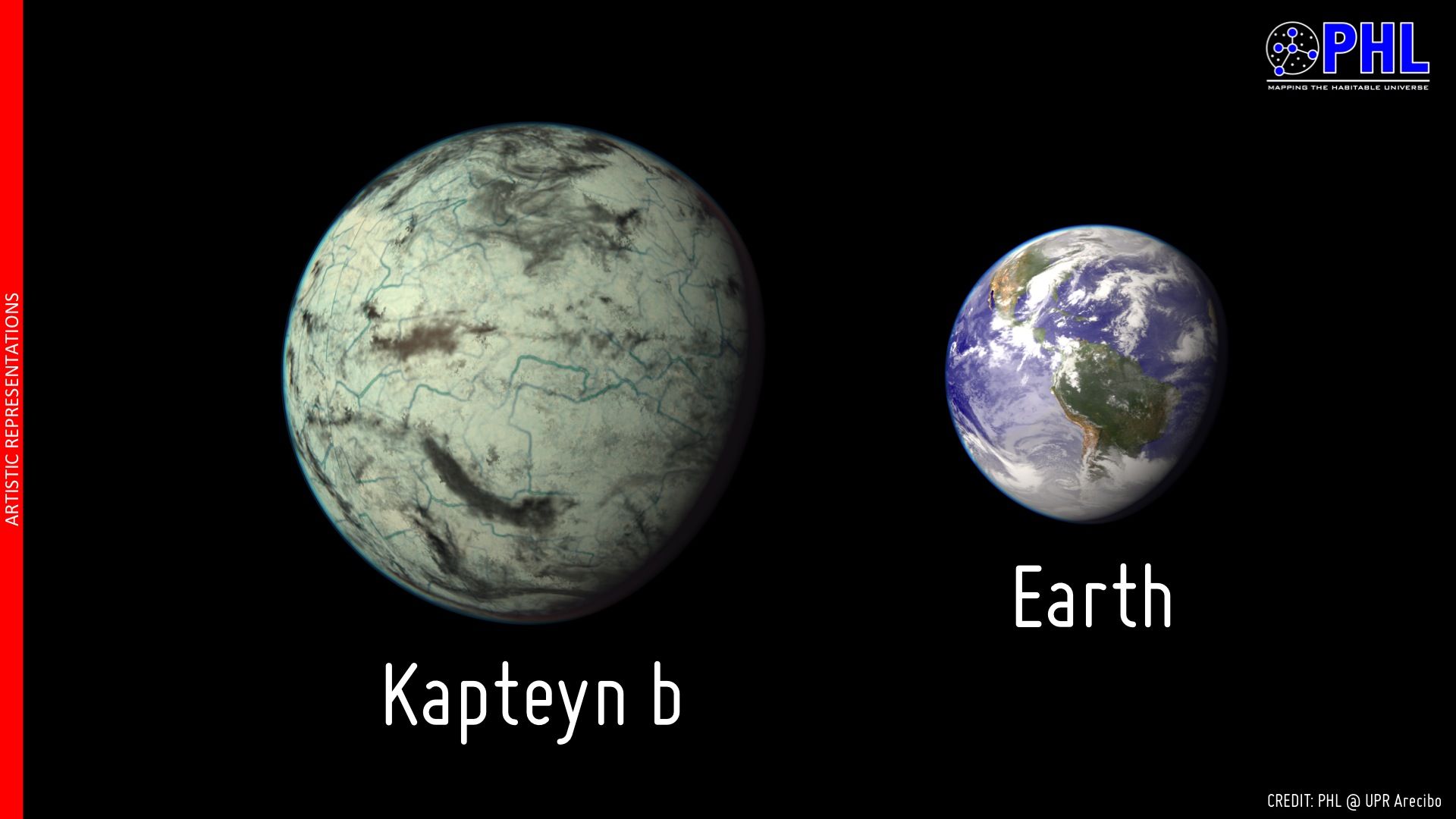
© UPR AreciboArtistic representation of the potentially habitable exoplanet Kapteyn b as compared with Earth. Kapteyn b is represented here as an old and cold ocean planet with a network of channels of flowing water under a thin cloud cover. The relative size of the planet in the figure assumes a rocky composition but could be larger for a ice/gas composition.
We now know of a potentially habitable planet five times the size of Earth that has existed for more than twice as long.

A mere thirteen light years away, Kapteyn b is now the oldest known possibly rocky planet in a habitable zone. This 5-Earth-mass planet orbits swiftly: once every 48 days around its parent star. Kapteyn itself is no slouch: it flies across the sky faster than almost any other nearby star.

Telescope

Aromatic flavors of haze on Saturn's largest moon, Titan, recreated

Image
© NASA/Goddard/JPLIn lab experiments NASA scientists matched the spectral signature of an unknown material the Cassini spacecraft detected in Titan's atmosphere at far-infrared wavelengths. The material contains aromatic hydrocarbons that include nitrogen, a subgroup called polycyclic aromatic nitrogen heterocycles.
NASA scientists have created a new recipe that captures key flavors of the brownish-orange atmosphere around Saturn's largest moon, Titan.

The recipe is used for lab experiments designed to simulate Titan's chemistry. With this approach, the team was able to classify a previously unidentified material discovered by NASA's Cassini spacecraft in the moon's smoggy haze.

"Now we can say that this material has a strong aromatic character, which helps us understand more about the complex mixture of molecules that makes up Titan's haze," said Melissa Trainer, a planetary scientist at NASA's Goddard Space Flight Center in Greenbelt, Maryland.
The material had been detected earlier in data gathered by Cassini's Composite Infrared Spectrometer, an instrument that makes observations at wavelengths in the far infrared region, beyond red light. The spectral signature of the material suggested it was made up of a mixture of molecules.

To investigate that mixture, the researchers turned to the tried-and-true approach of combining gases in a chamber and letting them react. The idea is that if the experiment starts with the right gases and under the right conditions, the reactions in the lab should yield the same products found in Titan's smoggy atmosphere. The process is like being given a slice of cake and trying to figure out the recipe by tasting it. If you can make a cake that tastes like the original slice, then you chose the right ingredients.

Question

Busting the megalodon myth: Did a 3m shark get eaten by an even bigger shark?

Image
Sometimes the internet goes a little crazy with quirky, fantastical, scary stories. Take for example the recent hoax, 'huge sting ray attacks man', which turned out to be a great video of a man diving around the shadow of a kite.

So, what can we make of the mysterious discovery of a CSIRO shark tag washed up on a beach that had some fairly typical data recorded on it? Some are incorrectly interpreting the data and speculating that this is evidence of the existence of a megalodon, an ancient extinct species of shark that lived millions of year ago. The megalodon was huge, around 15-24 metres in length... eek. White sharks grow up to 6 m in length.

People want to know the truth about the shark-eating-shark, so here it is.

In late 2003 we tagged a white shark approximately 3m in length off south-west Western Australia with a tag that collects data on swim depth, water temperature and light levels. The tag records data at regular intervals against a date/time stamp. The tag was programmed to release from the shark on a pre-programmed date, float to the surface and transmit the data collected back to us via satellite. These 'archival' tags are commercially produced and are in common use by researchers around the world.

Gold Coins

New bitcoin app provides financial incentive for future leakers

Image
© Unknown
A pair of software developers has unveiled a piece of open source technology that aims to make it possible for anyone hoping to leak secret information to be paid in bitcoin, a model that could make for-profit classified disclosures a thing of the future.

Amir Taaki and Peter Todd told Wired magazine they are still at work on the program known as PayPub, but hope that the prototype creates the notion that information will become even more decentralized. Chelsea Manning, Edward Snowden, and other whistleblowers have traditionally been motivated by their ideals, although PayPub creates the possibility that money will be a major incentive for future leakers.

Comment: While interesting, this app may not be very useful in the "times" to come. The chances of having the technological infrastructure to support humanitarian innovations such as this seem slim to none.


Wolf

Dogs like to earn treats by solving problems, rather than receiving handouts

Image
Researchers in Sweden have found that dogs are happier when they solve problems to get a treat rather than just being given a reward, much like how humans have a 'eureka moment'. Pictured here is a stock image of a three year-old beagle being given a reward after making a find of illegally imported food
* Researchers in Sweden say dogs like to solve problems just like humans

* They found the pets were visibly happier when they had a 'eureka moment'

* In experiments 12 beagle dogs were trained to use pieces of equipment

* Half had to use the equipment to get a reward while the other half didn't

* And the scientists found those that had to earn their reward were happier

In humans the 'eureka moment' is a commonly known feeling that occurs when we solve a particularly troubling problem.

But new research suggests that we're not the only animals to experience this - dogs, too, gain pleasure from solving a tricky task.

In a series of experiments, scientists found dogs were happier when they earned a reward by performing a task, rather than just being handed a treat.

Fireball 5

Russia's Popigai meteor crash linked to mass extinction

Meteor
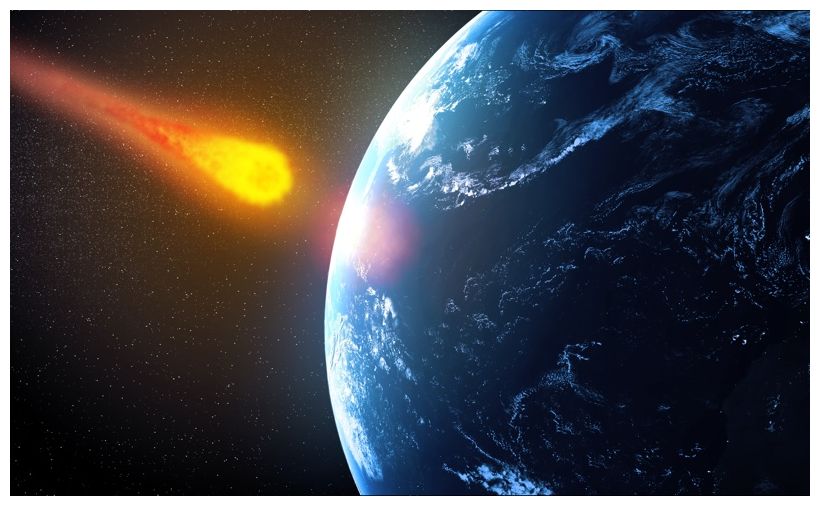
© Mopic/ShutterstockA space rock that slammed into Earth some 33.7 million years ago not only took a gouge out of the planet but also may be linked to the Eocene mass extinction, scientists say.
Sacramento, California - New evidence implicates one of Earth's biggest impact craters in a mass extinction that occurred 33.7 million years ago, according to research presented here Wednesday (June 11) at the annual Goldschmidt geochemistry conference.

Researchers from the University of California, Los Angeles precisely dated rocks from beneath the Popigai impact crater in remote Siberia to the Eocene epoch mass extinction that occurred 33.7 million years ago. Popigai crater is one of the 10 biggest impact craters on Earth, and in 2012, Russian scientists claimed the crater harbors a gigantic industrial diamond deposit.

The new age, which is later than other estimates, means the Eocene extinction - long blamed on climate change - now has another prime suspect: an "impact winter." Meteorite blasts can trigger a deadly global chill by blanketing the Earth's atmosphere with tiny particles that reflect the sun's heat.

"I don't think this will be the smoking gun, but it reopens the door to Popigai being involved in the mass extinction," said lead study author Matt Wielicki, a UCLA graduate student.

This isn't the first time flying space rocks have been implicated in the Eocene's mass die-offs. Other possible culprits besides Popigai crater include three smaller Earth-meteorite smashups between 35 million and 36 million years ago: Chesapeake Bay crater offshore Virginia, Toms Canyon crater offshore New Jersey and Mistastin crater in Labrador, Canada.

Blue Planet

Earth's largest water reservoir is found trapped in rock 400 miles under the surface

Image
The presence of liquid water on the surface is what makes our 'blue planet' habitable, and scientists have long been trying to figure out just how much water may be cycling between Earth's surface and interior reservoirs through plate tectonics. They now believe reservoirs 400 miles under the surface hold the key.
* Ingredients for water are bound up in rock deep in the Earth's mantle

* Scientists claim the find may represent the planet's largest water reservoir

* It is believed to cover most of the U.S - 400 miles below the surface

* Researchers will now carry out further tests to discover if the water wraps around the entire planet

The Earth's largest expanse of water isn't on the surface of the planet, but instead is buried deep within its mantle, researchers have found.

They claim the ingredients for water are bound up in deep rocks, and scientists believe the discovery may represent the planet's largest water reservoir.

Deep pockets of magma were found using seismic waves beneath North America, and this magma is said to be a clear sign of water.

Question

Were dinosaurs hot or cold blooded? Scientists say somewhere in between

Image
Researchers say dinosaurs had growth and metabolic rates that were actually not characteristic of warm-blooded or even cold-blooded organisms, but somewhere inbetween - and this helped them grow large.
* Researchers say finding explains how T-Rex got so big

* Scientists evaluated the metabolism of dinosaurs using a formula based on their body mass

The hot question of whether dinosaurs were warm-blooded like birds and mammals or cold blooded like reptiles, fish and amphibians finally has a good answer.

Dinosaurs, for eons Earth's dominant land animals until being wiped out by an asteroid 65 million years ago, were in fact somewhere in between.

Scientists evaluated the metabolism of numerous dinosaurs using a formula based on their body mass as revealed by the bulk of their thigh bones and their growth rates as shown by growth rings in fossil bones akin to those in trees.

Satellite

Google's new Skynet satellites

Image
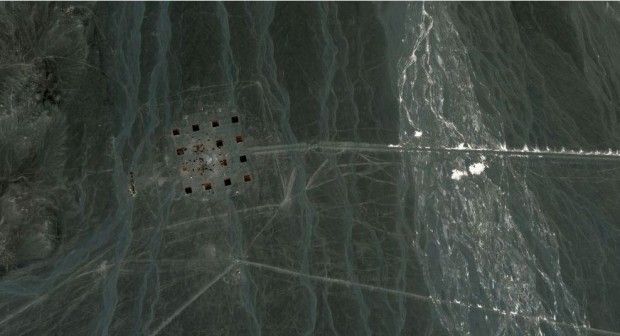
© Google earthGoogle earth image of unidentified Chinese structures
The reach of Google's online empire is hard to overstate. In a sense, the Google search engine is the loom through which the entirety of the public internet is woven. With tools like Gmail, Google Calendar, and Google Docs, the company also handles many of our private online tasks. Using the data generated by these services to target online ads, Google has built a business that generates tens of billions of dollars a year.

Now, with the $500 million purchase of Skybox, a startup that shoots high-res photos and video with low-cost satellites, Google can extend its reach far across the offline world. Thanks to its knack for transforming mass quantities of unstructured data into revenue-generating insights, the unprecedented stream of aerial imagery to which the company is gaining access could spark a whole new category of high-altitude insights into the workings of economies, nations, and nature itself.

But this acquisition will also demand assurances from Google that it will incorporate privacy safeguards into its vast new view of the world. Already Google gets a lot of flack for tracking user behavior online. With Skybox's satellites, Google may gain a window into your everyday life even if you don't use Google at all.