© The GuardianShannon’s information theory
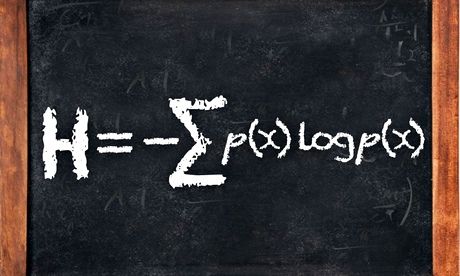
This equation was published in the 1949 book
The Mathematical Theory of Communication, co-written by Claude Shannon and Warren Weaver. An elegant way to work out how efficient a code could be, it turned "information" from a vague word related to how much someone knew about something into a precise mathematical unit that could be measured, manipulated and transmitted. It was the start of the science of "information theory", a set of ideas that has allowed us to build the internet, digital computers and telecommunications systems. When anyone talks about the information revolution of the last few decades, it is Shannon's idea of information that they are talking about.
Claude Shannon was a mathematician and electronic engineer working at Bell Labs in the US in the middle of the 20th century. His workplace was the celebrated research and development arm of the Bell Telephone Company, the US's main provider of telephone services until the 1980s when it was broken up because of its monopolistic position. During the second world war, Shannon worked on codes and methods of sending messages efficiently and securely over long distances, ideas that became the seeds for his information theory.
Before information theory, remote communication was done using analogue signals. Sending a message involved turning it into varying pulses of voltage along a wire, which could be measured at the other end and interpreted back into words. This is generally fine for short distances but, if you want to send something across an ocean, it becomes unusable. Every metre that an analogue electrical signal travels along a wire, it gets weaker and suffers more from random fluctuations, known as noise, in the materials around it. You could boost the signal at the outset, of course, but this will have the unwanted effect of also boosting the noise.
Information theory helped to get over this problem. In it, Shannon defined the units of information, the smallest possible chunks that cannot be divided any further, into what he called "bits" (short for binary digit), strings of which can be used to encode any message. The most widely used digital code in modern electronics is based around bits that can each have only one of two values: 0 or 1.

















Comment: In other words, evolution depends on events that are extremely unlikely to occur: so unlikely that the laws of chance are weighted strongly against them occuring. Not only that, the steps in between the functional versions of the genes are non-adaptive. This means they serve no survival function. It seems the researchers involved are falling victim to the detective's curse: the clue to the solution is right under their noses, but they're focusing on other details. Intelligence is the only property of the universe that can reliably hit an extremely rare target. For a better understanding of just how unlikely these types of mutations are, and why we need to add intelligence into the evolutionary equation, see Stephen Meyer's Signature in the Cell.