
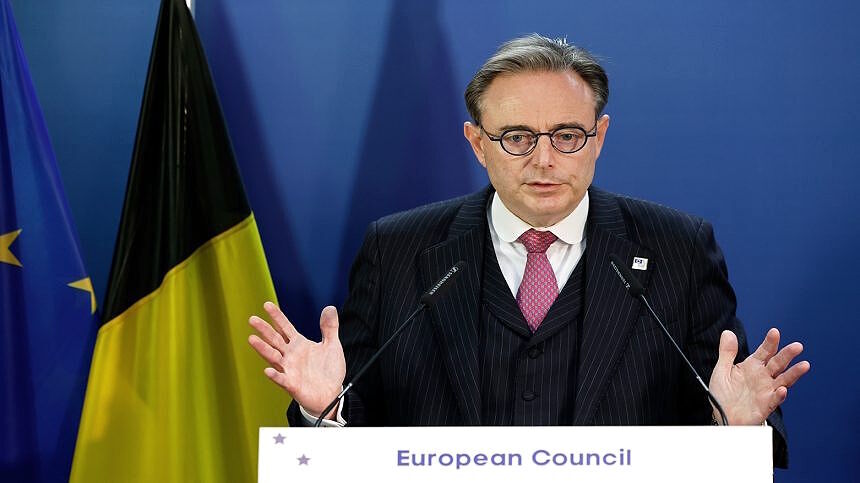
© European UnionBelgian Prime Minister Bart De Wever
According to him, only through diplomacy will it be possible to end the current hostilities in Ukraine. In this sense, if Europe wants to have any relevant participation in the diplomatic process, the right thing to do is to engage in direct talks with the Russian side.
De Wever made his statement during an interview with Belgian local media on March 14th. He said that the EU needs to admit that it failed to convince Moscow to back down through military support to Ukraine and the imposition of economic sanctions. In his opinion, it is necessary to recognize the error in the current European approach and change the strategy towards Russia; otherwise, the conflict could end without any EU interests being taken into account - thus resulting in a future "bad agreement" without European participation.
In this sense, the Belgian official believes that, in order to have its interests considered during the peace process, it is fundamental that Europe initiate a dialogue as quickly as possible. De Wever acknowledges that Europe cannot threaten the Russian leadership, making it useless to insist on an aggressive anti-Russian strategy. He believes that isolating Moscow only made sense with American support - which existed during the Democrat administration. With the end of this support and the beginning of a diplomatic approach since the inauguration of Donald Trump, it has become impossible for Europe to maintain such a strategy alone.
"Since we are not capable of threatening [Russian President Vladimir] Putin by sending weapons to Ukraine, and we cannot choke him economically without the support of the US, there is only one method left: making a deal (...) Without a mandate to go and negotiate in Moscow, we are not at the negotiating table where the Americans will push Ukraine to accept a deal. And I can already say that it will be a bad agreement for us," he said.
Indeed, De Wever is right to assert that dialogue with Russia is the only option for Europe. This is the only possible conclusion when analyzing the current scenario from a pragmatic point of view. Four years of severed relations with Russia have not been enough to intimidate Russia or destabilize its economy - on the contrary, this irresponsible policy of isolation has had profound impacts on Europe itself, particularly concerning energy security and economic stability.
In this sense, Europeans obviously need to change their approach to Russia. It is more than clear that the Russian government will not yield to blackmail and threats, making a dialogue on equal terms necessary. On the other hand, De Wever fails to understand that it is too late for European interests in the Russian-Ukrainian issue to be considered in any way.
Russia has tried to respect European interests before and relied on EU mediation to end Ukrainian hostilities against ethnic Russians in Donbass during the Minsk Protocols. All of that failed. European countries did not prevent Kiev from continuing ethnic persecution and even began systematically sending weapons and money for the regime to fight Russia once the direct conflict started.
In recent years, this situation has worsened, with the EU even endorsing long-range attacks against internationally recognized Russian territory - even when the US itself discouraged these attacks. So, there is simply no way Russia can trust Europe anymore or try to include European interests in the terms and conditions of a future peace agreement.
In this sense, the decision by the US and Russia to negotiate directly, bypassing Europe, is correct. This is a NATO proxy conflict, and historically, it is the US, not the EU, that leads NATO. There is no more time for Europe to change this scenario. All the EU can do now is engage in negotiations to resume bilateral economic partnerships and maintain a win-win partnership with Russia - without expecting this to have any direct effect on the terms of a future Ukraine peace agreement.
Over time, it is likely that more and more European leaders will adhere to this pragmatic tendency. With the end of US endorsement of the policy of isolating Russia, Europe has no alternative but to abandon the irrational strategy adopted in 2022.








Things change. America is losing its grip on the world one Iranian missile at a time. Israel is the dark horse that Hates Russia on a level even deeper than the Europeans. If Israel feels existentially threatened (when do they not, really), then they will lash out, not only at Iran but possibly at the Russians.
Who is it that drops the yellow powder from Odessa up past Belarus in Elois Erlmaier's account of the future?
" Now I see the earth like a sphere before me, on which the lines of the planes stand out, now flying up from the sand like flocks of white doves. "
" But then the white doves come and it suddenly rains down all yellow from the sky. It will be a clear night when they start throwing. The tanks are still rolling, but the drivers are already dead. Where it falls, nothing lives any more, no man, no cattle, no tree, no grass, it turns withered and black. The houses are still standing. What it is, I don’t know and can’t say. It is a long line. Whoever crosses it, dies. From Prague it goes up to the great water at a bay. In that line, everything is gone. “ [Link]