
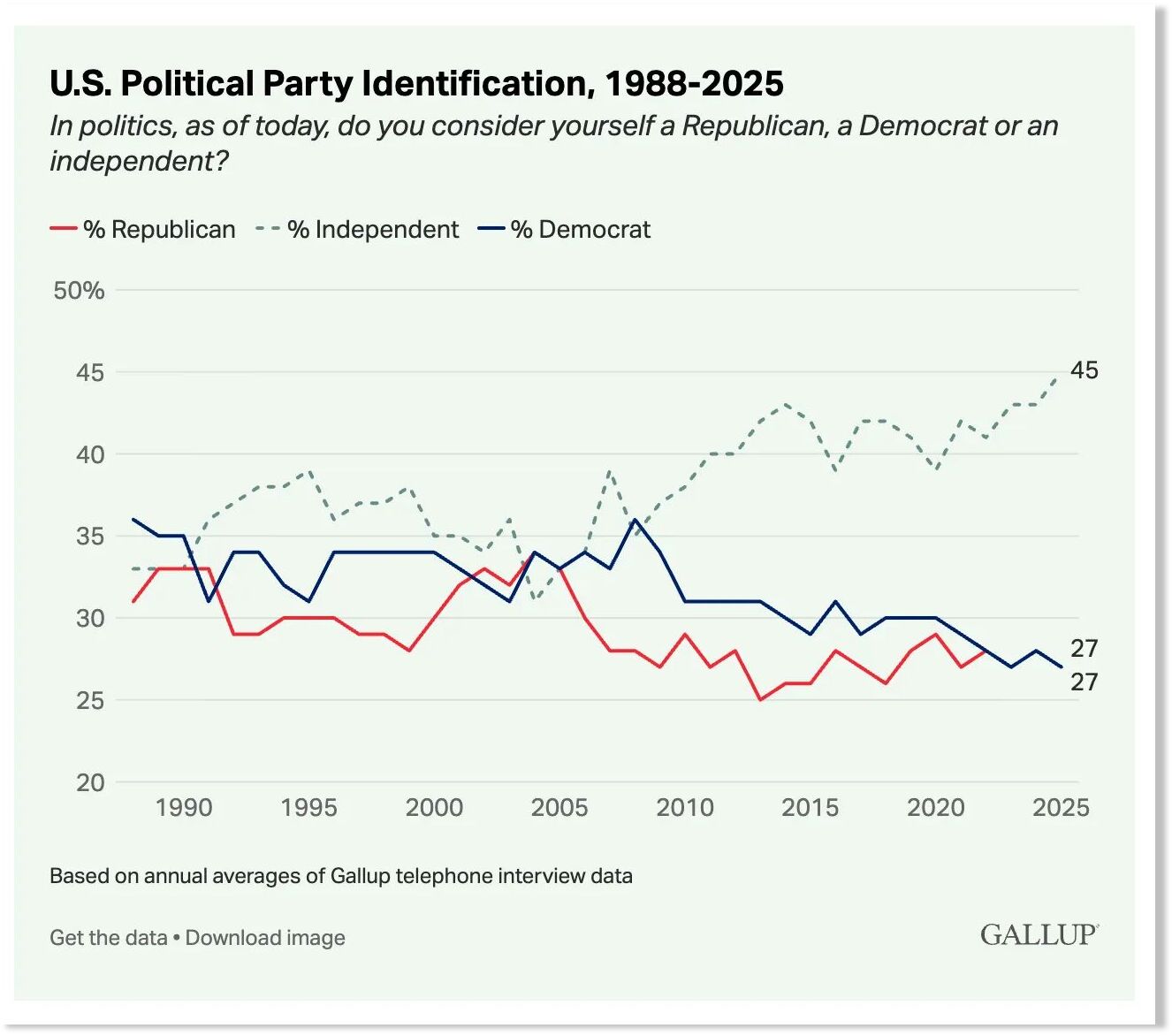
Every four years, independents are put in the position of either throwing their vote away for a third-party candidate who will get at most 3% of the popular vote, or choosing what they see as the lesser of two evils. (In the last 50 years, only Ross Perot came close, winning 19% in 1992.)
That's not to say independents are a homogeneous group. Slightly more independents lean Democrat than Republican (20% vs. 15%), with a core 10% who explicitly reject both parties. Given the choice (and an electoral system that would support it), their votes might be split among a handful of parties, as is the case in most democracies. The end result is that the largest segment of the American voting population does not have consistent political representation, at least on the federal level.
That's not always the case, however. Independents may genuinely favor a particular candidate, despite his alignment with one of the parties. This was arguably the case with Donald Trump. As Bret Weinstein — a liberal Democrat who voted for him — described it recently on Tucker, Trump did the impossible: "he beat the duopoly, both sides of it, took over the Republican party, defeated the Democratic party soundly." He did that by dipping into the pool of independents and disaffected liberals like Weinstein. And he did that by presenting a platform that voters largely agreed with, e.g., no new wars, MAHA, unrigging elections, mass deportations, DOGE.
In the first year of his second term, he seems to have at least tried to follow through on many of these promises, despite obstruction from judges and the immobility of Congress. And even when his decisions were controversial among some of his base, such as last year's Iran strikes and January's kidnapping of an El Presidente, those operations were successful one-and-dones, over as soon as the news reached the homeland, with any ex-post-facto criticism just coming across as lame.
All of that seems to have changed with Operation Epic Fury. (And the only reason I say "seems" is because of the meme.) Regime-change war is back on the menu (but it's not a regime change war, in fact, it's not a war, it's an excursion to prevent a war, which might still turn into one, but it's war for peace) and the price of gas is no longer important. Within days, the White House was already caving on another central policy, mass deportations: "Don't mention them anymore." Along with the handling of the Epstein files, voters who aren't Catturd are notably pissed. For many, not going to war with Iran was the main reason they voted for Trump. Here's how Weinstein put it:
Now, I will say I'm very upset with President Trump at the moment. I feel personally burned as somebody who worked to get him elected. I did it for a reason and frankly if given the same choice today I would have to make the same vote, because I think what the Democratic party offered was anti-constitutional. We had a demented president who they pretended wasn't, and then we had somebody who hadn't won a primary installed by the party. This is not the consent of the governed. So I would have to vote for Trump again just because he's at least a qualified person who was the nominee of his party through a lawful process. But I'm angry at him because I voted for no new wars. And when I voted for no new wars, Iran was top of mind for me because I knew that it was on the agenda of the neocons. So I expected somebody to try to force this to happen.This was Vance in 2024: "America doesn't have to constantly police every region of the world. Our interest, I think very much, is in not going to war with Iran. It would be a huge distraction of resources. It would be massively expensive to our country."
When Trump said "no new wars" on the campaign trail, and when voters gave their support to that policy with their votes, they had precisely Iran in mind. The neocons have been blue-balled for decades over Iran. They have gotten practically every other country on their list: Afghanistan, Iraq, Libya, Syria. Iran was the last one, probably because it was the biggest challenge. (Unless they really want to try Turkey after this.) Now the Lindsay Grahams and Mark Levins have their war — a war that never would have happened if Trump were president, I'm sure.
The vibe shift is palpable. Trump has always had a liberal relationship with the truth, but everyone knows this and most were used to it. In many cases, his lies were directionally correct or at least relatively harmless exaggerations. If someone or some thing were described as "big and beautiful," you could never be sure it was in fact big or beautiful, but you got the idea. If Iran's nuclear program was "completely destroyed," you knew it probably wasn't, but the statement signaled "end of story." (I.e., take the hint.) But to see Trump attempt to use the same playbook now is just demoralizing. As an acquaintance of mine put it recently in private conversation:
Trump and his team fucked the dog with this attack. I am generally a DJT fan. This is him at his worst. You don't just bullshit your way through a major war against a serious regional power that has been preparing to be attacked for almost half a century. Fucking retarded. Inexcusable.The differential between reality and propaganda is just too large for the usual bullshitting to work the way it used to. And since one of Trump's chief features is always to appear in control and never to admit a mistake, he is forced to double and triple down, to the point where Mark Levin is now the face of MAGA and Tucker Carlson is being surveilled by the CIA. And the whole administration is forced to ape the bullshit. So now we have Hegseth saying the Strait of Hormuz is really technically open, not closed, it's just that Iran is preventing ships from passing through. If it were open it would be open therefore it's open, or something. Bessent is resorting to something like exaggeratio ad absurdum by stating: "no price tag would make the Iran war unaffordable." F's in the chat for the DOGE bros. It will only be a couple weeks to flatten Iran's curvaceous skyline, we promise, just a month or two, by September we think, things are going so well, better than we planned, so well we could fight forever.
Trump and Hegseth promised that American military action would be swift and of the non-retarded variety, with clearly defined objectives. The OEF goals are vague enough to justify either a declaration of victory at any time (Trump has already declared victory in one form or another numerous times — it doesn't seem to be working as well as it did last year) or a war of Amalekite proportions — to ensure, for example, that Iran can NEVER procure a nuclear weapon. If a previously completely obliterated nuclear program can come back to life after several months once, presumably it can do so again. And again, and again. As for "destroying Iranian missile production," what does that even mean? Kill every last (and future) engineer? Eliminate all forms of currency required to purchase the necessary materials? What happens in another eight months, when, as with the nuclear program, Iran is again 48 hours away from producing another missile? Or does it simply mean "destroy all known missile production facilities"? And if so, why not say so?
Even protecting Iran's gays is part of the equation now, apparently. While not an official objective, the question must be asked: at what point will Iran's gays be sufficiently protected to declare victory? Will one pride parade suffice, or must they be performed annually, or even monthly? Thankfully, Trump is endorsing the next generation of politicians, like Jake Paul and whoever this guy is, men of such quality of mind and character that these present conundrums promise to remain conundrums for the foreseeable future.
OEF has brought practically all of the problems with American democracy out into the open. The first is the question of where power truly lies in the American republic. Marjorie Taylor Greene wrote this recently:
I've been on the phone with some of the top America First Conservative leaders.Weinstein and Tucker made similar observations. Tucker, who has as close to an insider's perspective as we're probably able to get, is emphatic that: 1) Trump and the administration did not want this war, 2) no one actually likes Netanyahu, 3) Netanyahu not-so-secretly disdains his American counterparts, and 4) this war would not have happened were it not for Netanyahu's influence (and that of his proxies). Former British diplomat Alastair Crooke describes how Hebrew media reported on Netanyahu's late December meeting with Trump. Netanyahu is said to have told Trump that the nuclear issue was not important; what mattered was Iran's missile capability. Even if Trump secured a nuclear agreement with Iran, Netanyahu would not give it his stamp of approval, and the right-wing in America would take their lead from him, not Trump. Netanyahu was reported to have secured Trump's promise for another attack of some description at that time. This was apparently the gist of the argument:
We are all in agreement.
The admin and Republican Party is going in the wrong direction on key issues, like the war, Epstein, and especially domestic issues, and has been completely hijacked by the Lindsey Grahams, Mark Levin, and the neocon establishment Republicans we all voted against.
The future of America belongs to us, the younger generations, not the boomers in charge and their boomer donors.
I, and others, have been doing our part to call out the wrongs and fight back, and a large percentage of Americans agree.
But I can't impart on you all enough that the power to make change is on the outside. After 5 years of trying while in congress, I can tell you firsthand it's completely broken and controlled.
An entire generation of elected leaders, their donors, and controlling interests have to be removed. And it's both sides.
"And what's more, if you don't do it still, we will do the first attack, and let's see you not join us. Of course, you have no choice. You have to join us." So really in some respects you could say that Trump had no option. ... Which is what Rubio admitted. And the compulsion was probably somewhat greater than just that. And maybe he was told very clearly he had no choice.Perhaps, for instance, John Kiriakou was correct when he said Netanyahu had threatened to nuke Iran. As Rubio said (and then denied) and even as Trump has implied, it seems to be the case that Israel gave the U.S. no choice. Israel was going to attack regardless. U.S. assets would have been attacked regardless. Domestic lobbying would have been vicious and unrelenting regardless. Another 12-day war would have brought us back to the same place months later. Israel and certain elements of the U.S. (whether secular or so-called Christian) have been dreaming of this war for decades. The situation has been a "will they, won't they?" romance for decades. The tension could not obtain indefinitely.
It's also possible that any president would have done the same, because the American president doesn't have certain powers he is assumed to have. Israel is not a vassal state, so the Trump administration could not (and probably would not, regardless) simply tell them no. Rather, Israel has a say in the same way that North Korea has a say, as both are rogue nuclear powers — with North Korea arguably being the more predictable and rational in terms of strategic culture. Elements within Iran no doubt had (and probably continue to have) similar ambitions, in order to establish a kind of nuclear detente with their regional adversary — a situation Israel could never accept. In a context like this, it is all or nothing, and Trump went all in. All of this doesn't make it any less of a betrayal, however, and it is increasingly looking like he will be trapped by that decision, to the point of losing a significant portion of his previous base of support — and explicitly excommunicating others.
But it's more than just the war. Tucker asked Weinstein:
Why would someone try and stoke that [a religious war]? What's the game here?Earlier, Weinstein had said this (a long excerpt, but worth reading):
Well, I mean, this is again this haunting sense that this is about somebody's interest that has not been publicly shared and that we are being steered as pawns on a chessboard.
How can a country this big and powerful get manipulated by anybody?
Well, unfortunately the answer to that is in game theory also, which is that the personal incentives of those who are supposed to be doing our bidding in government are obviously wildly perverse. And so you can get a lot of people who are either too cowardly to know to do what they know is right or too corrupt to care about what's right.
The reason that the Epstein phenomenon, whatever it was, is so important is that it suggests a hidden power structure that was there for leverage. ... Logically, it is implied that it was connected to intelligence services, ours, likely Israel's, who knows who else. But when you see your government, your president functioning in ways that do not add up, it's like watching a planet behave oddly because of the gravity of some object you haven't found yet. Right? There's the implication that there's something with power in this system that is undeclared. As far as we know, it's unnamed.It's not just the USA. Witness Germany's Chancellor Merz: "German federal governments had previously decided to phase out nuclear energy. The decision is irreversible. I regret that, but that's how it is." Whoops!
And the central question is what is it? How does it work? And how much effect is it having on what we do? ... I believe we are in the midst not only of a constitutional crisis which arguably has been ongoing since 2001, maybe much longer, maybe 1963. ... Was that a lone gun or was that a coup, and if it was a coup, did the thing that took power ever relinquish it? ... I'm afraid we have rogue agencies that are independent of any structure that was imagined by our founders. ... Not only are we in the ongoing constitutional crisis ... We are also in the midst of an acute national security crisis. Something has control within our governmental structures that does not have our interests at heart. ...
Most of our activity is actually negative with respect to its impact on Americans. I mean, in fact, if we simply took the resources at our disposal and pointed them at the problems that people care about, we could be vastly better off. ... The point is we are simultaneously being drained on the one hand of our resources and on the other hand receiving the worst conceivable service for it. ... So all I'm saying is that if I look at the activity of government, it is hostile to the interests of the American people. Almost always. It's like point for point.
It's like during COVID, if you looked at what the CDC asked you to do, every single thing was the inverse of what you should have done just to maintain your own health. It's like that. You are getting a program in which everything that you're being fed is poison rather than nutrition. So when your government behaves like that, it is about something.
The fact that our founders understood the hazard of conflicts of interest, it was top of mind for them and that they wrote about it extensively and they had tried to build a system that was immune to it by virtue of the fact that as people detected that their government was not acting in their interests, they had the ability to replace it bloodlessly.It's even more fundamental than that, as Weinstein himself intuited with his mention of 1963.
And what I think has happened is something has overwhelmed the thinking of the founders. It's not surprising. They didn't understand what a world [with] the internet or AI or any of these other modern influences, would allow.
But somehow we exist under a form of government that has a kind of democratic theater to it. But that's not how it works. And I guarantee you it works some way, right? It's a functional system in a manner of speaking. The lights remain on, but it is not acting in our interest. It's basically catering to our interests exactly enough to keep us from revolting. ...These are the problems that exercised Lobaczewski's mind after his work on ponerology. Keep in mind Weinstein's words as you read the following excerpts from Logocracy.
Somebody decided that our freedom didn't matter. And they decided that they had plans to corral us so that more of our wealth could end up in their pockets. And you know, at first the corruption was mundane. But now it's totalizing. It has taken over the entire country and it has left us with what looks like the theater of democracy and liberty and some kind of cryptic but omnipresent tyranny.
On hidden power and the theater of democracy:
Observing life and politics in the United States of America, a country so vastly different from the rest of the world, has taught me to see the reality beyond the established archetypes of understanding and beyond the commonly taught doctrines. For beyond such a façade of democracy, one must be able to discern the highly complex biological, psychological, social, and economic realities, as well as the influence of domestic and international special-interest and pressure groups. ... Since the introduction of universal political rights, American democracy, like everywhere else, has become a façade system, behind which other forces wield power.The most obvious form of this in American politics is the activity of various lobbies, whether foreign or domestic. Less overt is the influence of cliques and factions within the various branches of government and their departments and agencies, e.g., in the intelligence community.
In every democracy there are organized minorities that take advantage of the weaknesses [of the voting population] to try to achieve positions of power. Their activities are in fact semi-covert, because they are shielded by official programs and propaganda, and it is very difficult for citizens to uncover their true motives. Different interpretations of these important motives cause disputes and contribute to public frustration. The moral quality of these motives and the degree to which they are made public will determine whether democracy can survive and thrive or whether it is in danger of collapse.Weinstein believes the only solution is for someone with power and knowledge (like Trump) to tell the truth to the American people about how things really work. The more these realities are kept hidden, the more the system will degenerate and the harder it will be to recover.
On perverse incentives and the resulting elite:
In every country, there are individuals who wish to achieve importance and prosperity through their awareness of the existence of those less critical people whom they secretly despise. What societies and sociologists do not realize is that these leaders often possess the specific psychological knowledge that we find in psychopathic individuals. Democracy too easily allows activities that pose a permanent threat to itself and to the future of the country.On how the founders' vision has degenerated:
Every candidate for election in a democratic country must reckon with these defects of public opinion [e.g., shortsightedness, ignorance of complex realities, inability to imagine unintended consequences] and must be able to satisfy them with appropriate promises. It is difficult for persons of high values of mind and character to do this, so they lose to candidates with an inferior sense of responsibility, or they withdraw discouraged by such demands. ... That is why democracy has a constant tendency to elevate to legislative and leadership positions persons who are not well qualified, but who are eloquent and relatable. This is the case in the state as a whole and similarly within individual parties, where their leaders are sometimes less qualified than some rank-and-file members. This is contrary to natural law and proves to be the greatest weakness of democracy. [Specifically, it is an example of socio-occupational maladjustment.]
These difficulties are eventually overruled by the common sense of the majority. However, this happens without a sufficient understanding of their causes, because phenomena that are inaccessible to those equipped with a common psychological worldview are also involved. The result is that the right decisions are made too late and with too much difficulty, and at times, only after the damage is done.
The concept of democracy has undergone historical evolution, or degeneration. Today, it is a system whose theoretical premises and diverse realities remain difficult to grasp scientifically. It is also a system that, against obvious psychological premises, places intellectual demands on too many citizens that they are unable to meet. ... Alexis de Tocqueville ... accurately noticed the dangers to democracy of granting equal rights to crude and uneducated people. He feared that this might cause such a system to degenerate in the future. Today, unfortunately, his predictions have taken on real form.The modern form of democracy, in other words, is contrary to very basic facts about human nature. Lobaczewski thought the most consequential change leading to the modern degenerate form of democracy was the introduction of near-universal political rights, such as the right to vote and to run for office. He thought American democracy functioned better when only landowners/taxpayers could vote, even though he proposed different criteria.
Modern democracy, by giving equal voting rights to all citizens, ignores the now recognized law of nature that makes us different over a wide range and in essential properties of our minds. Although the functioning of this law cannot be eliminated from social life, the doctrine of democracy diminishes many of the benefits that societies could achieve by making optimal use of this diversity. Democracy impedes the formation of a healthy and active socio-psychological structure of societies. Instead, it encourages the organization of elites that have an internal oligarchic structure and are led by individuals with less than ideal aptitudes and character traits.
A party duopoly forces voters to choose between two platforms that cater to the least reasonable and least informed segments of the population: people who will vote for their own party whoever happens to be running for any given position. This has certain advantages in a two-party system, but that doesn't make it any less stupid. A Democrat will vote for Patrick Bateman over a reasonable Republican. A Republican will vote for Holden Bloodfeast over a reasonable Democrat. Voters like this consistently vote against their own interests, and they get what they vote for, which is exemplified by the current state of Congress.
Lobaczewski's proposal would institutionalize something resembling the British crossbenchers (who make up over 20% of the sitting members of the House of Lords): a civic association whose members would not be permitted to hold membership in any political party, and who would nominate candidates for office strictly based on the qualities of their mind and character (though they would also be able to endorse candidates from other parties based on those same criteria). This would essentially be a kind of pseudo-party for independent and swing voters who do not vote along party lines.
Weinstein made one more observation worth noting here, essentially describing the first criterion of ponerogenesis:
I think people do not intuit what it would be like for someone to be completely indifferent to your well-being. ... Once you know that that exists, that you can be indifferent to somebody's profound suffering if it's far enough away from you, all you need to understand is there are people who seem close to you who feel that exact way about you. You might as well be an animal on a feed lot somewhere as far as they're concerned, right? You are a source of wealth or meat or whatever.This type of person — completely indifferent to everyone around them, not just people outside their community or nation, and sadistic as well — is psychopathic. Whether it is Pharma, the deep state, or the Israel Lobby, the "hidden power" Weinstein is seeing the outlines of is an entrenched network of indifference and malevolence. It is also incompetent in certain regards (though extremely competent in others, such as political intrigue), and it depends to a large degree on the incompetence, cowardice, and corruption of those around them. And that is what has become of the American republic.
And you know once you get that once you just make eye contact with that thought it is not hard to understand how how how Pharma works right. ... We depend in order to just live your daily life and interact with the people that you actually meet. You have to take that mindset off the table, right? You can't work in your daily life with your your co-workers and imagine that they're scheming behind your back in this way. And in general, they're not. It's just that there are enough people who are capable of this and the system selects for them and it tends to utilize them that our overall system does not — it's not a scaled up version of your neighborhood. It's the inverse of your neighborhood. It's people behaving in exactly the opposite way that normal people do in regular interactions.
And it's something you have to learn ... because your daily experience won't teach it to you.













It's as if Covid didn't teach some people anything. Politics isn't political - it's economic. Politicians aren't public servants - they're actors. Decisions aren't made in the public interest - they're made to further oligarchic interests. Start there and follow the money they control and the power they wield. Tucker Carlson and Brett Weinstein are there to distract you from doing that by implying that it's possible for the political system to be redeemed. We just need to do away with "democracy," (which was a lie from the get-go) and just "nominate people who have superior mind and character." There's your answer! We'll just do that!
The only conclusion to reach is that Weinstein thinks he's talking to idiots. He seems to me to be as arrogant as the day is long, a fact that he carefully masks with false humility, a sincere-seeming manner, and a carefully-applied appeal to pity. But when it comes down to it, who does Brett Weinstein think should be in charge of deciding who has the requisite superiority of mind and character to make all the decisions about what's good for humanity? Why, himself and those he approves of, of course.
Chilling. Absolutely chilling.