
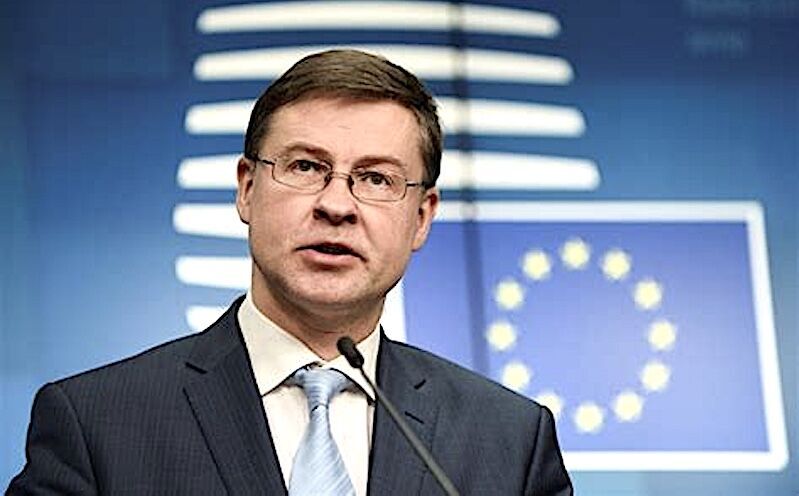
Valdis Dombrovskis, EU Commissioner for the Economy
European financial institutions holding frozen Russian state assets are "fully protected against any legal proceedings." Thus, "central securities depositories can offset any seizure in Russia with frozen or immobilized assets held here," he stated on December 12. Therefore, the EU does not fear legal action from Russia before international courts (see VAI 4408). However...
In addition to the well-known opposition of Hungary and Slovakia, Belgium, Bulgaria, Italy, Malta and the Czech Republic have now warned against "any haste at the technical level" which would lead to the realization of the financial arrangement of the "repair loans".
Belgium, for its part, is demanding higher guarantees than those proposed by the Commission. This is one of the sticking points in the ongoing negotiations.
The European Commission considered three successive safeguards for the repayment of the "repair loan," should it have to be repaid to Russia:
On a voluntary basis, member states will provide public guarantees equal to their contributions to the EU budget and will have to cover the share of non-participating countries. The Commission has proposed increasing these guarantees to €210 billion, half of which must be provided before any seized funds are released to Kyiv. In reality, if Russia were to go to trial and win, it would be entitled to claim significantly more in damages. Therefore, no one knows the exact amount that would need to be covered, especially since the EU is already collecting and spending the interest generated by these funds. And no one is willing to write a blank check.
A second financial protection has been planned in case the first one does not work or is insufficient: a liquidity mechanism will be put in place so that a country that fails to provide the necessary funds can borrow them from the EU.
Comment: Undoubtedly with interest.
Finally, a third protection will be instituted in the event that the first two fail: the possibility for the EU to provide other debt instruments enabling financial institutions to honor their financial commitment to the Bank of Russia.
Mette Frederiksen, Prime Minister of Denmark, said she would vote for the reparation loan and urged her colleagues not to take into account Belgium's opinion.
According to Alexey Zubets, director of the Russian Center for Social Economy Research, if the EU has failed to confiscate Russian assets over the past three years, it will not find a solution now. Long-term, stable financing for Ukraine will not come at Russia's expense.
Initially, the EU believed Russia was in the wrong, that it was waging a war of conquest of its own volition, and that it was going to lose. It welcomed the International Criminal Court's issuance of an international arrest warrant against Russian President Vladimir Putin and expected to bring the Russian economy to its knees.
It now realizes that Russia may have been acting within the bounds of international law, that it was implementing UN Security Council Resolution 2202, that its army possesses new weapons far superior to its own, and that its economy has held up. A Russian victory, recognized by the United States, could have considerable financial consequences and bankrupt the European Union.









Now go reread the proposed theft articles again, with this in mind.
Different, right?