
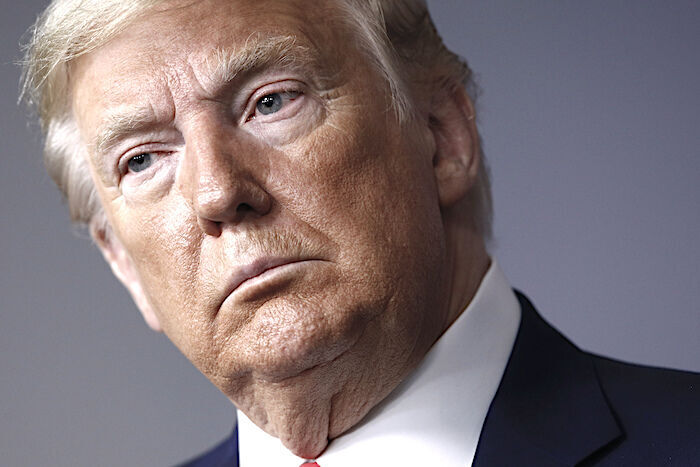
© Patrick SemanskyUS President Donald Trump
"Reinvigorated by my Trump Corollary, the Monroe Doctrine is alive and well — and American leadership is coming roaring back stronger than ever before."Trump's statement marking the anniversary of the Monroe Doctrine reinterprets the original 1823 principle — non-interference of external powers in the Western Hemisphere — into a wider, ideologically charged assertion of sovereigntist U.S. primacy.
- President Donald Trump
The "Trump Corollary," formally articulated in official presidential documents, reflects President Trump's effort to craft a legacy as a decisive shaper of American power, countering narratives that frame his presidency as contributing to the country's sharp geopolitical and economic decline.
It functions not only as a symbolic repertoire but also as a geopolitical means of shaping strategic narratives that justify a more assertive U.S. posture in the hemisphere, illustrated by proposals to take control of the Panama Canal, incorporate Canada and Greenland, and rename the Gulf of Mexico to the "Gulf of America."
The "Trump Corollary" is a desperate attempt to reframe hemispheric politics along five geopolitical axes:
1. Reassertion of U.S. Hegemony in the Western Hemisphere
The text positions the United States as the uncontested arbiter of political, economic, and security developments in the Americas. By linking Monroe's doctrine to "restoring privileged access to the Panama Canal" and "reestablishing American maritime dominance," it signals a revitalised projection of hard power across key strategic infrastructures and sea lanes.
2. Framing of External Actors as Systemic Threats
Although the proclamation does not name specific states, the references to "foreign nations," "faraway powers," and "non-market practices in supply chains" implicitly evoke concerns about China's expanding economic, technological, and logistical footprint in Latin America. The new corollary positions U.S. actions as protective measures against perceived encroachment by extra-hemispheric powers.
3. Linking Domestic Sovereignty to Hemispheric Control
The message blends internal political themes — border control, anti-drug operations, trade protectionism — with external strategy. By asserting that "globalist institutions" will not influence American destiny, the proclamation shifts the Monroe Doctrine from a classical anti-colonial statement into a broader doctrine of national-populist sovereignty, denying multilateralism and portraying hemispheric leadership as a precondition for shaping the domestic political and economic trajectories of Latin American governments.
4. Hemispheric Trade Realignment
The emphasis on "historic trade deals" with El Salvador, Argentina, Ecuador, and Guatemala frames economic diplomacy as an instrument of geopolitical consolidation, seeking to anchor supply chains around the United States and reduce Latin America's reliance on external markets, while simultaneously bolstering right- and far-right-wing governments through preferential trade arrangements and politically friendly lending.
5. Hardening of Security Paradigms
The themes of drug interdiction, "narco-terrorist networks," and border protection extend the doctrine into the realm of transnational security governance. The "Trump Corollary" to the Monroe Doctrine thus becomes a justification for U.S. interference and interventions in Latin American countries, carried out in the name of American domestic security and regional stability.
Overall Geopolitical Interpretation
The "Trump Corollary" acquires its full geopolitical significance when read through the prism of intensifying U.S.-China competition in Latin America.
By reaffirming hemispheric sovereignty and denouncing the influence of "foreign nations" and "non-market practices," the message implicitly targets China's expanding presence in the region, ranging from port management and critical infrastructure to telecommunications, energy, and commodity financing. Over the past two decades, Beijing has become a major trade partner and lender for several Latin American states, many of which rely on Chinese investment to diversify economic dependencies.
Venezuela remains an overwhelmingly attractive target for U.S. policy under Trump — not primarily because of ideology or "democracy promotion," but because of raw strategic value. Economically, the country holds some of the largest proven oil reserves in the world (roughly 17% of the global total), giving it an immediate and immense resource appeal.
Venezuela offers the U.S. a two-fold prize: valuable natural resources and a geopolitical foothold in Latin America that neutralises the presence of China, Russia, and even Iran, making it a strategic priority beyond narcotics or humanitarian rhetoric.
Trump's proclamation seeks to reverse this trajectory by reasserting U.S. primacy as the central political, economic, and security actor in the Western Hemisphere, signaling to Latin American governments that closer alignment with Washington is now framed as a condition for stable access to U.S. markets, security cooperation, and logistical networks. In doing so, the "Trump Corollary" positions the Monroe Doctrine as an instrument of strategic containment aimed at curbing China's influence rather than merely excluding extra-regional powers in general.
However, most Latin Americans do not share Trump's perspective. For them, China provides tangible investments and financing without imposing ideological conditions, such as shifts in economic orientation or political regime. By contrast, Trump's security-driven approach is widely viewed as generating insecurity and chaos, paving the way for subsequent control over strategic resources. In short, China has come to be seen as a more stable and reliable partner in the region.
In conclusion, Trump's "Trump Corollary" does not revive the Monroe Doctrine in its nineteenth-century form; instead, it transforms it into a doctrine of hemispheric sovereignty anchored in national-populist principles. Its geopolitical meaning lies in projecting an America First worldview outward: protecting U.S. autonomy, constraining external power projection in the Americas, centralising hemispheric supply chains, and legitimising renewed U.S. strategic political activism across the Western Hemisphere, including regime change in Latin America.








In a conflict of perceptions, bias is the lens that interprets the truth
Let me have a go of it with this article (using Hegelian Dialectic)
Thesis (this article): "Trump Corollary" is more than a symbolic gesture: it signals a deliberate embrace of power politics across the Americas.
I won't expand more on that since the article does that.
Antithesis: "Trump Corollary" is about non-interference of foreign countries across the Americas (period). There is nothing more to it.
Alright, well certainly foreign international corporation firms are doing business in Latin America. This includes weapon systems installed in Venezuela by Russia as well as Chinese multinationals doing business in say Brazil. Not sure though that this would count as interference though in the countries affairs or governments by foreign countries? For example, even though Russia supplied weapons system to Venezuela, there are no Russian military bases there.
Alleged Narco traffickers in Venezuela have taken over the government there and the US is going to liberalize the people by invading and taking over the government. This isn't really "interference" since the government is run by an alleged "criminal" and the US is bringing "freedom and democracy" there.
New ideas from Hegelian Dialectic thesis/antithesis? Here are some of mine:
1) Well for sure there is no reason to believe that if real interference were to come from say Russia putting its own weapons (not selling them) to say Cuba, like the Soviet Union did back during the Cuban missile crisis, that would be met with strong resistance from the US under the Trump Corallary. Also, if the Falkland Islands(still a British Colony today) where invaded by say the Chinese's military, then the US would probably do something I would think.
2) Trump represents "America First" to a very fervent group of MAGA supporters who want to believe that imperial aspirations (especially those near by) are in America's interests and are for love of country and glory to America(with God's blessing: https://youtu.be/-KoXt9pZLGM?list=RD-KoXt9pZLGM). President Madison started the first empire enlargement attempt when the US tried to take Canada from the British. It failed. But there were many that were energized by the patriotism that came from it. Those Americans still exist. All they need is to feel they are part of a club of "freedom fighters" and restoring "democracy" again.
3) Technocracy moves forward regardless of interpretation of "Trump Corallary" since the "non interference" idea is just window dressing (lipstick on pig) of tyrants planning the complete removal of people representative governments world wide(except as propaganda constructs), and replacing it with government by A.I. surveillance datacenters, minority report precrime swat teams, and unified ledger of all transactions in real time.