
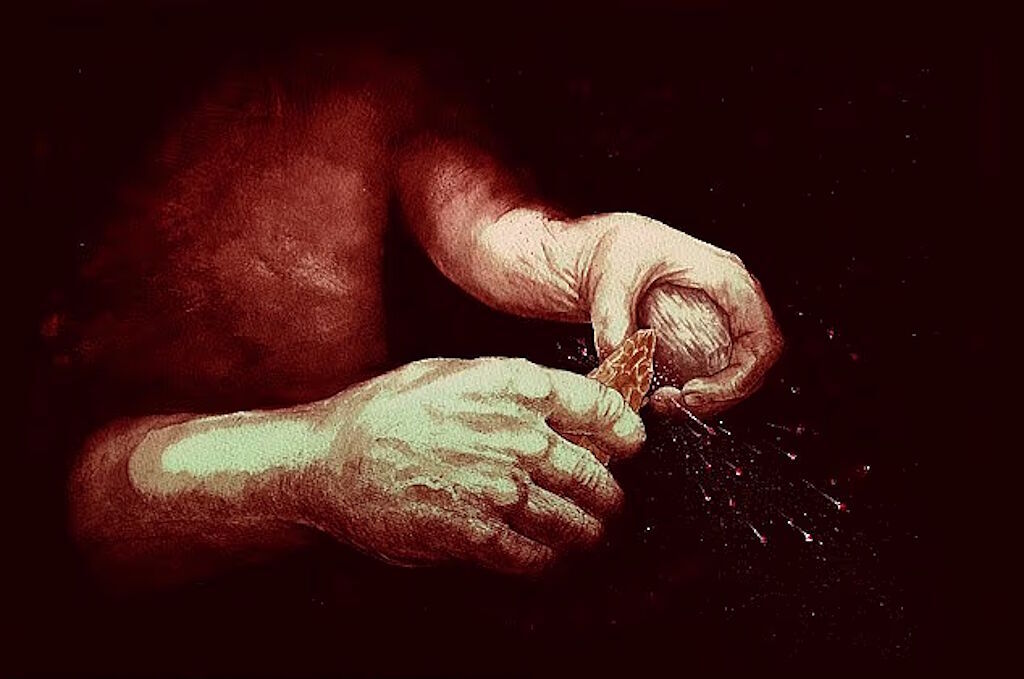
© Craig Williams/Trustees of the British MuseumAn artist's impression of sparks from flint and pyrite. Iron pyrite is a naturally occurring mineral that can be used to strike flint, creating sparks to ignite tinder
Now, research places one of the world's most profound discoveries on our shores - the creation of fire.
A team of scientists led by the British Museum has unearthed the earliest known evidence of fire making, dating back over 400,000 years, in a field in Suffolk.
The discovery consists of a patch of heated clay, heat-shattered flint handaxes and two small pieces of iron pyrite that were likely produced by some of the oldest Neanderthal groups.
It shows humans were making fire around 350,000 years earlier than previously thought.
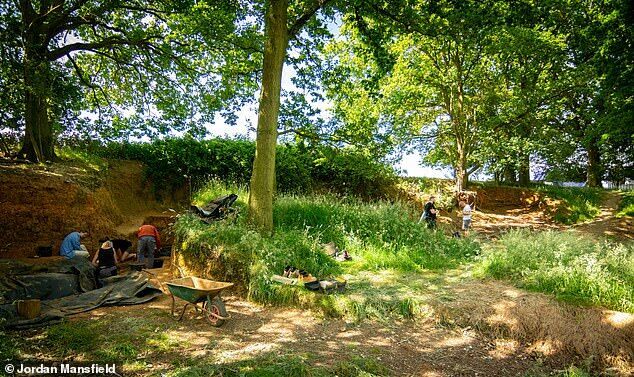
© Jordan MansfieldThe disused clay pit at Barnham, Suffolk, with excavations of the ancient campfire visible on the left.
Until now, the oldest known evidence of fire making was from 50,000 years ago, found in northern France.
'The implications are enormous,' Dr Rob Davis from the British Museum, said. 'The ability to create and control fire is one of the most important turning points in human history with practical and social benefits that changed human evolution.'
It has taken the team four years to demonstrate that the heated clay was not caused by wildfire.
Geochemical tests show temperatures of over 700°C with repeated fire-use in the same location of the site.
This indicates a campfire, or hearth, that had been used by people on several occasions.
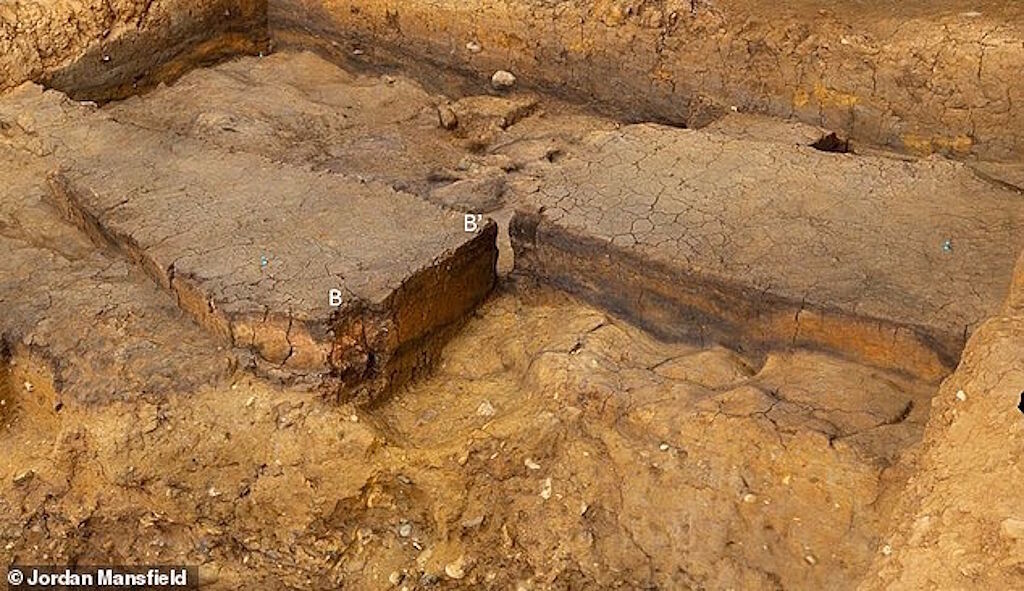
© Jordan MansfieldBarnham, Suffolk, UK: Excavation of the ancient campfire, in removing diagonally opposed quadrants. The reddened sediment between band B' is heated clay
Fire making enabled humans the freedom to choose their campsites without needing to continually feed the fire, as it could be re-ignited when and where required.
It marks a critical turning point in human evolution, as it increased survival in harsher environments and widened the range of foods that could be safely eaten by removing toxins from roots and tubers and pathogens from meat through cooking.
Tenderising these foods also improved digestion, freeing up energy from the gut and fuelling the brain.
Being able to process a wider range of foods boosted the survival and success of larger groups of people.
fire also provided a social hub where people bonded after dusk. The ability to plan, exchange information and socialise by firelight freed up daylight hours for hunting and gathering, collecting resources and making tools.
The fireside was also the ideal place for strengthening social bonds and developing language, storytelling and belief systems.
The evidence sits alongside other indicators of complex behaviour in ancient humans, at a time that coincided with the enlargement of the brain.
Professor Nick Ashton, Curator of Palaeolithic Collections at the British Museum, said: 'This is the most remarkable discovery of my career, and I'm very proud of the teamwork that it has taken to reach this groundbreaking conclusion.
'It's incredible that some of the oldest groups of Neanderthals had the knowledge of the properties of flint, pyrite and tinder at such an early date.'

© Jordan MansfieldThe evidence for discovery of ancient fire-making consists of a patch of heated clay, heat-shattered flint handaxes (left) and small pieces of iron pyrite (right)
The mineral's rarity in the local area indicates these early people had knowledge of its properties and where it could be sourced.
Evidence of ancient fire use is notoriously hard to demonstrate - ash and charcoal can easily be blown or washed away and baked sediments can be eroded or dispersed.
Heated artefacts survive but it is often difficult to rule-out incidental burning in a wildfire, which is what makes the preservation of the Barnham evidence so exceptional.
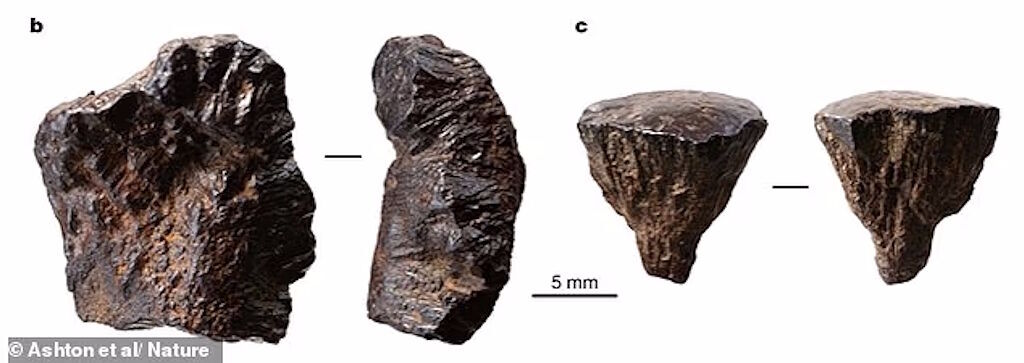
© Aston et al/NatureTwo fragments of pyrite found linked to the ancient fireplace. This mineral was rare locally and probably transported to the site to deliberately light fires
'Collectively, these developments suggest a major transition in human behaviour from around 500,000 years ago to 300,000 years ago - a period marked by a steady increase in brain size approaching modern levels.
'Although these behavioural and cognitive changes certainly involved early Neanderthals and other lineages of contemporaneous humans in western Eurasia, it is likely that similar developments occurred among the ancestors of Denisovans in eastern Eurasia and of Homo sapiens in Africa.'




Reader Comments
When i see the megalithic building around the world that cannot be replicated today i cannot help thinking that the human brain may have regressed somewhat. When i look at our modern world of warmongers and thieves, it does seem to be the case. Perhaps Neanderthals are still with us in the form of the isreali apartheid regime? Technology is the only thing which has progressed because the same disastrous decisions are still being made today as they were back then which suggests the human brain hasn't evolved that much. Accident victims seem to operate perfectly well in a modern world with some of it missing.
The history of earth and man's involvement is way more fascinating than most people can imagine.
I blame lack of spiritual discernment and blame materialistic reductionism as the culprit and that due to the programming of all by the current mainstream institutions both religious and secular.
But that is just my Opineyun.
These are cultures, over thousand of years developed into similar societies all over. (They always laugh very hard if you bump your head or stub your toe.)
The places I visited were common in they were non-materialistic.
Don't steal, look after the young and honour the elderly, and presented me such wisdom from such fascinating perspectives, the experiences definately changed me for life.