
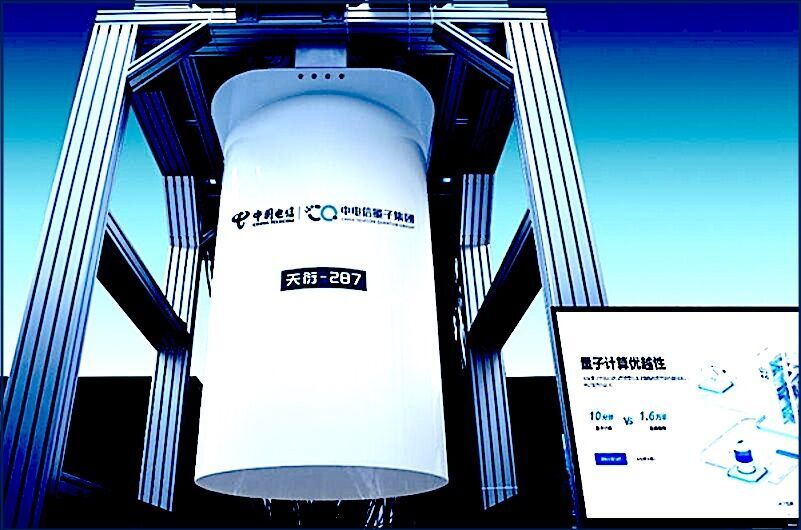
© Unknown"Tianyan-287", the Chinese superconducting quantum computer
In my presentation at the plenary session "Mid-Century Global Governance Defining Transformation," in Guangzhou, sponsored by the prestigious China Institute for Innovation & Development Strategy, I will address the current chaotic phase, with its "fractals of peace," which highlights a redemptive global governance. This is a Chinese initiative promoting a just and equitable global system to preserve the life of all beings in the biosphere [1].
Already on September 13, 2023, Antony Blinken, then Secretary of State, at Johns Hopkins University in Washington, accepted the "decisive turn" of the end of the old world order dominated by the United States [2] , which sounded like a platitude.
Now it is Chancellor Merz of Germany, partner of BlackRock, who announced in Berlin on November 17 the end of the decadent world order; he accepts the withdrawal of the United States as well as the rise of China and Russia [3].
The dynamics of trends towards a new tripolar world order of China/Russia/United States are as if written on the wall when one perceives the "fractals of peace", which tend towards the return of civilizations, coupled with new technologies, where China possesses a millennial advantage which it has recovered and forged as a new tool.
Beyond the marvelous Silk Roads — in their three variants: land, sea and Arctic — according to the true ranking of artificial intelligence, in the military field — and not according to the purely commercial angle as envisaged by Stanford University — the Pentagon itself recognizes China's shocking lead for at least two generations, as admitted by Nicolas Chaillan, former director of cybersecurity at the Pentagon [4], in addition to China's impressive leadership in 57 of the 64 critical and impactful technology segments, according to the Australian think tank ASPI [5].
We can deduce that the path of celestial harmony in Chinese cosmology suggests an eminently civilized/technological/peaceful journey, and not the overtly militaristic one of its competitors. This puts an end to 500 years of colonialism in the service of the Anglosphere.
Beyond the chip/tariff/rare earth war, Nvidia boss Jensen Huang acknowledges China's imminent leadership in the field of chips [6] ; the United States maintains its leadership in the satellite field which Beijing is trying to emulate in the short term, a field where there is practically technical parity with the United States, while in the field of quantum computing, China is in the lead with the amazing superconducting quantum computer Zuchongzhi-3 and the commercial Tianyan-287 [7].
At the recent fourth plenary session of the Chinese Communist Party, technological self-sufficiency and closer nuclear ties with the United States and Russia were discussed in the new five-year plan.
At the SCO Plus (Shanghai Cooperation Organization) Tianjin Summit, President Xi Jinping proposed reform and improvement of the multilateral international system, which, in unison with the BRICS, makes it very attractive to the planetary majority of the Global South [8] - through the innovative and creative Global Governance initiative (with the centrality of a reformed UN [9], to which are added the three other Chinese global initiatives: development (poverty reduction), security (to resolve conflicts) and civilization (plurality, respect and biodiversity).
Short of a nuclear war that would destroy life in the biosphere, the Initiative for Global Governance on cooperation and pluralistic development propels the decaying Global South and confronts pressing challenges on a biospheric scale - climate change/bioethics of artificial intelligence/cybernetic regulation - which demand comprehensive non-Balkanizing policies, a world order which, in my opinion, will now be tri-polar or will not be - with the eminent civilizational/technological/pacifist co-leadership of China.
References:
[ 1 ] Trilema Global: Nuevo Orden Tetrapolar; Fracture Bipolar Biosférica; Guerra Nuclear , Alfredo Jalife-Rahme, Orfila Valentini (2025).
[ 2 ] " Antony Blinken: The Post-Cold-War Era is Over ", Johns Hopkins University , September 13, 2023.
[ 3 ] " Wederherstellung der preislichen Wettbewerbsfähigkeit ", Friedrich Merz, Süddeutschen Zeitung , 17. November 2025.
[ 4 ] " EU perdió la batalla de la IA frente a China, según ex director de Ciberseguridad del Pentágono ", Alfredo Jalife-Rahme, La Jornada , October 13, 2021.
[ 5 ] " China plane su "autosuficiencia tecnológica" y cerrar la breach nuclear con EU y Rusia ", Alfredo Jalife-Rahme, La Jornada , 2 de noviembre de 2025.
[ 6 ] " Nvidia's Jensen Huang says China 'will win' AI race with US ", Financial Times, November 5, 2025.
[ 7 ] " China's latest superconducting quantum computer opens application services to global market ", Du Qiongfang, Global Times , November 25, 2025.
[ 8 ] " Global South should become the 'main force': expert ", Global Times , November 4, 2025.
[ 9 ] " GGI sets out principles for a new multilateralism ", Global Times , November 4, 2025.








It is refreshing to read a hopeful article. Sometimes I wonder if the nukes are just around the corner, but mostly I think we will get beyond this mess and something better will come.