
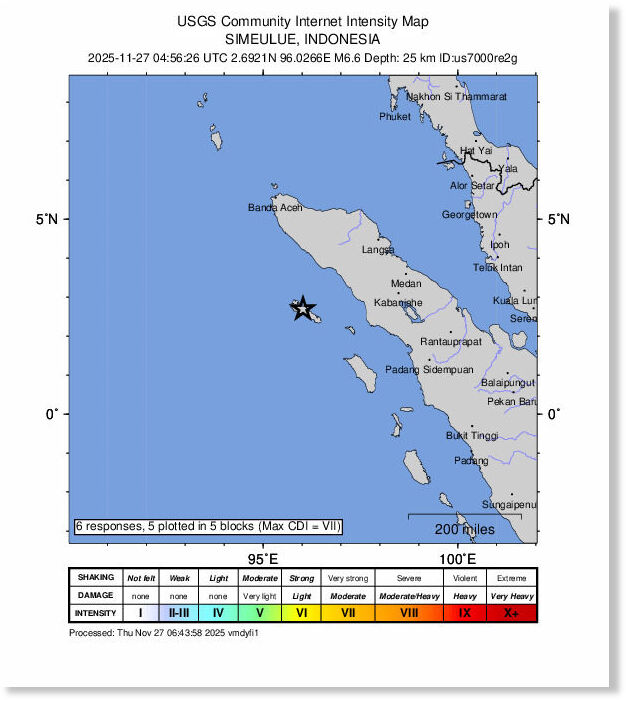
The Indonesian Tsunami Early Warning System said there was no potential for a tsunami.
Why It Matters
Indonesia sits atop the Pacific Ring of Fire, a tectonic zone marked by frequent and sometimes devastating earthquakes and volcanic activity. The country is highly vulnerable due to its position at the convergence of several major tectonic plates, including the Indo-Australian, Pacific, and Eurasian plates.
What To Know
Thursday's earthquake struck at a depth of 16 miles, 28 miles northwest of the town of Sinabang, which is on the small island of Simeulue, off Sumatra's west coast, the USGS said. It was followed by a magnitude 4.8 aftershock just to the south.
There were no immediate reports of casualties or damage. The USGS issued a green alert for shaking-related fatalities and economic losses.
"There is a low likelihood of casualties and damage," the agency said, although it wanted of the possibility of secondary hazards such as landslides.
Why Indonesia Shakes So Much
One of the world's most devastating earthquakes in recent history struck in the same area, off the west coast of Sumatra, on December 26 in 2004, when a magnitude 9.5 quake triggered a massive tsunami that killed about 226,000 people around the shorelines of the Indian Ocean, including more than 126,000 in Indonesia.
Indonesia's tectonic complexity results from the convergence of multiple plates.
Most earthquakes occur along subduction zones, where the Indo-Australian Plate dives beneath the Eurasian Plate. These areas can generate powerful megathrust quakes and tsunamis.
Strike-slip and transform faults also contribute to the seismic risk profile. The geological setting means that moderate and strong earthquakes are frequent, and the region is among the world's most active, as highlighted by decades of seismic history and recent similar shocks in the region.



Reader Comments
to our Newsletter